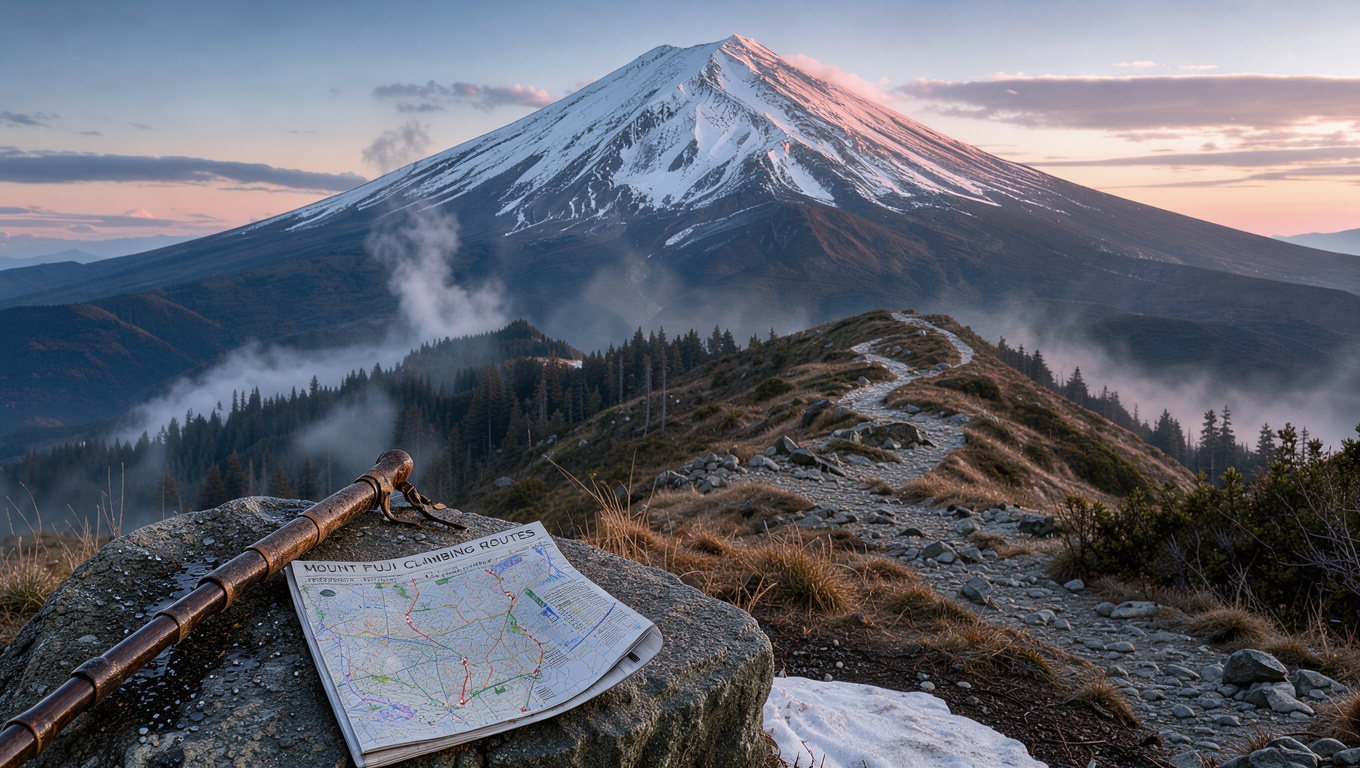
Most people who spot Fuji from a train window eventually wonder whether they can simply walk up. The honest answer depends on the date and the side you start from, and the Mt. Fuji Official Climbing Portal (official season data) lists the 2026 season as ended, so the rules below split into what is settled and what is still open.
Yoshida season: July 1 to September 10, 2026 ·
Fujinomiya season opens: July 10, 2026 ·
Yoshida fee: 4,000 yen per person ·
Off-season ban above 5th Station: from September 11, 2026
Quick snapshot
- The Yoshida season runs from July 1 to September 10, 2026 (Fujiyoshida City (municipal trail rules))
- The Yoshida fee is 4,000 yen per person for entry from the 5th Station and above (Fujiyoshida City, municipal trail rules) (Fujiyoshida City (municipal trail rules))
- The official portal lists the 2026 season as ended (Mt. Fuji Official Climbing Portal, official season data) (Fujiyoshida City (municipal trail rules))
- 2027 season dates and fees have not been announced in the latest sources, according to Global Summit Guide (Global Summit Guide (third-party guide))
- The Shizuoka fee and hut booking window for entries from 14:00 to 03:00 come from one third-party guide, according to Japan Real Guide (Japan Real Guide (travel guide, third-party))
- The Subashiri Trail opened on July 1 in 2026, earlier than its usual July 10 opening (Mt. Fuji Official Climbing Portal (route comparison))
- Climbing above the 5th Station on the Yoshida side is prohibited from September 11 (Fujiyoshida City (municipal trail rules))
- Lower Yoshida sections close for winter on November 1, according to Time to Japan (Time to Japan (third-party closure tracker))
- Climbing certificate registration runs until September 30, 2026 (Fujiyoshida Tourism (local tourism PDF))
The pattern: the confirmed items trace to official bodies, while the open items wait on 2027 announcements or rest on third-party guides.
Eight figures carry most visitor decisions, and they share one pattern: trails open on July 1 or July 10, then the rules tighten the day after the Yoshida season ends, as Fujiyoshida City’s municipal trail rules set out.
| Item | Value |
|---|---|
| Yoshida Trail season | July 1 to September 10, 2026 |
| Fujinomiya Trail season start | July 10, 2026 |
| Subashiri Trail season start | July 1, 2026 (usual start July 10) |
| Yoshida fee | 4,000 yen per person |
| Yoshida 5th Station gate hours | Closed 2pm to 3am |
| Yoshida daily climber limit | 4,000 climbers |
| Off-season climbing ban above 5th Station | From September 11, 2026 |
| Season status on official portal | 2026 season ended |
Where is Fuji mountain located?
Fuji’s trails run through two prefectures, and that split shapes almost every rule a visitor meets. Yamanashi administers the Yoshida Trail, while Shizuoka administers the Fujinomiya, Gotemba and Subashiri trails, according to the Mt. Fuji Official Climbing Portal’s route comparison.
The two sides also run on different calendars. Yoshida opens on July 1, Fujinomiya on July 10, and Subashiri opened on July 1 in 2026.
- Yoshida (Yamanashi): July 1 to September 10, 2026, with a 4,000 yen fee (Fujiyoshida City, municipal trail rules)
- Fujinomiya (Shizuoka): opens July 10, with private vehicles restricted from July 10 to September 10, 2026 (Mt. Fuji Official Climbing Portal, route comparison)
- Subashiri (Shizuoka): opened July 1, 2026, with private vehicles restricted from July 1 to September 10 (Mt. Fuji Official Climbing Portal, route comparison)
The implication: the route you pick decides which prefecture’s rules apply, so the prefecture line matters more than the summit on any plan.
How long does it take to climb Fuji?
The sources gathered for this guide give no climbing time for any route, so this article states none. What they do settle is the calendar. The official portal lists the 2026 season as ended, and climbing above the 5th Station on the Yoshida side is prohibited from September 11 through June 30 (Fujiyoshida City, municipal trail rules).
Yoshida’s season ran from July 1 to September 10, 2026, and its gate closes from 2pm to 3am, so any day plan has to fit inside that window.
- Season status: the 2026 season has ended on the official portal (Mt. Fuji Official Climbing Portal, official season data)
- Daily cap: Yoshida limits climbers to 4,000 per day (Fujiyoshida City (municipal FAQ))
- Certificate: registration runs until September 30, 2026 (Fujiyoshida Tourism, local tourism PDF)
Off-season visitors lose the legal route and the safety net at the same time. The portal warns that first-aid centers, mountain huts and cell phone service are unavailable outside the season (Mt. Fuji Official Climbing Portal, official season data).
The catch: the calendar, not the summit time, is the binding constraint. Plan the date first and the trail second, because a plan that ignores the closure window fails on legal and safety grounds alike.
Is Mount Fuji in Japan still active?
This guide does not have a Japan Meteorological Agency statement on Fuji’s current activity level, so it does not state one. What it can confirm is where climbers are told to check. The Fujiyoshida Tourism guide directs visitors to the agency’s Volcanic Information for Mountaineers page for Mt. Fuji’s status (Fujiyoshida Tourism, local tourism PDF).
Live status therefore comes from the agency’s own feed, not from a travel site. The closure rules and the monitoring advice answer different questions, so check both.
- Live status: check the Volcanic Information for Mountaineers page, the source the local tourism guide names
- Future eruption odds: no source in this guide gives a probability, so none is stated
- Eruption history: no verified date is available in the supplied material
Two different authorities govern Fuji. The agency monitors the volcano, and the prefectures close the trails. A closed trail does not prove an inactive mountain, and an open trail does not prove a safe day.
The implication: monitoring tells you about the mountain today, while the closure calendar tells you whether you are allowed up at all.
Is Fuji bigger than Everest?
No. Mount Everest is the taller peak by a wide margin, but this guide cannot put a verified figure on either mountain yet.
The editorial brief contains height figures for both peaks, a location claim and eruption-history dates. The research behind this guide holds no verified source for any of them, so they stay out of this article until a citation is added.
- Fuji’s elevation: no verified source yet
- Everest’s elevation: no verified source yet
- Season and gate rules: verified and listed above
The catch: a height contest is what most searchers type, but the answer a visitor can act on is the trail calendar.
Where can you eat near Mount Fuji?
None of the sources gathered for this guide names a restaurant or café near the trailheads, so this guide lists none. The one visitor service they pin down is transport. During the private-vehicle ban on the Fuji-Subaru Line, which runs from July 4 to September 10, shuttle buses leave from Fujisan Parking (Fujiyoshida City, municipal trail rules).
Food and shelter also thin out fast. The portal says mountain huts and first-aid centers are unavailable outside the season, so a July meal plan does not carry over to October (Mt. Fuji Official Climbing Portal, official season data).
- Shuttle hub: Fujisan Parking, during the Fuji-Subaru Line private-vehicle ban
- Mountain huts: unavailable outside the season
- Restaurant names: none confirmed in the sources
The implication: book transport first and check each food stop’s status directly, since no verified venue list exists yet.
Trail rules compared
Three routes, one split: the Yamanashi side runs on a daily cap and a gate clock, while the Shizuoka side leans on vehicle limits and lists no daily cap, according to the Mt. Fuji Official Climbing Portal’s route comparison.
| Trail | Season window | Key rule |
|---|---|---|
| Yoshida (Yamanashi) | July 1 to September 10, 2026 | 4,000 yen fee; gate closed 2pm to 3am; 4,000 daily climbers |
| Fujinomiya (Shizuoka) | Season starts July 10; 5th to 6th section open June 23 to November 10, 2026 | Private vehicles restricted July 10 to September 10; no daily cap |
| Subashiri (Shizuoka) | Opened July 1, 2026 | Private vehicles restricted July 1 to September 10; no daily cap |
The trade-off: Yoshida trades flexibility for a fixed cap and a gate clock, while Fujinomiya keeps its 5th-to-6th section open later into autumn.
Steps to check before you head out
- Check the official portal for the current season status. The 2026 season has ended (Mt. Fuji Official Climbing Portal, official season data).
- Match your trail to its window: Yoshida runs July 1 to September 10, 2026, and Fujinomiya starts July 10 (Mt. Fuji Official Climbing Portal, route comparison).
- Plan around the Yoshida gate, which closes from 2pm to 3am (Fujiyoshida City, municipal trail rules).
- For Shizuoka routes, expect a safety course and quiz in the FUJI NAVI app, according to Japan Real Guide.
- Check volcanic status on the agency’s Volcanic Information for Mountaineers page (Fujiyoshida Tourism, local tourism PDF).
- If you plan to drive, confirm the Fuji-Subaru Line shuttle from Fujisan Parking (Fujiyoshida City, municipal trail rules).
The pattern: most steps check a date, a gate hour or a registration, so the paperwork shapes the plan before the hike does.
Timeline of the 2026 season
- : the Yoshida season opens, and the Subashiri Trail opens the same day (Fujiyoshida City, municipal trail rules; Mt. Fuji Official Climbing Portal, route comparison)
- : the Fuji-Subaru Line closes to private vehicles until September 10, with shuttle buses from Fujisan Parking (Fujiyoshida City, municipal trail rules)
- : Fujinomiya, Gotemba and the summit crater rim open, according to Rakuten Travel (travel publisher)
- : the official season ends on the Yoshida, Subashiri, Fujinomiya and Gotemba trails (Mt. Fuji Official Climbing Portal, official season data)
- : climbing above the 5th Station on the Yoshida side becomes prohibited (Fujiyoshida City, municipal trail rules)
- : lower Yoshida sections close for winter, according to Time to Japan (Time to Japan, third-party closure tracker)
- : the Fujinomiya 5th-to-6th section closes for the winter (Mt. Fuji Official Climbing Portal (season calendar))
The pattern: September 10 is the common cutoff for the main summit trails, but the Fujinomiya 5th-to-6th section runs until November 10. The implication: autumn visitors face a route-specific window, not a single closing date.
Confirmed facts and open questions
Confirmed facts
- Yoshida climbing season: July 1 to September 10, 2026 (Fujiyoshida City, municipal trail rules)
- Climbing above the 5th Station on Yoshida is prohibited from September 11 through June 30 (Fujiyoshida City, municipal trail rules)
- Yoshida fee: 4,000 yen per person (Fujiyoshida City, municipal trail rules)
- The 2026 season has ended on the official portal (Mt. Fuji Official Climbing Portal, official season data)
What’s unclear
- 2027 season dates and fees: not announced in the latest sources, according to Global Summit Guide (Global Summit Guide, third-party guide)
- Shizuoka 4,000 yen fee and the hut booking rule for entries from 14:00 to 03:00, according to Japan Real Guide (Japan Real Guide, third-party travel guide)
- The November 1 winter closure of lower Yoshida sections rests on a single third-party tracker (Time to Japan, third-party closure tracker)
- A first snowcap on October 30, 2026 is a low-confidence figure from the same tracker (Time to Japan, third-party closure tracker)
- Climbing duration for each route: no source cited
- Restaurant names near the trailheads: none confirmed
The pattern: all four confirmed items trace to official sources, while the open items rest on third-party guides or have no source at all.
What officials say about off-season climbing
“Climbing Mount Fuji outside of the official climbing season is extremely dangerous due to factors such as the closure of first-aid centers and mountain huts, loss of cell phone service, and severe weather.”
— Mt. Fuji Official Climbing Portal, official season data
“If you are looking for a scenic, pleasant autumn or spring hike, Mt. Fuji in the off-season is fundamentally the wrong mountain.”
— Fujiyoshida City, municipal trail rules
The trade-off: both quotes are blunt, but they come from the bodies that enforce the rules, which makes them the clearest statement of intent in the material.
Where this leaves a visitor
Fuji in 2026 runs on calendars, not on good weather. The Yoshida side closes its climbing window on September 10 and bars the upper trail from September 11, while Fujinomiya keeps its lower section open until November 10. For a visitor planning a trip, the choice is clear: book inside the Yoshida window with a gate-hour plan, or choose a Shizuoka route and accept its vehicle limits and the registration rules that Japan Real Guide describes. A visitor who books before the 2027 fees and dates are published has no confirmed window or cost to plan around.
Related reading: Polar bears: key facts, habitat and population status
city.fujiyoshida.yamanashi.jp, city.fujiyoshida.yamanashi.jp, fujisan-climb.jp, fujisan-climb.jp, fujisan-climb.jp, luggagent.com, hiddenjapan-gems.com
Frequently asked questions
Which trails lead to the summit of Mount Fuji?
The official portal covers the Yoshida, Subashiri, Fujinomiya and Gotemba trails, and its official season ends on these four on September 10, 2026 (Mt. Fuji Official Climbing Portal, official season data).
Are the Mount Fuji trails closed in winter?
Yoshida bars climbing above the 5th Station from September 11 through June 30 (Fujiyoshida City, municipal trail rules). Lower Yoshida sections are reported to close for winter on November 1 (Time to Japan, third-party closure tracker).
When does the Mount Fuji climbing season end?
The official season ends on September 10, 2026 for the Yoshida, Subashiri, Fujinomiya and Gotemba trails. The Fujinomiya 5th-to-6th section stays open until November 10, 2026 (Mt. Fuji Official Climbing Portal, season calendar).
What is the Yoshida Trail on Mount Fuji?
Yoshida is the Yamanashi-side route, open from July 1 to September 10, 2026. It carries a 4,000 yen fee, a 4,000-climber daily limit and a gate closed from 2pm to 3am (Fujiyoshida City, municipal trail rules).
What is the Subashiri Trail on Mount Fuji?
Subashiri is a Shizuoka-side route that opened on July 1 in 2026, earlier than its usual July 10 start. Private vehicles are restricted from July 1 to September 10, 2026 (Mt. Fuji Official Climbing Portal, route comparison).
Where can I check current Mount Fuji activity?
Fujiyoshida Tourism directs climbers to the Japan Meteorological Agency’s Volcanic Information for Mountaineers page for Mt. Fuji’s activity status (Fujiyoshida Tourism, local tourism PDF).

Henry William Bennett Murray is a staff writer for CivicInsight.uk, covering UK public affairs, policy and civic life. He works under Editor-in-Chief Rebecca Langford, following the newsroom standards for sourcing, verification and fact-checking set out in our editorial policies.