Most people picture the polar bear as the Arctic’s unofficial mascot, so it’s surprising how often its basic numbers come wrapped in caveats. Britannica’s encyclopedia entry places the species’ IUCN Vulnerable status in 2015, but the population total and the 2050 forecasts tell a murkier story; this guide separates measured figures from model projections so you can tell which extinction claims are documented and which are forecasts.
Maximum male weight: up to 800 kg (IFAW animal profile) · Maximum length: up to 3 m (IFAW animal profile) · Range: within the Arctic Circle · Primary prey: seals
Quick snapshot
- Classed as Vulnerable on the IUCN Red List (Britannica encyclopedia entry)
- Listed as threatened under the US Endangered Species Act on 2008-05-14 (PBS Nature fact sheet)
- Females first breed at 4 to 5 years, and litters of two cubs are most common (US Fish and Wildlife Service species profile)
- Almost exclusively carnivorous, unlike most other bears (National Wildlife Federation wildlife guide)
- The global count of 26,000 is an estimate, not an exact census, and the US Fish and Wildlife Service dates it to 2023 across 19 subpopulations (US Fish and Wildlife Service species profile)
- The two-thirds decline figure is a model projection, not a measured outcome (Wikipedia conservation article)
- No Tier 1 or Tier 2 source in this research supports a standing height, so this article gives none (US Fish and Wildlife Service species profile)
- 1972: Trophy hunting was banned in Alaska under the Marine Mammal Protection Act (Alaska Department of Fish and Game)
- 2008-05-14: Threatened listing under the US Endangered Species Act (PBS Nature fact sheet)
- The Southern Beaufort Sea population was about 900 bears in 2015, more than 50% below earlier estimates (Defenders of Wildlife species page)
- Habitat loss from ice decline is pushing bears into more human conflict (BBC Earth conservation feature)
Eight figures carry the core picture, one pattern: the size and status numbers are firm, while the population total moves between sources.
| Fact | Value |
|---|---|
| Range | Within the Arctic Circle |
| Primary prey | Seals |
| Maximum male weight | Up to 800 kg |
| Maximum length | Up to 3 m |
| IUCN Red List category | Vulnerable (designated 2015) |
| US Endangered Species Act listing | Threatened, 2008-05-14 |
| Global estimate | 26,000 (IUCN 2021 Status Report) |
| Subpopulations | 19 (US Fish and Wildlife Service) |
What are some key features of polar bears?
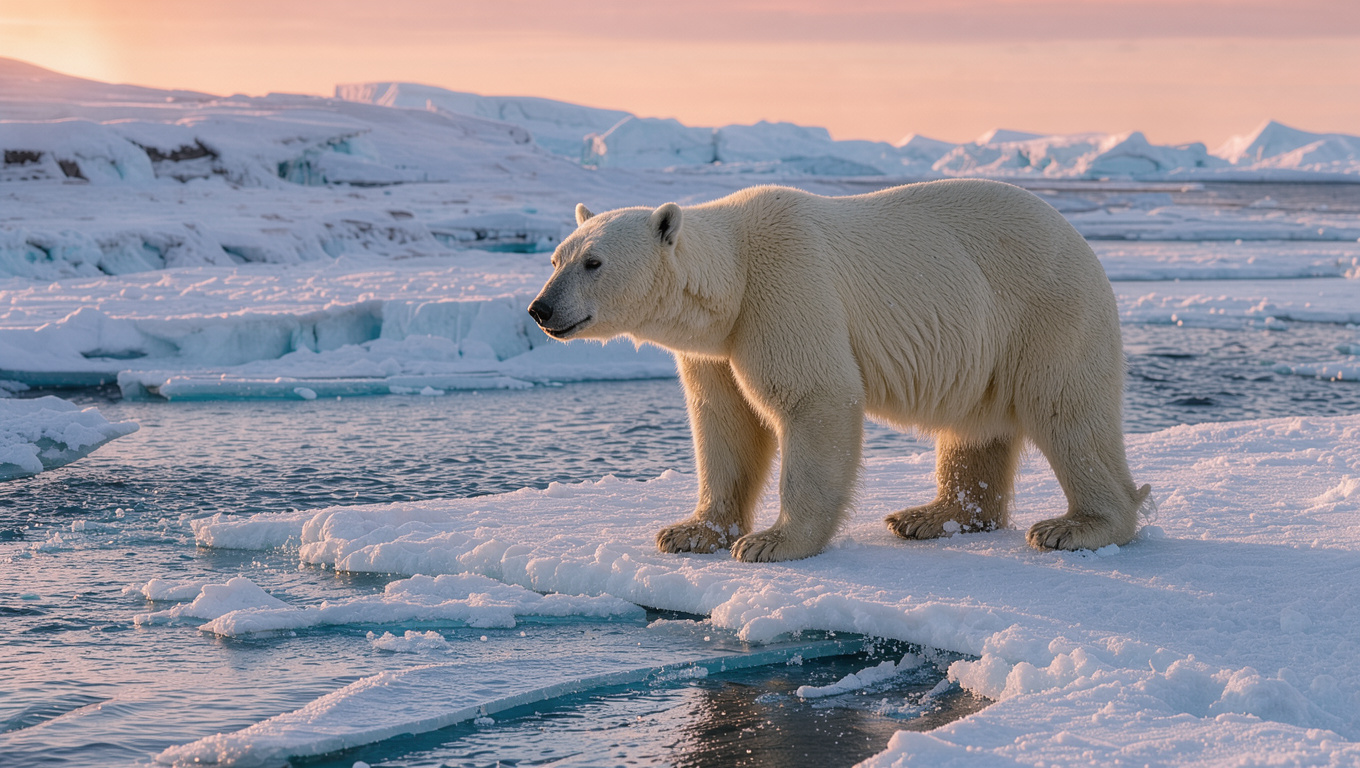
Polar bears are the largest land carnivore. Males can weigh up to 800 kg and reach about 3 m in length (IFAW animal profile). Their diet is almost exclusively meat, unlike most other bears, which eat a wider mix of food (National Wildlife Federation wildlife guide).
- Maximum male weight: up to 800 kg
- Maximum length: about 3 m
- Hunting ground: sea ice, where seals are caught
How tall is a polar bear standing up?
- None of the Tier 1 or Tier 2 sources gathered for this article gives a verified standing height, so this article does not publish one.
- The dimension that is sourced is body length, up to 3 m, which is the figure to use for size comparisons.
A male that can reach 800 kg still depends on sea ice to hunt, so its bulk tells you less about survival than the ice under its feet.
The implication: Size explains the bear’s power, but the ice explains its survival, and the rest of this article follows that split.
Where do polar bears live?
Polar bears live within the Arctic Circle, spread across five range states: Canada, Greenland (Denmark), Russia, Norway (Svalbard), and the United States (Alaska), according to the Bear Biology species review.
Their range follows the ice, because hunting and travel both happen on it. A map of the range therefore says less about where bears survive than the condition of the sea ice does.
Five range states means five different data systems, so no single count covers the whole species.
What this means: A single range map hides large differences between populations, so each claim needs its subpopulation attached.
What do polar bears eat?
According to the Bear Biology species review, polar bears are primarily carnivorous, feeding mainly on ringed seals and secondarily on bearded seals, and the mix varies among subpopulations.
They hunt on sea ice, using breathing holes and ice edges to ambush seals, and they favor seal blubber for its calorie density. Their detection range is about 1 km, according to the WWF UK species guide.
- Detect a seal from up to about 1 km away.
- Find a breathing hole or ice edge where the seal surfaces.
- Wait and ambush the seal from the ice.
- Eat the blubber, the calorie-dense part of the kill.
Do polar bears hibernate?
- Mated females dig dens in late October or early November, typically in snowdrifts on mountain slopes or hills near shore, on sea ice, or in peat along inland riverbanks (Polar Bears International conservation FAQ).
- Denning is the sourced part of this question, and the research gathered here does not describe a hibernation cycle like that of many other bears.
The trade-off: A diet this narrow ties the bear’s food supply to one platform, so the ice question and the diet question describe the same risk.
How many polar bears are left in the world?
No one has an exact global count. The IUCN Polar Bear Specialist Group’s 2021 Status Report gives 26,000, compared with a 2015 estimate of 22,000 to 31,000 (Polar Bears International conservation FAQ).
Is the polar bear rare?
- Rarity is framed by conservation status and population trend, not by headcount alone.
- The IUCN lists the current population trend as unknown, while some subpopulations are stable or increasing. Vulnerable status rests on criterion A3c, which requires an expected decline of at least 30% over three generations, about 34.5 years, according to the Wikipedia conservation article.
Regional counts sharpen the picture. The Southern Beaufort Sea population was estimated at about 900 bears in 2015 and is declining, while the Bering and Chukchi Seas status is unknown (Alaska Department of Fish and Game).
A steady global total can hide a falling subpopulation, so read the regional line before the headline number.
The trade-off: A single global number is easy to repeat, but rarity depends on trend and region, so the headline total can mislead.
Will polar bears go extinct by 2026?
No source reviewed for this article names 2026 as an extinction year, so the near-term story is about risk, not a deadline. The risk is driven by sea-ice loss rather than by predators.
What is a polar bear’s worst enemy?
- Loss of sea ice from warming is the main threat to survival, according to the WWF UK species guide.
- Predators are not the main concern in the sources reviewed; the threat is habitat decline.
What is a sad fact about polar bears?
- Habitat loss from ice decline is pushing bears into more human conflict, with polar bears entering settlements in search of food (BBC Earth conservation feature).
- Alaska’s Southern Beaufort Sea population fell more than 50% from earlier estimates, to about 900 bears in 2015 (Defenders of Wildlife species page).
A USGS-led study from 2007 estimated polar bears could be reduced to one-third of their population by 2050 (Bear Biology species review). The two-thirds figure that circulates widely comes from a USGS study predicting decline by 2051, and its validity has been debated (Wikipedia conservation article).
Why this matters: The 2050 figures are the most quoted numbers in this subject and the least measured, so treat them as scenarios rather than forecasts of a date.
Timeline signal
- : The Marine Mammal Protection Act banned trophy hunting in Alaska. Polar bear numbers had declined by the early 1970s from overharvest in the 1950s and 1960s, then recovered moderately (Alaska Department of Fish and Game).
- : The polar bear is listed as threatened under the US Endangered Species Act, the first vertebrate listed because of predicted climate change (PBS Nature fact sheet).
- : The horizon for the USGS-led model projections discussed above.
What this means: The dated listings are documented, while the 2050 numbers are projections, and the timeline should not blur the two.
Confirmed and unclear
Confirmed
- Polar bears live within the Arctic Circle and mainly eat seals (Bear Biology species review).
- The polar bear is listed as threatened under the US Endangered Species Act, dated 2008-05-14 (US Fish and Wildlife Service species profile).
- Males can weigh up to 800 kg and reach about 3 m in length (IFAW animal profile).
- The IUCN Polar Bear Specialist Group’s 2021 Status Report gives 26,000 polar bears (Polar Bears International conservation FAQ).
Unclear
- The exact global population count, since every figure is an estimate.
- The two-thirds decline by 2050, which is a model projection and not a measured outcome.
- Any extinction date for polar bears, since no source in this research supplies one.
- Typical wild lifespan figures, which vary by source and study.
- A standing height, because no Tier 1 or Tier 2 source supports one.
The pattern: The confirmed list covers listings, size, and the 2021 estimate, while every forward-looking number sits in the unclear list.
What the sources say
“No, polar bears are not an endangered species, but they are threatened.”
Britannica editorial, Britannica encyclopedia entry
“Wild polar bears will become extinct unless we take action to reduce greenhouse gas emissions.”
Polar Bears International scientist, Polar Bears International conservation FAQ
The pattern: An encyclopedia entry and a conservation group describe the same species at different levels of alarm, so the wording of a quote matters as much as its source.
The population story is less settled than the headlines suggest. For anyone citing these numbers, the choice is clear: quote the 2021 estimate with its date and label the 2050 figures as model projections, or repeat a headline that the sources do not support.
Related reading: Loch Lomond practical guide · Wellcome Collection visitor guide
wwf.org.uk, en.wikipedia.org, worldwildlife.org, polarbearsinternational.org
Frequently asked questions
How long do polar bears live in the wild?
The research gathered for this article does not give a reliable wild lifespan. Figures vary by source and study, so this article does not state one.
Why does sea ice loss affect polar bears?
Polar bears hunt seals from the ice, so losing sea ice cuts their access to prey. The WWF UK species guide names sea-ice loss as the main threat to survival (WWF UK species guide). Other foods such as berries, bird eggs, and carrion are lower in calories and cannot sustain populations.
Why is the polar bear listed as threatened in the United States?
The threatened listing took effect on 2008-05-14. It was the first vertebrate listed because of predicted climate change, as covered in the timeline above.
Are polar bears protected in Alaska?
Yes. The US Fish and Wildlife Service states that polar bears in Alaska are protected under the Endangered Species Act and the Marine Mammal Protection Act (US Fish and Wildlife Service species profile).
How are polar bear populations counted?
The global figure is an estimate rather than an exact census, and regional figures differ. Use the 2021 IUCN status figure with its date, and treat regional counts, such as about 900 bears in the Southern Beaufort Sea in 2015, as local snapshots rather than totals.

Henry William Bennett Murray is a staff writer for CivicInsight.uk, covering UK public affairs, policy and civic life. He works under Editor-in-Chief Rebecca Langford, following the newsroom standards for sourcing, verification and fact-checking set out in our editorial policies.