
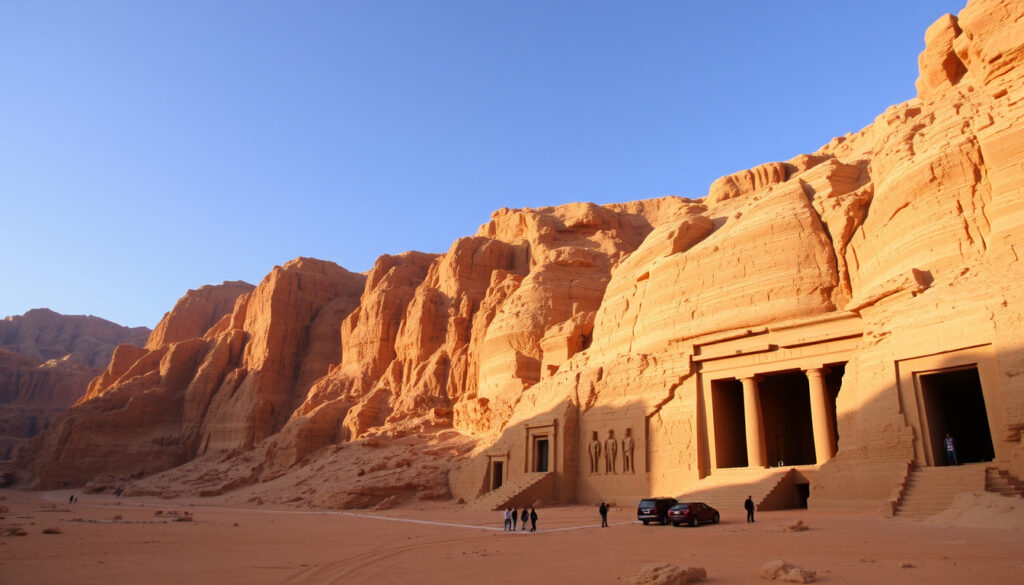
The Valley of the Kings stands as one of archaeology’s most significant discoveries, a concealed burial ground where Egypt’s most powerful rulers were laid to rest across nearly five centuries. Located on the Nile’s west bank near Luxor, this desert valley holds the secrets of pharaohs whose names still echo through history.
Hidden within crumbling limestone cliffs, the site contains over 60 documented tombs carved deep into the mountainside. These chambers preserve intricate wall paintings, ancient texts, and artifacts that reveal how the New Kingdom’s elite envisioned the journey into the afterlife. The valley’s isolation offered protection from tomb robbers, though modern threats like flash floods continue to challenge preservation efforts.
Among its many secrets, one discovery transformed Western understanding of ancient Egypt more than any other. In 1922, Howard Carter uncovered an intact royal burial that had remained sealed for over 3,000 years, sending shockwaves through the archaeological world and captivating public imagination worldwide.
Who Was Buried in the Valley of the Kings?
West Bank of Nile, Luxor, Egypt
16th–11th century BCE (New Kingdom)
60+ for pharaohs like Tutankhamun
Tutankhamun’s intact tomb discovery 1922
Key Insights on Valley of the Kings
- Archaeologists have linked 41 royals to approximately 37 tombs, though some burials were shared or remain unidentified
- The shift from pyramid burial began around c. 1539 BC, driven by the need for secrecy and security against tomb robbers
- Only about 20 of the 60+ tombs actually contain the remains of kings; the remainder held queens, nobles, children, and royal family members
- The valley includes more than 20 unfinished pits, suggesting construction was sometimes abandoned mid-project
- Tutankhamun’s tomb (KV62) remains the only fully intact royal discovery, though it had been entered and resealed in antiquity
- The site was used for approximately 500 years, from the 18th Dynasty through the 20th Dynasty
- Non-royal burials continued in reused tombs even after the New Kingdom ended around 1075 BC
Major Pharaohs Interred in the Valley
| Pharaoh | Tomb Designation | Notes |
|---|---|---|
| Thutmose I | KV20 (possibly) | May have been the first king buried here |
| Amenhotep I | KV39 (possibly) | Tomb identification remains uncertain |
| Thutmose IV | KV43 | Well-preserved tomb with decorated chambers |
| Tutankhamun | KV62 | Most famous discovery, 1922 |
| Ramesses II | KV7 | Located near the massive KV5 complex |
| Ramesses III | KV11 | Originally planned by Setnakhte |
| Ramesses IV | KV2 | Left unfinished; graffiti from Ptolemaic era |
| Setnakhte | KV11 (extended) | Two tombs originally planned |
| Ramesses X/XI | Various | Final kings buried in the valley |
What Are the Key Valley of the Kings Tombs?
Notable Tombs and Their Features
Tomb architecture in the valley varies dramatically, from simple pit graves to elaborate multi-chambered complexes. The smallest tombs, such as KV54, consist of little more than a brief shaft descending into bare rock. At the opposite extreme stands KV5, originally discovered in antiquity but only fully excavated in the 1990s by archaeologist Ken Weeks. This extraordinary complex contains over 120 chambers spread across multiple levels, making it the largest tomb in the valley and the final resting place for several sons of Ramesses II.
Most visitor-accessible tombs follow a recognizable layout: a sloping corridor descends into the cliff, passing through one or more rectangular halls supported by pillars before reaching the burial chamber itself. Deep shafts were carved into the rock not merely for structural reasons but as an additional security measure, deterring would-be robbers and masking the true location of the royal remains.
The walls of these tombs are covered with painted reliefs depicting spells from the Book of the Dead, representations of gods governing the underworld, and scenes showing the deceased pharaoh receiving offerings from family members and deities. These artistic programs served both devotional and practical purposes, providing the deceased with the knowledge and protection needed for successful passage into eternity.
The standard ticket grants access to eight tombs, while additional fees apply for the most famous chambers including Seti I’s tomb (KV17) and Tutankhamun’s burial chamber (KV62). Tickets can be limited during peak season, and photography restrictions vary by tomb.
The East and West Valleys
The burial ground divides naturally into two sections. The East Valley contains the overwhelming majority of tombs and serves as the primary area for visitors. The West Valley, separated by a narrow ridge, holds fewer than ten tombs but includes some of the most beautifully decorated chambers in the entire necropolis.
Rising above the East Valley stands Al-Qurn, a pyramid-shaped peak that the ancient Egyptians associated with Hathor, worshiped as “Mistress of the West.” This sacred mountain served as a visual reminder of the sun’s descent into the underworld each evening and the corresponding journey of the deceased into the realm beyond. The barren, cliff-lined floor of the valley created a natural amphitheater ideal for concealing royal burials from casual observers.
Valley of the Kings Facts and Overview
Physical Setting and Geographic Context
The Valley of the Kings sits within the Theban Necropolis, a vast area on the Nile’s west bank devoted to royal and elite burials since the Middle Kingdom. Bordered by steep limestone cliffs and dominated by the distinctive silhouette of Al-Qurn peak, the valley offered both natural concealment and easy access to the temples of Karnak and Luxor on the river’s opposite bank.
Ancient Thebes, modern Luxor, served as Egypt’s capital during the New Kingdom, and the decision to locate the royal necropolis across the river reflected both practical and symbolic considerations. The western horizon, where the sun sets daily, symbolized death and rebirth in Egyptian cosmology, making this location the ideal setting for a city of the dead.
Tombs are designated by “KV” numbers, standing for “King’s Valley” followed by sequential numerals. The numbering system began with early excavations and continues as new tombs are discovered, with KV63 being among the most recent major finds in 2005.
Threats to Preservation
Despite the valley’s remote location, the tombs have faced threats throughout their existence. Ancient robbery remains well-documented, with royal decrees threatening severe punishment to those who violated burial sites. Modern challenges prove equally difficult: seasonal flash floods, introduced in part by the tourism infrastructure, periodically surge through the corridors, carrying debris and moisture that damage painted surfaces. Climate change has intensified these weather events, prompting ongoing conservation efforts by Egyptian authorities and international organizations.
Valley of the Kings Map and Photos
Understanding the Site Layout
Unlike many archaeological sites, the Valley of the Kings lacks a comprehensive published map detailing all known tomb locations. Tombs are cataloged individually using the KV numbering system, with each entry appearing in archaeological records alongside brief descriptions of its contents and dimensions.
Modern visitors can obtain site maps at the entrance showing which tombs remain open, though detailed interior plans are available only through specialized archaeological publications. The site is divided into zones where excavation continues, areas open to the public, and restricted sections where ongoing work limits access.
The valley offers limited shade and substantial walking between tomb entrances. Summer temperatures regularly exceed 40°C, making early morning visits advisable. Comfortable footwear and adequate hydration are essential for exploring the site safely.
Photography within the tombs varies by location. Some chambers permit flash-free photography for personal use, while others ban all imaging to protect fragile painted surfaces from cumulative light damage. Tripods and professional equipment typically require special permits.
Timeline of Valley of the Kings
The following key moments mark the site’s history from its initial use through recent discoveries:
- c. 1539 BC – Burial practices shift to concealed cliff tombs; Thutmose I or Amenhotep I becomes the first king interred in the valley
- 16th–11th century BC – Peak construction period for 18th through 20th Dynasty royal burials over approximately 500 years
- c. 1301 BC – Queens’ Valley begins receiving royal women, established during Ramesses I’s reign as a separate necropolis
- 278 BC (Ptolemaic era) – Some tombs already known to visitors; graffiti in KV2 dates to this period
- November 4, 1922 – Howard Carter discovers Tutankhamun’s tomb (KV62), the first intact royal burial found by modern archaeology
- 1932 – Clearance of Tutankhamun’s tomb completed, revealing over 5,000 artifacts now housed in the Grand Egyptian Museum
- 1995 – KV5 fully re-excavated by Ken Weeks, revealing its extraordinary scale with more than 108 chambers
- 2005 – KV63 discovered, representing the last major pre-2005 tomb find in the valley
- 2008 – Two previously unknown tomb entrances documented, demonstrating ongoing potential for new discoveries
Confirmed Facts vs Ongoing Discoveries
Established Information
- The valley served as the primary royal necropolis during the New Kingdom (c. 1539–1075 BC)
- At least 63–65 tombs have been cataloged, plus over 20 unfinished pits
- Archaeologists have identified 41 royals linked to approximately 37 tombs
- Tutankhamun’s tomb remains the only fully intact royal discovery
- The East Valley contains the majority of tombs; the West Valley has fewer but significant examples
- KV5 is the largest known tomb with over 120 chambers
Information That Remains Uncertain
- Which specific pharaoh was the first buried in the valley (Thutmose I or Amenhotep I remains debated)
- The exact identification of several tomb occupants remains unresolved
- Unexcavated pits may contain additional burials or artifacts
- The complete contents and layout of certain tombs have not been fully documented
- Ongoing surveys using ground-penetrating radar may reveal undiscovered chambers
Historical Context and Significance
The emergence of the Valley of the Kings marked a decisive break with earlier Egyptian burial traditions. During the Old and Middle Kingdoms, pharaohs constructed massive pyramids as visible monuments to their power and permanence. These grand structures, however, proved irresistible targets for robbers, and the great pyramids were stripped of their treasures within generations of their construction. The Valley of the Kings, a significant archaeological site, is detailed further in this Карта Близького Сходу.
The New Kingdom pharaohs adopted a fundamentally different approach. By concealing their tombs within a natural wadi, accessible only through narrow passages carved into solid rock, they hoped to protect their remains and funerary equipment from theft. The shift also reflected theological changes, as the afterlife became increasingly democratized, with elaborate texts and rituals now available to officials and eventually commoners rather than reserved exclusively for royalty.
The choice of the Theban west bank held symbolic meaning beyond practical security considerations. Ancient Egyptians associated the west with the realm of the dead, viewing the sunset as a daily rehearsal of death and resurrection. The pyramid-shaped Al-Qurn peak, sacred to Hathor as “Mistress of the West,” reinforced these associations, transforming the entire valley into a sacred landscape devoted to rebirth and eternal life.
Sources and Expert Quotes
Located on the west bank of the Nile, opposite modern Luxor, the Valley of the Kings served as the burial site for pharaohs and powerful nobles during the New Kingdom period.
The discovery of Tutankhamun’s tomb in 1922 by Howard Carter was unprecedented—the first time a virtually intact royal burial chamber from ancient Egypt was found.
Contemporary archaeological work continues to enhance understanding of the valley through non-invasive survey techniques. Ground-penetrating radar and electrical resistivity surveys have revealed anomalies beneath the valley floor that may indicate previously unknown chambers or buried features.
Planning a Visit or Further Reading
For those planning to explore the Valley of the Kings, tickets can be purchased at the site entrance, with different pricing tiers for basic access versus premium tombs. The Grand Egyptian Museum in Cairo houses the majority of objects recovered from Tutankhamun’s tomb, offering context before or after a valley visit.
Those interested in the broader context of ancient Egyptian civilization may find it useful to understand the evolution of Newspaper Types, History and Evolution of archaeological documentation, while travelers to the region might also explore Stoke-on-Trent History, Facts and Potteries Heritage for comparison with other historical preservation efforts worldwide.
Frequently Asked Questions
Why did New Kingdom pharaohs choose cliff tombs over pyramids?
Security concerns drove the shift. Earlier pyramids were systematically robbed within generations, and the concealed valley location made tombs harder to discover and access.
How many tombs can visitors enter?
The standard ticket provides access to approximately eight tombs, while additional fees apply for special tombs including Tutankhamun’s burial chamber and Seti I’s elaborately decorated complex.
What is the most famous discovery at the Valley of the Kings?
Tutankhamun’s tomb (KV62), discovered by Howard Carter in 1922, remains the most celebrated find as the only virtually intact royal burial chamber ever found.
Are there tombs besides those of pharaohs?
Yes. The valley contains burials for queens, princes, princesses, nobles, and even royal household members. Some chambers served as caches for mummification materials.
Has the Valley of the Kings appeared in films or games?
The Tutankhamun discovery has inspired numerous documentaries and dramatizations. The valley also features in various Egypt-themed video games and virtual tours.
What threats do the tombs face today?
Flash floods pose the most significant modern threat, though increased tourism, humidity from visitor breath, and natural erosion all contribute to gradual deterioration of painted surfaces.
How are new tombs discovered?
Modern discoveries typically result from systematic surveys using ground-penetrating radar, electrical resistivity mapping, or accidental encounters during maintenance work or targeted excavations.

Samuel Hartley is Managing Editor at CivicInsight.uk, responsible for daily editorial planning, news prioritisation, article production and the publishing schedule. He coordinates writers, editors and the research team to keep coverage consistent and timely.