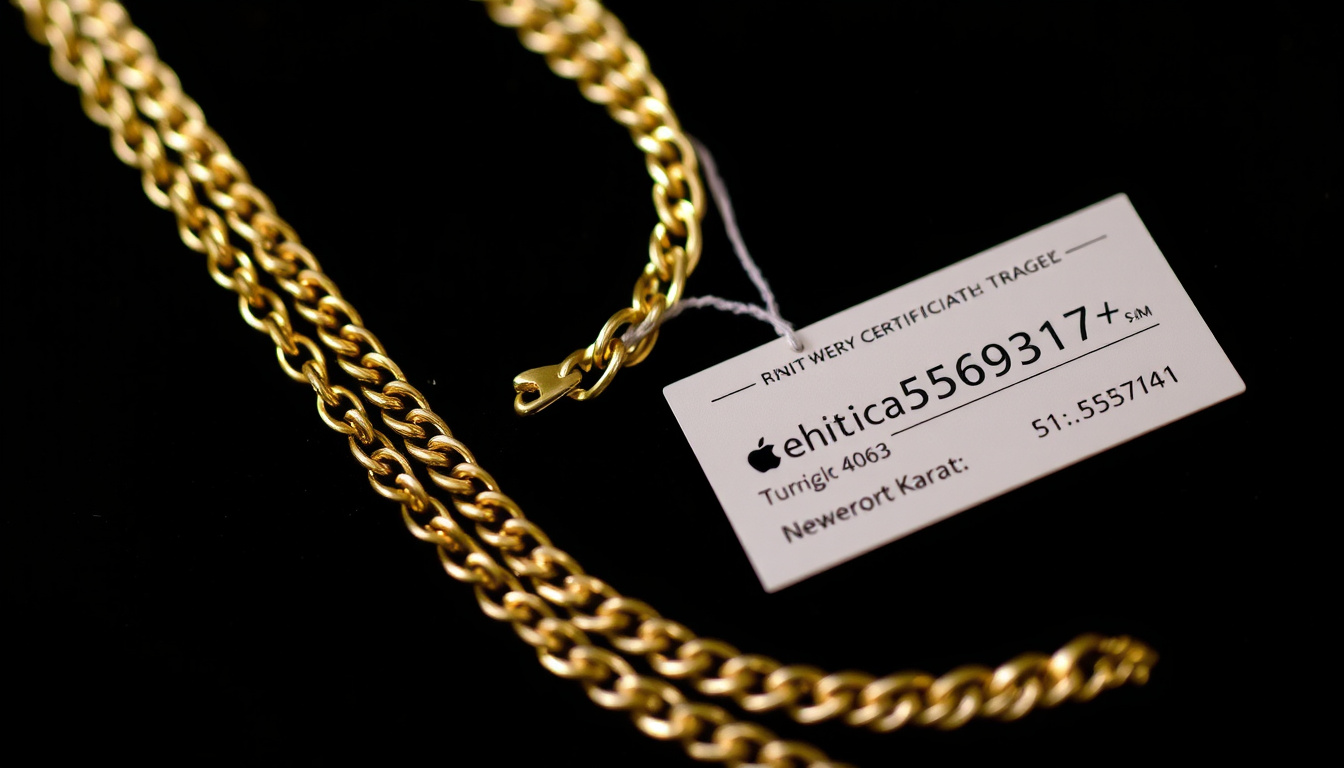
Anyone who has squinted at a jeweller’s display case comparing 18k and 24k tags knows the real challenge isn’t taste — it’s certainty. In the UK, a gold necklace over 1 gram must carry an independent hallmark before it can legally be described as gold (UK Government hallmarking guidance).
Purity of 24k gold: 99.9% (999 parts per thousand) · Purity of 18k gold: 75% (750 parts per thousand) · Purity of 22k gold: 91.7% (916 parts per thousand)
Quick snapshot
- 18k gold is 750 parts per 1,000 gold — 75% gold — per Beaverbrooks (UK jeweller’s hallmarking guide).
- UK law requires an independent hallmark on gold jewellery over 1 gram UK Government hallmarking guidance.
- Hallmarking rules apply to online sales, not just in-store purchases UK Government hallmarking guidance.
- Whether a 24k piece is marked 990 or 999 depends on the standard a product declares Beaverbrooks (UK jeweller’s hallmarking guide).
- How long a gold-plated finish lasts is not covered by gold hallmarking — the assay system reaches solid gold, not surface layers UK Government hallmarking guidance summary.
- Whether 24k can survive daily wear remains a purity-versus-softness trade-off Beaverbrooks (UK jeweller’s hallmarking guide).
- Whether cable chains and pendant necklaces are the most popular style is a common claim but no official data confirms it. (Beaverbrooks (UK jeweller’s hallmarking guide))
- Whether “100% recycled gold” claims reflect the full supply chain is uncertain; documentation is required. (Beaverbrooks (UK jeweller’s hallmarking guide))
- The sale is the checkpoint: above 1 gram, a necklace cannot legally be described as gold without a hallmark UK Government hallmarking guidance.
- The assay-office mark tells you which UK office verified the metal UK Government hallmarking guidance summary.
- For everyday necklaces, 18k’s alloy content makes it harder than 22k or 24k National Association of Jewellers.
- Before checkout, look for three marks: sponsor, fineness, and assay office UK Government hallmarking guidance summary.
- For a 24k piece, choose a pendant design that won’t hit hard surfaces — pure gold’s softness is the documented trade-off Beaverbrooks (UK jeweller’s hallmarking guide).
Twelve facts, one pattern: the karat system and the hallmark law agree with each other — but only the hallmark proves it.
| Fact | What you need to know |
|---|---|
| Gold necklace karat standards | The UK fineness series runs 9k (375), 14k (585), 18k (750), 22k (916), and 24k (999); the 18k and 24k marks follow Beaverbrooks (UK jeweller’s hallmarking guide), and the 22k mark follows National Association of Jewellers. |
| UK hallmark required | Items over 1 gram of gold must be hallmarked before sale UK Governent hallmarking guidance. |
| Assay-office mark | Identifies the UK assay office that tested the piece UK Government hallmarking guidance summary. |
| Fineness mark meaning | Precious-metal content in parts per thousand UK Government hallmarking guidance summary. |
| 18k gold | 750 parts per 1,000 gold — 75% Beaverbrooks (UK jeweller’s hallmaring guide). |
| 22k gold | 916 fineness National Association of Jewellers. |
| 24k gold | 990 or 999 fineness, depending on the standard and product Beaverbrooks (UK jeweller’s hallmaring guide). |
| Dealer’s Notice | UK sellers must display one explaining how hallmarking works Chartered Trading Standards Institute. |
| Online sales | Covered by hallmarking law exactly as in-store sales are UK Government hallmarking guidance. |
What are the different gold karats for necklaces?
The karat number is a purity label: the higher the karat, the more gold in the alloy. The marks you’ll see in the UK come from a single legal series.
What is 24k gold and is it suitable for necklaces?
- Purity: 24k gold is the purest option in the series, commonly marked 990 or 999 — up to 999 parts per 1,000 gold Beaverbrooks (UK jeweller’s hallmarking guide).
- Softness: because it is nearly pure, 24k resists scratching and bending less than alloyed gold Beaverbrooks (UK jeweller’s hallmaring guide).
- Best use: a 24k necklace works best as a pendant or occasion piece that stays away from hard surfaces; a daily chain will show the wear.
The implication: 24k answers the question “is this real gold?” with a clear yes — then creates a second question about whether the necklace can handle your actual day. Purity and durability pull in opposite directions.
How does 22k gold compare to 18k gold?
- 18k = 750 fineness: 75% gold, 25% alloy Beaverbrooks (UK jeweller’s hallmarking guide).
- 22k = 916 fineness: 91.7% gold National Association of Jewellers.
- Hardness: 18k’s larger share of alloy makes it harder and more practical for everyday necklace wear National Association of Jewellers.
- Softness: 22k is more vulnerable to deformation exactly because it contains more gold National Association of Jewellers.
Every karat you add raises the gold content, the price, and the necklace’s sensitivity to daily wear. 18k’s 25% alloy share is the structural compromise that makes it the sensible default for UK everyday necklaces National Association of Jewellers.
What is 9k gold and why is it common in the UK?
- 9k = 375 fineness: 37.5% gold — the rest is alloy.
- Why it appears so often: more alloy means a harder, more affordable metal — the same principle that makes 18k tougher than 22k National Association of Jewellers.
- Legal status: over the 1-gram threshold, a 9k piece still needs a 375 hallmark before it can be sold as gold UK Governent hallmarking guidane.
Which gold necklace is best for women?
The phrase “best for women” hides a real question: best for what — everyday colour, formal occasions, or the pendant you already own? The answers share one rule: let the necklace’s job decide the karat and the length.
What styles of gold necklaces are popular for women?
- Cable chains — round links that lie flat; the everyday default that layers well.
- Box chains — a clean, squared line that catches the light and holds pendants firmly.
- Pendant necklaces — a neutral chain plus a focal point; the easiest way to make a simple gold chain personal.
The pattern: your wardrobe decides. If you never take it off, a cable or box chain in 18k will outlast a delicate fashion piece National Association of Jewellers.
Should I choose a chain or pendant necklace?
- Chain-only: maximum versatility — wear it alone, layer it, or add a pendant later.
- Pendant: delivers a specific look; the chain has to be strong enough for the pendant’s weight.
- Rule of thumb: box and cable chains carry pendants better than rope or snake styles.
One check matters more than styling: if the chain is sold as gold and weighs more than 1 gram, it must carry a hallmark UK Government hallmarking guidance. That applies to branded “gift” necklaces as much as to fine jewellery.
What length is best for a women’s gold necklace?
- Choker: 14–16 inches, sitting high on the neck.
- Classic: 16–18 inches, resting on or just below the collarbone — the default for most buyers.
- Longer drape: 20+ inches, for layering over knitwear or creating a lower focal point.
If you are buying blind online, 16–18 inches is the safe first length: it suits both open collars and crew necks, and it pairs with a second chain in the 20-inch range.
How much does an 18 carat gold necklace cost?
An 18k necklace price is a maths problem with three inputs: gram weight, today’s gold price, and the design markup. Here’s how UK pricing behaves.
What factors determine the price of an 18k gold necklace?
- Gram weight is the biggest single driver — a 10-gram chain contains 7.5 grams of pure gold at 75% purity Beaverbrooks (UK jeweller’s hallmarking guide).
- Karat sets the gold fraction: 18k = 750 parts per 1,000 gold Beaverbrooks (UK jeweller’s hallmarking guide).
- Design and brand add labour, finishing, and margin — two chains of identical weight can differ in price by double.
Useful arithmetic: multiply the gram weight by the current gold price per gram, then by 0.75 for 18k. That is the metal value; anything above it is craft, brand, and convenience.
How does gold spot price affect necklace cost?
- The gold content is valued off the daily spot price — a working rule of thumb for 2024 is roughly $40–60 per gram of 18k gold before labour and markup.
- Because the spot price moves every trading day, the same necklace can carry a different tag a month apart.
- Retailers who quote “priced live” are showing their cards; fixed “sale” prices simply bake in the day’s gold rate.
The catch: any price list ages fast. The durable numbers are the gram weight and the fineness mark — those you can verify.
What is the typical price range for an 18k gold necklace in the UK?h3>
- Simple 18k chains in UK stores typically start around £200; designer and heavier pieces pass £1,000.
- The spread reflects weight and labour — a lightweight chain is a starter piece, not a discount on the same necklace.
- Check the hallmark before comparing prices: two “18k” listings are only comparable if both are genuinely hallmarked 750 UK Government hallmarking guidance.
Bottom line: The trade-off: a cheaper 18k necklace usually means less gold, not a better deal. Weigh the gram count, apply the fineness, and the true value becomes visible before you pay.
Is Pandora gold jewelry real gold?
The short answer is yes — and sometimes it isn’t. Pandora sells both solid gold pieces and gold-plated pieces, so the real question is which one you are looking at.
What materials does Pandora use for gold necklaces?
- Pandora’s gold range includes solid 14k and 18k pieces alongside gold-plated collections — the price divides them before the photos do.
- Solid gold is gold alloy through the whole piece; plated pieces use a base metal with a gold layer on the surface.
- Both categories are genuine products of the Pandora line, but they are not the same product class.
The implication: “Pandora gold” is not one material. If solid gold matters to you, confirm the specific collection and the fineness mark before buying.
Is Pandora gold solid or plated?
- Both exist. The deciding cue in the UK is the hallmark: solid gold over1 gram must carry one; plated pieces should be described as plated.
- If a listing says “18k gold” but the piece weighs more than1 gram and has no hallmark, the description and the law disagree UK Government hallmarking guidance.
- When in doubt, ask for the hallmark and the fineness mark — a retailer selling solid gold has both at hand.
Are Pandora gold necklaces hallmarked?
- If they are solid gold and sold in the UK above the1-gram threshold, yes — the law requires it UK Government hallmarking guidance.
- Look for three marks: the sponsor or maker mark, the fineness mark, and the assay‑offfice mark UK Government hallmarking guidance summary.
- A missing hallmark on a heavy “gold” necklace is a red flag whether the brand is Pandora or anyone else.
A brand name doesn’t verify purity. The hallmark does. For any necklace sold as solid gold over1 gram, UK law requires the same assay marks online as in-store UK Government hallmarking guidance.
The takeaway: treat the brand label as marketing and the hallmark as evidence. Solid Pandora gold is real gold; plated Pandora is real plating — the hallmark tells you which one you paid for.
Where can I buy 24k gold necklaces in the UK?
24k gold is a niche purchase in the UK — not because it is rare, but because it is soft. You will find it through specialist jewellers and online stores that cater to 22k/24k buyers.
Which UK retailers stock 24k gold necklaces?
- Generalist high-street jewellers rarely stock 24k chains because pure gold’s softness makes them fragile as daily wear Beaverbrooks (UK jeweller’s hallmarking guide).
- Specialist jewellers, bridal houses, and online gold retailers are the main sources; many target the 22k/24k buyer explicitly.
- Prefer sellers who publish hallmark details before you ask — that is the sign of a 24k specialist rather than a general gift store.
Is 24k gold necklace more expensive than 18k?
- Per gram, yes: 24k carries up to 999 parts per 1,000 gold versus 750 for 18k, so the gold content alone costs more Beaverbrooks (UK jeweller’s hallmarking guide).
- The total price still depends on gram weight — a light 24k chain can cost less than a heavy 18k chain.
- Online comparisons should always convert to price per gram of gold content; otherwise the comparison hides the weight difference.
Should I buy24k gold necklace online or in-store?
- UK hallmarking law covers online sales exactly as it covers shop sales UK Government hallmarking guidance.
- A UK-registered seller gives you hallmark protection and consumer-law recourse if the item fails the description.
- Ask for the hallmark and, if the listing mentions recycled gold, ask for the recycled-content documentation before treating it as fact.
Every online checkout is covered by the1-gram hallmark rule — the distance between you and the assay office is not a legal gap. If a seller can’t show a hallmark, they’re asking you to accept a description where the law requires proof UK Government hallmarking guidance.
What this means: 24k is a purity purchase, not an everyday purchase. For daily wear, 18k’s alloy content keeps the necklace on your neck instead of the repair bench National Association of Jewellers.
Five karats, one pattern: as the gold content climbs, the necklace gets richer, softer, and more expensive per gram.
| Karat | Fineness mark | Gold content | Everyday durability | Best for |
|---|---|---|---|---|
| 9k | 375 | 37.5% | Hardest of the five — most alloy | High‑street daily basics |
| 14k | 585 | 58.5% | Strong balance of gold and strength | Everyday with higher gold content |
| 18k | 750 Beaverbrooks (UK jeweller’s hallmaring guide) | 75% | Harder than 22k/24k National Association of Jewellers | Everyday fine jewellery |
| 22k | 916 National Association of Jewellers | 91.7% | Softer, vulnerable to deformation National Association of Jewellers | Traditional and bridal pieces |
| 24k | 990 or 999 Beaverbrooks (UK jeweller’s hallmarking guide) | 99.9% | Least resistant to scratching and bending Beaverbrooks (UK jeweller’s hallmarking guide) | Pendants and special occasions |
The pattern holds down to the last row: the karat scale is a single slide, and as purity increases, toughness decreases.
Ten checks, one habit: read the hallmark before you read the label.
| Check | What to verify |
|---|---|
| Hallmark threshold | 1 gram — items over this need a hallmark UK Government hallmarking guidance |
| Solid-gold label | Requires an independent hallmark above1 gram UK Government hallmarking guidance |
| 18k fineness mark | 750 Beaverbrooks (UK jeweller’s hallmarking guide) |
| 22k fineness mark | 916 National Association of Jewellers |
| 24k fineness mark | 990 or 999 Beaverbrooks (UK jeweller’s hallmaring guide) |
| Hallmark components | Sponsor/maker mark, fineness mark, assay‑office mark UK Government hallmarking guidance summary |
| Assay‑office mark | Identifies the UK office that tested the metal UK Government hallmarking guidance summary |
| Fineness definition | Precious‑metal content in parts per thousand UK Government hallmarking guidance summary |
| Dealer’s Notice | Sellers must display one explaining hallmarking Chartered Trading Standards Institute |
The pros and cons of 18k gold necklaces
Upsides
- 75% gold with enough alloy to handle everyday wear National Association of Jewellers.
- 750 fineness is legally verifiable through the UK hallmark system UK Government hallmarking guidance.
- Available at every price tier, from simple chains to designer pieces.
Downsides
- Costs more per gram than 9k or 14k because it contains more gold.
- Softer than lower-karat golds, so it can show scratches under heavy daily use.
- Its yellow colour reads lighter than 22k/24k, which matters if you want that deep gold tone National Association of Jewellers.
The balance: for most UK buyers, 18k is the compromise that works — enough gold to be worth the price, enough alloy to survive real life.
Separating confirmed facts from open questions
Given how much of the market depends on marketing language, it helps to split what UK law and assay offices actually confirm from what remains a judgment call.
Confirmed facts
- Gold jewellery over1 gram sold in the UK requires a hallmark UK Government hallmarking guidance.
- 18k = 750 fineness = 75% gold Beaverbrooks (UK jeweller’s hallmaring guide).
- 22k = 916 fineness National Association of Jewellers.
- 24k is marked 990 or 999 depending on the standard Beaverbrooks (UK jeweller’s hallmarking guide).
What’s unclear
- How long a gold-plated necklace keeps its finish — plating wears at different rates depending on base metal, thickness, and habits.
- Whether “100% recycled gold” claims reflect the full supply chain — a tagline is not a document.
- Where gold prices head next — the spot price moves daily, so any “best time to buy” is market timing, not jewellery advice.
- How a 24k chain will cope with years of daily wear — its softness is documented, but individual tolerance varies Beaverbrooks (UK jeweller’s hallmarking guide).
- Whether polished white-gold finishes will need re-plating — surface finishes are not a property of the gold alloy itself National Association of Jewellers.
The read: the confirmed list tells you what the law guarantees. The unclear list is where the marketing budget lives — ask for documents, not adjectives.
What the authorities say
Above1 gram, gold jewellery sold in the UK must be independently tested and marked before it can legally be described as gold.
— UK Government hallmarking guidance
22‑caraat gold carries roughly166 parts per thousand more gold than 18‑caraat — and it is exactly that extra purity that makes it softer under everyday pressure.
— National Association of Jewellers (UK jewellery trade body)
24‑caraat gold can be marked 990 or 999 depending on the standard used; either way it is the purest option and the least resistant to scratches and bends.
— Beaverbrooks (UK jeweller’s hallmarking guide)
Where precious metal is sold, a Dealer’s Notice must be displayed so buyers can see how hallmarking and fineness work before they commit.
Four different voices, one instruction: verify the metal before you trust the label, and keep the hallmark paperwork with the necklce.
The final takeaway
A gold necklace is one of the few purchases where the law insists on telling the truth. The karat describes the gold, the hallmark proves it, and the design decides whether you will actually wear it. Recyled-gold claims deserve encouragement — and documents. For UK buyers, the decision is clear: buy 18k with a visible hallmark for daily wear, or invest in 22k/24k for occasions — and never pay solid-gold prices for an unmarked piece.
gov.uk, pembrokeshire.gov.uk, sellercentral.amazon.co.uk, rbkc.gov.uk
Frequently asked questions
What is the difference between gold plated and solid gold?
Solid gold is a gold alloy through the entire piece — 18k is 750 parts per 1,000 gold Beaverbrooks (UK jeweller’s hallmarking guide). Gold plated starts with a base metal and adds a gold layer on top. UK law is the referee: over1 gram, a piece described as gold rather than gold-plated must carry a hallmark UK Government hallmarking guidance.
How to care for a gold necklace?
Wear it — gold alloys resist tarnish better than they resist dust. Clean gently with warm water and a soft cloth, and remove the necklace before swimming or workouts: chlorine is aggressive on gold alloys and harder on plated finishes. For 18k white gold, ask about rhodium maintenance when you buy National Association of Jewellers.
What chain is best for a pendant?
Box and cable chains carry weight well; rope and snake chains are more delicate and put extra pressure on the clasp. Choose 18k if the necklace will be worn daily — its alloy share gives it more everyday strength than 22k or 24k National Association of Jewellers.
Can I swim with a gold necklace?
Not ideal. Chlorine and salt water accelerate wear on gold alloys, and 24k’s softness makes it especially vulnerable to scratching and bending Beaverbrooks (UK jeweller’s hallmaring guide). 18k is the more resilient choice for a piece you prefer to keep on National Association of Jewellers.
How to check if a gold necklace is real?
Start with the hallmark, not a magnet or acid test. In the UK, a gold necklace over1 gram must be independently marked with a fineness mark, a sponsor mark, and an assay‑office mark UK Government hallmarking guidance summary. Missing marks on a heavy “gold” necklace makes the description legally doubtful — and the receipt is your only defence.
Does 18k gold tarnish?
18k gold itself is highly resistant to tarnish, but its 25% alloy share can react to chemicals and hard wear National Association of Jewellers. White 18k may also have a rhodium surface finish, so ask how the finish is maintained before you buy National Association of Jewellers.
How to layer gold necklaces?
Vary the lengths — a 16-inch with an 18-inch chain is the standard pairing. Keep clasps secure and weights light; a heavy pendant on a thin chain is a repair appointment waiting to happen.
The hallmark remains the one trusted mark for buyers in the UK.

Henry William Bennett Murray is a staff writer for CivicInsight.uk, covering UK public affairs, policy and civic life. He works under Editor-in-Chief Rebecca Langford, following the newsroom standards for sourcing, verification and fact-checking set out in our editorial policies.