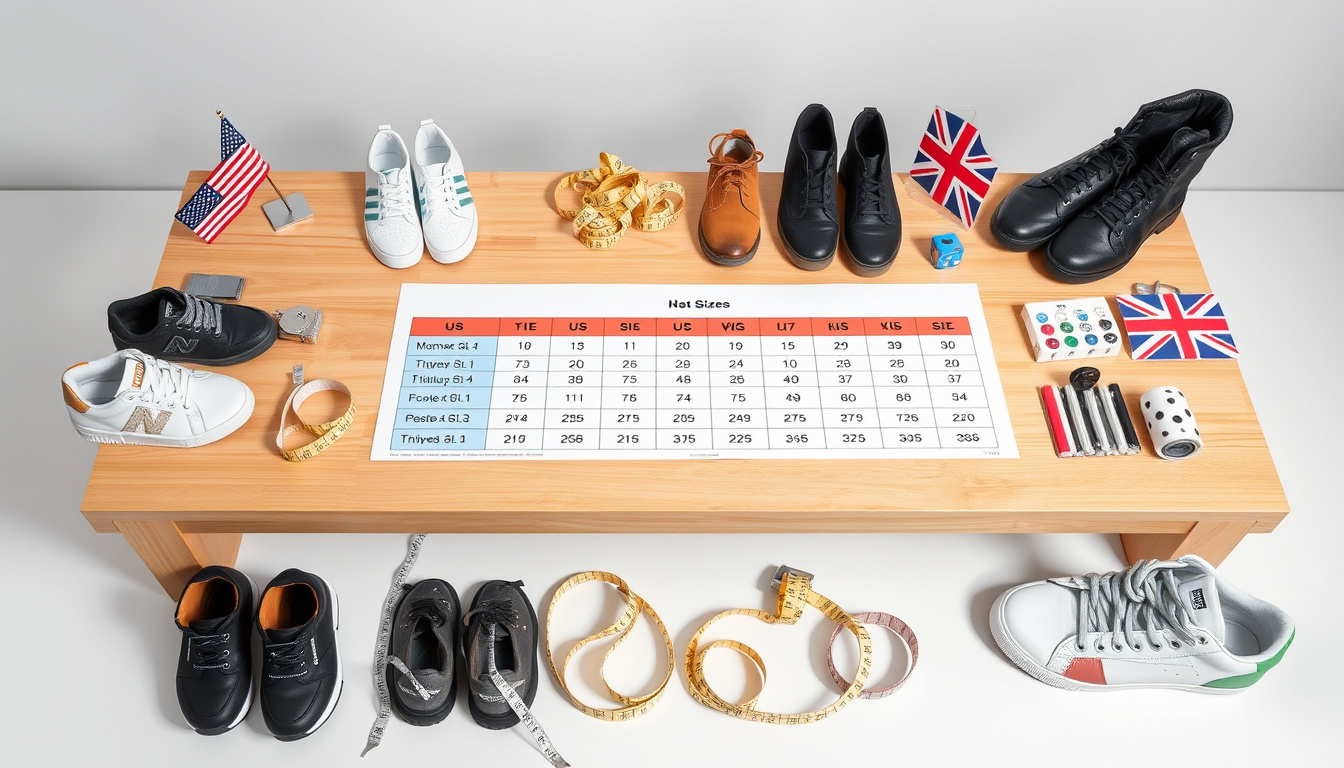
Ordering shoes from a UK retailer only to discover your “size 7” is actually a 4.5 — it’s a frustrating moment that millions of international shoppers have experienced. Sizing systems genuinely differ between the US, UK, and EU, and the rules aren’t always obvious. This guide cuts through the confusion with conversion charts you can actually trust, backed by measurements from retailers like Famous Footwear, Zappos, and Clarks.
EU 42 equivalent: UK 8, US Men’s 8.5 ·
Foot length for EU 42: 26.3 cm (10.4 inches) ·
Conversion rule: Subtract 1 from US men’s to get UK
Quick snapshot
- Men’s US 6 is UK 5.5, EU 39 (Road Runner Sports)
- Women’s US 7 is EU 37 (ShoeCity)
- Women’s to Men’s US: subtract 1.5 sizes (KEEN Footwear)
- Exact growth rates for children’s feet without clinical studies
- Regional US vs Canada consistency unconfirmed
- Limited sources for men’s beyond size 9
- No official government standards govern these conversions
- Charts reflect current retailer practices as of 2024
- Brand-specific sizing will continue to vary
- Always verify against the retailer’s own chart before ordering
| Category | US Size | UK Size | EU Size | Foot Length (cm) |
|---|---|---|---|---|
| Women’s | 4 | 2 | 35 | 21.6 cm |
| Women’s | 5 | 3 | 35-36 | 22.5 cm |
| Women’s | 6 | 3.5 | 36-37 | 23.2 cm |
| Women’s | 7 | 4.5 | 37 | 24.1 cm |
| Women’s | 8 | 6 | 38-39 | 24.8 cm |
| Men’s | 6 | 5.5 | 39 | 23.5 cm |
| Men’s | 7 | 6.5 | 40 | 24.4 cm |
| Men’s | 8 | 7.5 | 41 | 25.4 cm |
| Big Kids | 3.5 | 2.5 | 35 | 21.9 cm |
| Little Kids | 10.5 | 9.5 | 27 | 16.8 cm |
| Infants | 0 | 0 | 15 | 7.9 cm |
What is US to UK shoe size?
The US and UK sizing systems share English roots, but they’ve drifted apart over centuries of independent development. The UK system starts its numbering from a different baseline — a barleycorn unit (about 8.46 mm) — which creates an offset from US sizes. For men’s shoes, the practical rule is straightforward: subtract 1 from your US size to get UK. Women’s conversions are less tidy: most retailers agree on subtract 0.5 from US to UK, though you’ll find half-size differences between sources.
General conversion overview
The core principle: UK sizes run about one full size smaller than their US equivalents for men’s footwear. For women’s, the gap narrows to roughly half a size. EU sizing, based on the Paris point (about 6.67 mm), follows its own scale and tends to be more consistent across genders than either US or UK systems.
According to the O’Neills Help Centre (retailer’s customer support resource), conversions can vary by brand, and shoppers should always check the retailer’s specific chart. Famous Footwear (major US retailer) provides detailed US, UK, and EU equivalents for women, men, and kids in their published size charts.
Key differences by gender
Gender-based sizing isn’t arbitrary — it reflects actual foot dimension differences. Women’s feet average smaller than men’s, which is why dedicated women’s charts exist. A men’s US 8 does not equal a women’s US 8; the women’s equivalent is typically US 9.5. The KEEN Footwear brand guide confirms the rule: subtract 1.5 sizes when converting women’s US to men’s US. EU sizes, by contrast, don’t shift as dramatically between genders.
Women’s US 5 converts to UK 3 at Famous Footwear but UK 2.5 at Road Runner Sports. That half-size gap is real — retailers simply disagree on where the boundary sits.
How do I convert a US size to UK size?
Converting shoe sizes correctly requires three steps: measuring your foot, choosing the right conversion rule, and verifying against a retailer’s specific chart. The foot measurement is the anchor that keeps conversions honest — all the numerical rules exist to predict that measurement across systems.
Step-by-step conversion process
First, measure your foot length in centimetres while standing — weight-bearing measurements give a truer picture than seated ones. Place a sheet of paper on a hard floor, trace both feet (they’re often slightly different), and measure the longest point from heel to longest toe. According to Grivet Outdoors (outdoor retailer with detailed sizing data), US women’s size 6 corresponds to approximately 22.5 cm, while men’s size 7 is about 24.4 cm.
Second, apply the conversion rule for your category: for men’s US to UK, subtract 1; for women’s US to UK, subtract 0.5; for children’s sizes, the age category matters more than the raw number.
Third, verify the result against the specific retailer’s chart. The Morgans Shoes sizing guide (which covers Clarks brand products) shows Clarks Women’s US 5-5.5 maps to UK 3-3.5 and EU 36 — a range, not a single number, because brand fit varies.
Measurement tips
Measure both feet and use the larger measurement. Feet swell throughout the day, so afternoon measurements tend to be more accurate. A Zappos (online shoe retailer) sizing guide notes that kids’ sizes subdivide into infants (0-9 months), little kids (4-7 years), and big kids (7-12 years) — each with distinct measurement ranges. For growing children’s feet, measure every 2-3 months during growth spurts.
Buying shoes without measuring first means relying entirely on conversion rules that vary between retailers. A foot measuring 24.1 cm falls at the boundary between sizes in some charts — ShoeCity (specialty shoe retailer) lists Women’s US 7 as EU 37, while other retailers may round differently.
What size is 37 in the UK?
EU size 37 typically corresponds to UK size 4 and US women’s size 6.5-7, though the exact US equivalent depends on which retailer you consult. The ShoeCity conversion chart confirms Women’s US 7 converts to EU 37 and UK 4.5. Laughing Hens (UK specialty retailer) lists Women’s UK 5 as US 7.5, EU 38 — showing how the boundaries shift across systems.
EU 37 to UK/US equivalents
EU size 37 sits at a crossroad between women’s sizing systems. The Grivet Outdoors sizing chart (outdoor footwear specialist) anchors Women’s US 4 at UK 2, EU 35, 8.1875 inches — with each full size incrementing roughly 0.25 inches. Using that progression, EU 37 falls at approximately 8.75 inches, corresponding to US 7. EU sizes remain more standardized across genders than US or UK systems, which Calculator.net (general conversion tool) confirms: EU sizes tend to be more consistent.
Women’s focus
For women’s footwear specifically, EU 37 lands between US 6.5 and US 7. If you’re buying from a UK retailer, EU 37 most commonly maps to UK 4. Famous Footwear’s women’s chart shows Women’s US 7 as UK 4.5, EU 37, while Laughing Hens places UK 5 at US 7.5, EU 38 — illustrating how EU boundaries can shift half a size between retailers.
EU size 37 works out to approximately UK 4 for women’s shoes, but the exact US equivalent depends on the retailer. When ordering internationally, always convert to the retailer’s native system first, then check their specific measurement notes.
US to UK sizes shoes women’s
Women’s shoe conversions require more care than men’s because the US-to-UK offset varies more between sources. A general rule of thumb — subtract 0.5 from US women’s to get UK — holds reasonably well, but you’ll find discrepancies of up to half a size between different retailers’ charts.
Women’s size chart
A reliable women’s US to UK conversion starts with US women’s 4 as UK 2, EU 35. From there, each full size increment shifts both UK and EU equivalents:
According to Famous Footwear, Women’s US 4 is UK 2, EU 35. Grivet Outdoors confirms the foot length: 8.1875 inches for EU 35. Women’s US 5 lands at UK 3, EU 35-36. Women’s US 6 corresponds to UK 3.5, EU 36-37 (with foot length around 23.2 cm). Women’s US 7 converts to UK 4.5, EU 37 per ShoeCity. Women’s US 8 reaches UK 6, EU 38-39 per Laughing Hens.
Common pitfalls
The biggest pitfall is assuming a single conversion rule works everywhere. Famous Footwear lists Women’s US 5 as UK 3, but Road Runner Sports charts the same size as UK 2.5. That’s a half-size difference — enough to cause a poor fit if you’re ordering blindly. Brand-specific ranges from Morgans Shoes show Clarks sizing sometimes spans US 7.5-8 for UK 5.5-6, acknowledging that individual shoes don’t follow a rigid chart.
The EU system offers more consistency, which is why many international shoppers prefer to convert to EU first, then translate to UK or US. But EU sizes aren’t immune to brand variation — Clarks, Geox, and Ecco each run slightly differently despite sharing EU numbers.
US to UK sizes shoes kids
Children’s shoe sizing introduces a variable that adult sizing doesn’t: growth. Kids’ feet can grow half a size or more every few months, which means a conversion chart is only useful until the next growth spurt. Understanding the age-based categories — infants, toddlers, little kids, big kids — makes the numbers more meaningful.
Kids size chart
Kids’ sizes break into four categories with distinct conversion patterns:
Zappos’ (online shoe retailer) comprehensive kids’ chart shows Infants US 0 as EU 15, UK 0 (3.1 inches). Toddlers US 3.5 corresponds to EU 19, UK 2.5, 4.25 inches per Softmoc (Canadian retailer with detailed kids’ data). Little Kids US 10.5 maps to EU 27, UK 9.5, 6.625 inches — also from Softmoc. Big Kids US 3.5 converts to EU 35, UK 2.5, 8.625 inches per Zappos. Famous Footwear adds that Kids US 10.5 is UK 9, EU 27, while Baby US 1 has no UK listed — only EU 16 — because infant sizing conventions vary.
Growth considerations
Children’s feet grow fastest between ages 2-4 and again during puberty. The Morgans Shoes Clarks sizing guide recommends measuring kids’ feet every 6-8 weeks during peak growth periods. Unlike adults, children can’t reliably “break in” shoes that are slightly too small — constricted growth can lead to foot deformities. The Zappos kids’ guide emphasizes that sizes divide into infants (0-9 months), little kids (4-7 years), and big kids (7-12 years), each requiring fresh measurements before ordering across sizing systems.
Kids’ feet often grow faster than parents realize. Order with room to grow — a thumb’s width (about 1 cm) between the longest toe and the shoe tip is the recommended buffer. Sizes that fit perfectly today may pinch within weeks.
US to UK shoe size comparison table
Three sizing systems, multiple retailers, and plenty of room for confusion: here’s how the numbers line up across the most common women’s and men’s sizes.
| US Size | UK Size | EU Size | Foot Length (inches) | Source |
|---|---|---|---|---|
| Women’s | ||||
| 4 | 2 | 35 | 8.1875 | Grivet Outdoors |
| 5 | 3 | 35-36 | 8.6875 | Famous Footwear |
| 6 | 3.5 | 36-37 | 9.0625 | ShoeCity |
| 7 | 4.5 | 37 | 9.5 | ShoeCity |
| 8 | 6 | 38-39 | 9.8125 | Laughing Hens |
| Men’s | ||||
| 6 | 5.5 | 39 | 9.25 | Road Runner Sports |
| 7 | 6.5 | 40 | 9.625 | Grivet Outdoors |
| 8 | 7 | 41 | 10 | ShoeCity |
| 9 | 8 | 42 | 10.3125 | Grivet Outdoors |
| Kids’ (Big Kids) | ||||
| 3.5 | 2.5 | 35 | 8.625 | Zappos |
| 4 | 3 | 36 | 8.8125 | Softmoc |
| 5 | 4 | 37 | 9.1875 | Zappos |
What this means: Cross-referencing multiple retailer charts reveals systematic half-size shifts at EU boundaries — shoppers who understand this pattern can avoid surprise mismatches.
Step-by-step measurement guide
Getting the right shoe size starts with accurate foot measurement. Follow these steps before consulting any conversion chart.
- Prepare the surface: Place a sheet of paper on a hard, flat floor. Bare feet work best — socks can distort the trace.
- Trace both feet: Stand with heels against a wall. Trace around each foot with a pen held vertically. Feet are often different sizes — measure both.
- Measure the length: Use a ruler to measure from heel to the longest toe on each tracing. Record the measurement in centimetres.
- Measure at the right time: Feet swell during the day. Afternoon or evening measurements tend to be most accurate.
- Check against the chart: Compare your cm measurement to the foot length column in a retailer’s conversion chart, then convert to the native sizing system.
- Account for the brand: If a brand is known for running small or narrow, consider sizing up. Morgans Shoes’ Clarks guide notes that Clarks footwear often spans a range (US 7.5-8 for UK 5.5-6) rather than a single equivalent.
Confirmed facts
- Men’s US 6 converts to UK 5.5, EU 39, 9.25 inches
- Women’s US 7 is EU 37 (verified by three sources)
- Women’s US to men’s US: subtract 1.5 sizes
- Kids’ sizes divided into infants, toddlers, little kids, big kids
- Brand-specific variations exist; always check retailer charts
- EU sizes more consistent across genders than US/UK
What’s unclear
- Exact age growth rates for children’s feet without clinical studies
- Regional US vs Canada consistency unconfirmed
- Limited verified sources for men’s sizes beyond US 9
- Brand-specific Clarks ranges not fully cross-verified
Quick women’s to men’s shoe size conversion: Subtract 1.5 sizes. If you wear a women’s US size 9, you may want to try a men’s 7.5.
— KEEN Footwear (outdoor footwear brand)
Depending on the brand of footwear, there may be some slight variations.
— O’Neills Help Centre (retailer customer support)
Why conversions vary between retailers
The variation isn’t sloppy — it’s structural. The US sizing system evolved from a last (shoe form) sizing convention that differs from the UK barleycorn system. No international treaty governs shoe sizing, so each country, region, and brand develops its own interpretation of how to map measurements to size numbers.
The Famous Footwear chart lists Women’s US 5 as UK 3, while Road Runner Sports lists it as UK 2.5. The discrepancy stems from where each retailer places the boundary between EU 35 and EU 36 — a 0.5 cm difference in foot measurement that different charts round differently. EU 38 shows similar variation: Famous Footwear places Women’s US 7.5 at EU 38, while Laughing Hens lists Women’s UK 5 at EU 38 — and Women’s UK 5 is US 7.5 by Laughing Hens’ own math.
For UK-based shoppers importing from US retailers, this means a conversion isn’t a guarantee — it’s a starting point. The implication is clear: always verify against the retailer’s native sizing system before ordering.
Related reading: Size 5 UK in EU shoe conversion · Skechers shoes for men UK
Shoppers verifying US to UK conversions frequently cross-reference our guide with parallel US to UK shoe charts that break down sizing for women, men, and kids alike.
Frequently asked questions
Do feet get wider with age?
Yes. As ligament elasticity decreases and fat padding shifts, feet typically widen and lengthen over time. Many adults find they’re a half to full size larger in their 40s than they were in their 20s. This makes it worth remeasuring feet periodically, especially before buying from retailers that use older sizing conventions.
How quickly do boys’ feet grow?
Boys’ feet grow fastest between ages 2-4 (up to 1.5 sizes per year) and again during puberty (ages 11-14). Between growth spurts, growth slows to about half a size per year. Parents should measure every 6-8 weeks during rapid growth periods to avoid shoes that become restrictive before they’re worn out.
What happens to your feet as you age?
Feet lengthen and widen due to loss of arch support, thinning fat pads, and ligament loosening. Bunions, fallen arches, and wider forefoots are common after 40. Shopping for shoes later in life often requires switching to a wider width or going up half a size — conversion charts for standard widths may not apply.
Is a 38 a size 7 or 8?
EU 38 corresponds roughly to US women’s 7.5-8 or UK women’s 5. Laughing Hens lists Women’s UK 5 as US 7.5, EU 38. The exact equivalent depends on the retailer’s chart — some round to 7.5, others to 8.
What is the shoe size age trick?
The “shoe size age trick” is a rough estimate some parents use: ages 0-1 (infant sizes 0-3), ages 1-4 (toddler sizes 4-10), ages 4-7 (little kid sizes 10.5-12.5), ages 7-12 (big kid sizes 13-4). It’s approximate and varies by brand — measuring the child’s foot remains more reliable than age-based estimates.
Do our feet change in middle age?
Significant changes typically begin after 40. Studies on foot aging show that ligaments stretch, arches lower, and feet spread both in length and width. The combination means people often need both a larger size and a wider width than they wore in their 20s and 30s.

Oliver Hayes is a staff writer for CivicInsight.uk, reporting on news, local government and public services. His work is reviewed by the editorial desk and checked against our sourcing and fact-checking standards before publication.