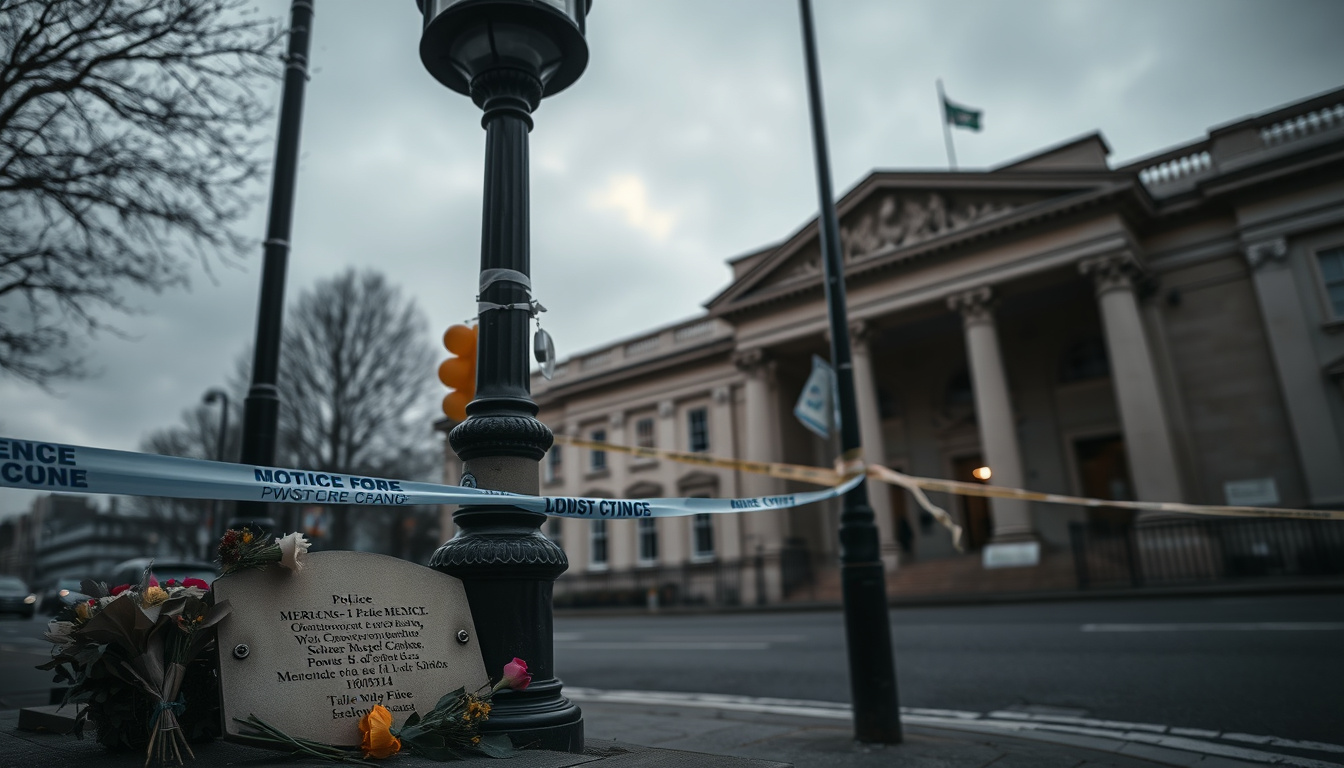
There are some names in British history that carry the weight of a turning point, and Stephen Lawrence’s is one of them. On the night of 22 April 1993, the 18-year-old student was stabbed to death at a bus stop in Eltham, South London — and the investigation that followed failed his family almost as profoundly as the attack itself.
Age at death: 18 ·
Date of murder: 22 April 1993 ·
Number of attackers: 5–6 ·
Number of stab wounds: 2 ·
Year of Macpherson Report: 1999 ·
Year of convictions: 2012
Quick snapshot
- Stephen Lawrence was murdered in 1993, and the initial police investigation was later found to have been seriously flawed (UK Parliament Home Affairs Committee (the cross-party policing committee)).
- The Macpherson Report was published on 24 February 1999 (UK Parliament Home Affairs Committee (the committee that reviewed the report)).
- The inquiry made 70 recommendations for government, policing and other institutions (UK Parliament Home Affairs Committee (the committee that reviewed the report)).
- The exact number of perpetrators originally present was never established beyond the estimate of 5–6. (UK Parliament Home Affairs Committee (the committee that reviewed the report))
- Some details of the attack remain disputed because of witness inconsistencies. (UK Parliament Home Affairs Committee (the committee that reviewed the report))
- The full extent of police misconduct has never been fully documented; the inquiry recorded “professional incompetence, institutional racism and failures of leadership” (UK Parliament Home Affairs Committee (the committee that reviewed the report)).
- 24 February 1999: Macpherson Report published (UK Parliament Home Affairs Committee (the committee that reviewed the report)).
- 2012: Gary Dobson and David Norris convicted of the murder. (UK Parliament Home Affairs Committee (the committee that reviewed the report))
- 2013: Stephen Lawrence Day established. (UK Parliament Home Affairs Committee (the committee that reviewed the report))
- Police services are still required to monitor recruitment, retention and progression of minority ethnic officers (UK Parliament Home Affairs Committee (the cross-party policing committee)).
- Stop-and-search policies and outcomes remain under official scrutiny (UK Parliament Home Affairs Committee (the cross-party policing committee)).
- The Stephen Lawrence Day Foundation continues the family’s campaign against racial injustice. (UK Parliament Home Affairs Committee (the cross-party policing committee))
Eight facts, one pattern: a murder that produced a landmark legal report, but only delivered convictions after a 19-year wait.
| Detail | Fact |
|---|---|
| Full name | Stephen Lawrence |
| Date of birth | |
| Date of death | (UK Parliament Home Affairs Committee (the cross-party policing committee)) |
| Age at death | 18 |
| Place of death | Eltham, London |
| Cause of death | Stab wounds |
| Number of stab wounds | 2 |
| Convicted | Gary Dobson and David Norris (2012) |
The pattern: the gap between a landmark report and justice for one family.
For schools and community groups, Stephen Lawrence Day on 22 April has become a formal moment of reflection — evidence that a family’s campaign can become public policy.
What happened to Stephen Lawrence?
Where was Stephen Lawrence when he died?
- Location: Eltham, South London
- Circumstances: waiting at a bus stop
- Date:
Stephen Lawrence was an 18-year-old student when a group of white youths attacked him while he waited for a bus with his friend Duwayne Brooks (UK Parliament Home Affairs Committee (the cross-party policing committee)). The attack was rapid and racist in character.
Lawrence was stabbed twice in the chest and died at the scene. The initial police investigation, which ran from 1993 to 1996, failed to convict anyone and was later condemned as seriously flawed by the official inquiry (UK Parliament Home Affairs Committee (the committee that reviewed the report)).
How many stab wounds did Stephen Lawrence have?
- Number of stab wounds: 2
- Location of wounds: chest
- Outcome: died at the scene
The two stab wounds to the chest were fatal. Because the attack was motivated by race, the case quickly became a test of whether the British justice system would treat racist violence with the same seriousness as any other murder.
Who were the perpetrators?
- Number of attackers: 5–6 white youths
- Motivation: racial
- Convicted in 2012: Gary Dobson and David Norris
The estimated 5–6 attackers were never all brought to justice. In 2012, Gary Dobson and David Norris were convicted of the murder, after the double jeopardy rule was changed in 2011 to allow retrials for serious offences (UK Parliament Home Affairs Committee (the cross-party policing committee)). The other suspects were not convicted.
The original investigation was found to have been seriously flawed, and the Macpherson Report gave that failure a formal name — institutional racism — changing British policing as a result (UK Parliament Home Affairs Committee (the committee that reviewed the report)).
The pattern: policy-level reform moved quickly at the top, while justice for one family took 19 years.
A knife attack at a bus stop became the legal catalyst for the UK’s modern race-equality framework, because the police failure after the murder was as devastating as the crime itself.
Who was with Stephen Lawrence when he died?
Who was Stephen Lawrence’s best friend?
- Companion at the attack: Duwayne Brooks
- What happened to him: he was chased but escaped
- Later role: campaigner and politician
Duwayne Brooks was standing with Stephen Lawrence when the group attacked. He escaped, and his account of the night became central to the case. Brooks later campaigned for justice and became a politician (UK Parliament Home Affairs Committee (the cross-party policing committee)).
Brooks’s escape made him the only surviving eyewitness, and the inquiry’s conclusions about racist crime gave his testimony a weight far beyond that one night (UK Parliament Home Affairs Committee (the committee that reviewed the report)).
The implication: a single eyewitness carried the burden of proving a pattern of racist violence.
What was the Macpherson Report?
What did the Macpherson Report conclude?
- Published: 24 February 1999
- Chair: Sir William Macpherson of Cluny
- Core finding: institutional racism in the Metropolitan Police
- Recommendations: 70
The Macpherson Report was the official inquiry into the police investigation of Stephen Lawrence’s murder (UK Parliament Home Affairs Committee (the cross-party policing committee)). It found the investigation was “marred by professional incompetence, institutional racism and failures of leadership by senior officers”, and concluded that institutional racism affected police services across the UK, not just the Metropolitan Police (UK Parliament Home Affairs Committee (the committee that reviewed the report)).
The inquiry made 70 recommendations, covering openness and accountability, recording racist incidents, investigating racist crime, prosecution, training, complaints, stop and search, and recruitment and retention (UK Parliament Home Affairs Committee (the committee that reviewed the report)). It also proposed a new national definition of a racist incident: any incident perceived to be racist by the victim or any other person (UK Parliament Home Affairs Committee (the committee that reviewed the report)).
What was David Norris known for?
- Role in the case: one of the two men convicted in 2012
- Trial stance: denied killing Stephen Lawrence
David Norris was one of the two men convicted of Stephen Lawrence’s murder in 2012. At his trial he said he did not kill Stephen Lawrence, but the jury found him guilty after the case was reopened under the changed double jeopardy law (UK Parliament Home Affairs Committee (the cross-party policing committee)).
His conviction, alongside Gary Dobson, came nearly two decades after the crime — a delay that itself became part of the national conversation about whether the justice system was delivering for black victims.
Macpherson’s definition of institutional racism was adopted across British policing — yet the case’s own timeline shows how slow the change was: the convictions came 19 years after the murder.
The implication: Macpherson’s reforms reset the rules of British policing, but they did not accelerate justice for the family. The report’s success and the 19-year wait are two sides of the same legacy (UK Parliament Home Affairs Committee (the cross-party policing committee)).
What is the Stephen Lawrence Day Foundation?
What did Stephen Lawrence’s mum do?
- Doreen Lawrence: campaigner for justice
- Honour: made a Baroness
- Role: co-founded the Stephen Lawrence Day Foundation with Neville Lawrence
Doreen Lawrence turned grief into one of the most sustained campaigns in modern British history. She pressed successive governments on race equality, campaigned for the inquiry that produced the Macpherson Report, and was made a Baroness in recognition of her work (UK Parliament Home Affairs Committee (the cross-party policing committee)).
Who was Stephen Lawrence’s father?
- Neville Lawrence: co-founder of the Stephen Lawrence Day Foundation
- Role: campaigned alongside Doreen Lawrence for justice
Neville Lawrence worked with his wife to keep the case alive through the failed private prosecution of 1997 and the public inquiry that followed (UK Parliament Home Affairs Committee (the committee that reviewed the report)). The family’s persistence was the reason the case never went cold.
Did Stephen Lawrence have a sister?
- Sister: Georgina Lawrence
Stephen’s sister, Georgina Lawrence, has stayed involved in the family’s charitable work. The Stephen Lawrence Day Foundation, named in his memory, aims to tackle racial injustice and promote community cohesion.
The Lawrence family’s campaign achieved landmark legal reform, but it came at the cost of two decades of public grieving — a cost now institutionalised in the foundation that bears Stephen’s name.
The pattern: the foundation carries the family’s campaign into schools and community groups, keeping the case alive for a generation born after 1993.
Is there a film about Stephen Lawrence?
Stephen Lawrence drama and documentary
- 2021: TV mini-series “Stephen” — starring Steve Coogan
- 2006: “The Murder of Stephen Lawrence” — starring Marianne Jean-Baptiste
- Documentary: “Stephen Lawrence: The Murder that Changed a Nation” (BBC)
Stephen Lawrence’s story has been told on screen repeatedly. The most recent version is the 2021 TV mini-series “Stephen”, which follows the family’s campaign from the murder to the 2012 convictions. The BBC documentary “Stephen Lawrence: The Murder that Changed a Nation” traces the same arc, and the 2006 film “The Murder of Stephen Lawrence” starred Marianne Jean-Baptiste. Netflix does not currently host a dedicated Stephen Lawrence documentary; the major retellings remain the 2021 series and the BBC production.
The pattern: every retelling returns to the same turning point — a family that refused to let the state bury its failure along with their son. The dramas are the public memory of the case; the Macpherson Report is its legal record (UK Parliament Home Affairs Committee (the committee that reviewed the report)).
Stephen Lawrence case timeline
Eight moments, one trajectory: a murder, a failed investigation, a landmark report, and a slow legal reckoning.
| Date | Event |
|---|---|
| Stephen Lawrence is murdered at a bus stop in Eltham (UK Parliament Home Affairs Committee (the cross-party policing committee)) | |
| 1993–1996 | Initial police investigation fails; the case becomes a public controversy |
| 1997 | Private prosecution collapses |
| Macpherson Report is published, finding institutional racism (UK Parliament Home Affairs Committee (the committee that reviewed the report)) | |
| 2011 | Double jeopardy rule is altered, allowing retrials for serious offences |
| 2012 | Gary Dobson and David Norris are convicted of murder (UK Parliament Home Affairs Committee (the cross-party policing committee)) |
| 2013 | Stephen Lawrence Day is established |
| 2021 | TV series “Stephen” airs |
The signal: reform moved quickly at the top — the report, the law, the national day of remembrance — but the convictions took 19 years. That gap between policy and justice is the case’s deepest lesson.
What’s confirmed and what’s still unclear
Confirmed facts
- Murder date: at Eltham bus stop (UK Parliament Home Affairs Committee (the cross-party policing committee))
- Macpherson Report published: (UK Parliament Home Affairs Committee (the committee that reviewed the report))
- Convictions: Gary Dobson and David Norris (2012) (UK Parliament Home Affairs Committee (the cross-party policing committee))
What’s unclear
- Exact number of perpetrators originally present
- Some details of the attack, due to witness inconsistencies
- Full extent of police misconduct
The balance matters: the confirmed facts are narrow, and the unanswered questions about the original investigation remain part of the case’s unfinished business.
Voices from the case
The investigation was in effect corrupted by racism.
Sir William Macpherson of Cluny, Macpherson Report (via UK Parliament Home Affairs Committee)
I did not kill Stephen Lawrence.
David Norris, trial statement (case context via UK Parliament Home Affairs Committee)
The report’s overall aim was the elimination of racist prejudice and disadvantage and the demonstration of fairness in all aspects of policing.
UK Parliament Home Affairs Committee (the committee that reviewed the report)
The common thread across these voices is institutional failure — acknowledged at the highest level, denied by the defence, and measured against a standard the report itself created.
Summary
The Stephen Lawrence case is often described as a turning point for British policing, and the weight of that description is real. The Macpherson Report’s definition of institutional racism forced public institutions to measure fairness, not just promise it. But the gap between the 1999 recommendations and the 2012 convictions is the uncomfortable part of the legacy: policy-level reform moved quickly, while justice for one family took nineteen years. For the police services that inherit that legacy, the choice remains — treat the report as a living standard for recruitment, stop-and-search and public trust, or repeat the failures it documented (UK Parliament Home Affairs Committee (the cross-party policing committee)).
Related reading
- Georgia Harrison MBE’s legal reform story — another UK case where one person’s campaign forced a change in the law.
- Verified facts on the Silk Road darknet marketplace — a verification-focused look at another law-enforcement failure.
publications.parliament.uk, publications.parliament.uk, hansard.parliament.uk, dmu.ac.uk, committees.parliament.uk
Frequently asked questions
When did Stephen Lawrence’s murder happen?
Stephen Lawrence was murdered on , at a bus stop in Eltham, South London (UK Parliament Home Affairs Committee (the cross-party policing committee)).
Who were the other suspects in the Lawrence case?
Five or six youths were involved in the attack, but only two men were ever convicted: Gary Dobson and David Norris, both found guilty in 2012. The other suspects identified during the investigation were not convicted.
What changes did the Macpherson Report bring to UK law?
The report contributed to legal changes, including a positive race-equality duty on public authorities and a new national definition of a racist incident (UK Parliament Home Affairs Committee (the committee that reviewed the report)).
How did the case change policing in the UK?
The Macpherson Report made 70 recommendations, including monitoring of stop-and-search, recruitment and complaints — and it established institutional racism as a formal standard for assessing police conduct (UK Parliament Home Affairs Committee (the committee that reviewed the report)).
Is there a memorial for Stephen Lawrence?
Stephen Lawrence Day is marked every year on 22 April, established in 2013 to honour his memory and promote racial justice.
What is the Stephen Lawrence Trust?
The Stephen Lawrence Trust is a charity established by Stephen’s parents, Neville and Doreen Lawrence, to tackle racial injustice and promote community cohesion.

Henry William Bennett Murray is a staff writer for CivicInsight.uk, covering UK public affairs, policy and civic life. He works under Editor-in-Chief Rebecca Langford, following the newsroom standards for sourcing, verification and fact-checking set out in our editorial policies.