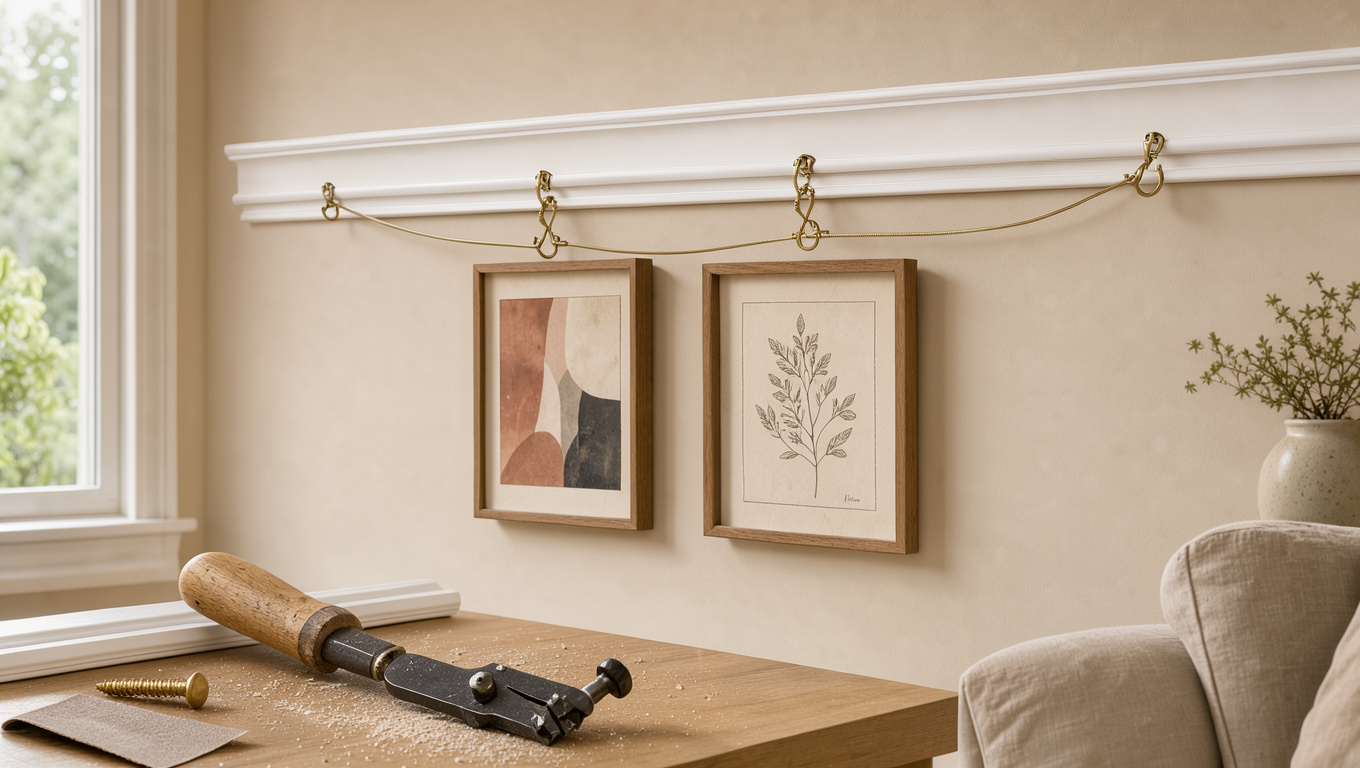
Hanging a favourite print on a bare wall usually means new nail holes and guesswork, but a picture rail moves the hanging point onto a moulding fixed high on the wall. Insight Britain (UK interior features publisher) describes the rail as a horizontal moulding for framed art and mirrors, but its load figures are the part to read twice, because the sources disagree on them.
Standard height below ceiling: 300–500 mm (TradeCalculator (UK trade measuring guide)) · Hook, 46 mm brass 20-pack: £5.00 ex VAT (LION Picture Framing Supplies (UK specialist framing retailer)) · Pine profile widths: 43–68 mm (LION Picture Framing Supplies (UK specialist framing retailer)) · Common materials: pine, MDF, oak (ManoMano (online DIY marketplace guide))
Quick snapshot
- A picture rail is a horizontal moulding fixed high on a wall, used to hang framed art and mirrors (Insight Britain (UK interior features publisher))
- LION’s pine profiles run from 43 mm (Victorian) to 68 mm (Edwardian) (LION Picture Framing Supplies (UK specialist framing retailer))
- Hook load figures conflict, from about 25 lb per hook to 15 kg per perlon line (Insight Britain (UK interior features publisher); BookABuilderUK (UK builders’ price guide))
- No brass rail profile is documented, so “brass” in these sources means hook finish (LION Picture Framing Supplies (UK specialist framing retailer))
- ManoMano’s interior moulding guide is dated 2024-02-06 (ManoMano (online DIY marketplace guide))
- Most retailer price pages in the research carry no date stamp, so prices are snapshots (LION Picture Framing Supplies (UK specialist framing retailer))
- Heavier frames need screws or nails into studs, not plasterboard alone (Insight Britain (UK interior features publisher)) (Signaldesk.uk (UK DIY blog))
- Check profile dimensions before buying hooks, since profiles vary by region, according to Signaldesk.uk (UK DIY blog)
Eight figures frame the rest of this guide, and none of them comes from a standards body; they come from trade guides and retailers.
| Item | Value |
|---|---|
| Standard height below ceiling | 300–500 mm (TradeCalculator (UK trade measuring guide)) |
| Height from floor in a standard 2.4 m room | 1.9–2.1 m (TradeCalculator (UK trade measuring guide)) |
| Typical top of a standard UK architrave head | around 2,050 mm (TradeCalculator (UK trade measuring guide)) |
| Rail height that clears door frames | 2,100 mm or higher (TradeCalculator (UK trade measuring guide)) |
| Purchase waste allowance | 10% for cutting waste and mitres (TradeCalculator (UK trade measuring guide)) |
| Stud spacing for fixings | 400 mm centres, according to The Sandwich Handyman (UK DIY how-to site) |
| Typical single-hook load | about 25 lb (11 kg), according to Insight Britain (UK interior features publisher) |
| Materials on sale | pine, MDF, oak (ManoMano (online DIY marketplace guide)) |
What is picture rail moulding and how is it used?
Where a picture rail sits on the wall
- Standard placement is 300–500 mm below the ceiling, which gives roughly 1.9–2.1 m height in a standard 2.4 m room (TradeCalculator (UK trade measuring guide)).
- Insight Britain gives a wider range of 30–50 cm below the ceiling, with the final figure depending on ceiling height and cornice depth (Insight Britain (UK interior features publisher)).
- Where the ceiling-based height falls within about 150 mm of the door architrave top, trade guidance drops the rail to align with the architrave head (TradeCalculator (UK trade measuring guide)).
Placement sets the hanging line for the whole wall. Cable and hanging length also push the rail higher, which is why ManoMano (online DIY marketplace guide) advises fixing it towards the ceiling.
The height you choose decides how every frame on that wall lines up, so the rail is a layout decision before it is a fixing job.
Why picture rails were used to hang pictures
- A hook sits over the top edge of the rail and gives a loop for the wire or chain that holds the frame (Regional Report (UK regional property features)).
- Rails are traditionally associated with older homes that have plaster walls and high ceilings, according to UK Picture Framing Supplies Blog (framing supplier’s blog).
The rail solved a practical problem: it let owners rehang art without drilling new holes into the wall each time.
The implication: the height you set is the starting point, and the door frame usually decides the final line.
Which materials and profiles suit a picture rail?
Wood and MDF picture rails
- Pine is the least expensive common moulding wood, oak is treated as high-end, and MDF and birch sit in the mid-range (ManoMano (online DIY marketplace guide)).
- A common pine rail is around 16 mm thick, with the typical range running 16–20 mm, according to BritainDaily.uk (UK consumer guide blog).
- MDF can be slightly thinner at 12–16 mm, but it swells if moisture reaches it, according to BritainDaily.uk (UK consumer guide blog).
LION supplies its pine profiles with two coats of primer already applied, so pine arrives ready for paint (LION Picture Framing Supplies (UK specialist framing retailer)). Pine is the cheaper route; MDF is the riskier one in a damp room.
Brass picture rails
- LION lists picture rail hooks in brass, bronze, silver and white finishes (LION Picture Framing Supplies (UK specialist framing retailer)).
- Its 46 mm × 32 mm brass hook comes in a 20-pack listed at £5.00 ex VAT (LION Picture Framing Supplies (UK specialist framing retailer)).
No solid brass rail profile appears in the sources. Brass here is a hook finish, which matters when you match metals across a room.
1930s picture rail profiles
- LION sells pine profiles named Victorian (43 mm), Georgian (63 mm), Modern (62 mm) and Edwardian (68 mm) (LION Picture Framing Supplies (UK specialist framing retailer)).
- The research found no dated source for 1930s profile dimensions, so the period question stays open.
Those names are retailer labels, not dated period records. Treat them as catalogue profiles, and check the dimensions against the wall before ordering.
The implication: profile choice is a matching exercise with the rest of the room, and the sources offer names rather than one standard set of dimensions.
How are picture rail hooks and fixings chosen?
Picture rail hooks and picture cord
- The hook rides on the rail’s top edge and carries the cord or wire that holds the frame (Regional Report (UK regional property features)).
- Attaching the cord near the top of the frame holds it flatter to the wall, while attaching near the middle tilts it forward, according to UK Picture Framing Supplies Blog (framing supplier’s blog).
- LION lists hook lengths of 38, 40, 42, 44, 46 and 51 mm (LION Picture Framing Supplies (UK specialist framing retailer)).
- A typical kit hook is rated at about 25 lb (11 kg) per hook, according to Insight Britain (UK interior features publisher).
The sources disagree on the numbers, so the safe reading is the weakest rating in the chain, not the highest. gemarkt.com (hardware and fixings blog) warns that ratings should not be added together unless the manufacturer documents that combination.
Buying a picture rail from a retailer or specialist supplier
- LION’s hook listings fall into 5 to 9.99 pound and 10 to 19.99 pound price bands (LION Picture Framing Supplies (UK specialist framing retailer)).
- Regional Report says B&Q and IKEA may stock rail moulding, with range varying by store and season (Regional Report (UK regional property features)).
- Specialist UK suppliers carry wider hook and kit ranges than general retailers, according to Regional Report (UK regional property features).
Fitting basics
- Set the rail 300–500 mm below the ceiling, and check that the architrave head sits near 2,050 mm before marking (TradeCalculator (UK trade measuring guide)).
- Order 10% extra for cutting waste and mitres (TradeCalculator (UK trade measuring guide)).
- Locate the studs and fix at 400 mm centres, according to The Sandwich Handyman (UK DIY how-to site).
- Cut 45° mitres on external corners and coped joints on internal corners, according to The Sandwich Handyman (UK DIY how-to site).
- Screw or nail into studs rather than plasterboard alone when frames are heavy (Insight Britain (UK interior features publisher)).
- Match hook length and rail profile before buying, since regional profile dimensions vary, according to Signaldesk.uk (UK DIY blog).
The trade-off: a cheap hook pack saves money at the till, but the fixing into studs decides how much the wall actually holds.
Ten specifications cover most buying decisions here, and the widest gap is between the 43 mm and 68 mm pine profiles.
| Specification | Value |
|---|---|
| Victorian pine profile width | 43 mm (LION Picture Framing Supplies (UK specialist framing retailer)) |
| Georgian pine profile width | 63 mm (LION Picture Framing Supplies (UK specialist framing retailer)) |
| Modern pine profile width | 62 mm (LION Picture Framing Supplies (UK specialist framing retailer)) |
| Edwardian pine profile width | 68 mm (LION Picture Framing Supplies (UK specialist framing retailer)) |
| Typical pine rail thickness | 16 mm, according to BritainDaily.uk (UK consumer guide blog) |
| MDF rail thickness | 12–16 mm, according to BritainDaily.uk (UK consumer guide blog) |
| Hook lengths listed | 38, 40, 42, 44, 46 and 51 mm (LION Picture Framing Supplies (UK specialist framing retailer)) |
| Hook finishes listed | brass, bronze, silver and white (LION Picture Framing Supplies (UK specialist framing retailer)) |
| 46 × 32 mm brass hook, 20-pack | £5.00 ex VAT (LION Picture Framing Supplies (UK specialist framing retailer)) |
| Single-hook load (kit hook) | about 25 lb (11 kg), according to Insight Britain (UK interior features publisher) |
Confirmed facts
- A picture rail is a horizontal moulding fixed high on a wall (Insight Britain (UK interior features publisher))
- LION’s pine profiles run from 43 mm to 68 mm (LION Picture Framing Supplies (UK specialist framing retailer))
- LION’s 46 mm brass hook 20-pack is listed at £5.00 ex VAT (LION Picture Framing Supplies (UK specialist framing retailer))
What’s unclear
- Hook load: about 25 lb per hook, with some systems rated to 50 lb when fixed into studs (Insight Britain (UK interior features publisher))
- Perlon cord rated to 15 kg per line and steel cable to 25 kg or more, according to BookABuilderUK (UK builders’ price guide)
- Metal track at 20 kg or more per hook when fixed into studs, according to BookABuilderUK (UK builders’ price guide)
- Regional profile dimensions vary, with no single UK and European standard, according to Signaldesk.uk (UK DIY blog)
Most retailer price pages in this research carry no date stamp, so treat every price here as a snapshot. The MDF Royal listing and the FSC-certified wood claim in the content plan had no retrievable link, so this article leaves them out.
Heavier loads need screws or nails into studs, because plasterboard alone is not enough. Insight Britain (UK interior features publisher)
LION lists picture rail hooks in 38, 40, 42, 44, 46 and 51 mm lengths, in brass, bronze, silver and white finishes. LION Picture Framing Supplies (UK specialist framing retailer)
Add 10% to the purchase for cutting waste and mitres. TradeCalculator (UK trade measuring guide)
A picture rail is cheap to buy and expensive to get wrong. The rail itself rarely fails; the hook, the cord and the fixing into the wall carry the risk. For a UK homeowner with plasterboard walls, the choice is clear: fix the rail into studs before hanging anything heavy, or keep to the lighter frames that the lower load figures cover (Insight Britain (UK interior features publisher)).
Related reading: Mona Lisa: Facts, Sitter, Ownership and Myths Explained · Georgia O’Keeffe: Paintings, Quotes, Blindness & Net Worth
Frequently asked questions
Can a picture rail be fitted to plasterboard?
Yes, but heavy frames need more than plasterboard. Nails into plasterboard alone are insufficient for heavy loads, so screws or nails should go into studs (Insight Britain (UK interior features publisher)).
How much weight can a picture rail hold?
The sources do not agree. Insight Britain (UK interior features publisher) cites about 25 lb (11 kg) per hook, while BookABuilderUK (UK builders’ price guide) rates metal track at 20 kg or more per hook into solid backing. Read any figure as conditional on the fixing.
Is a picture rail the same as a dado rail?
No. According to Signaldesk.uk (UK DIY blog), a picture rail is shallow and built to take hooks, while a dado rail is often deeper and can lack the lip a hook needs.
Does a picture rail need painting or finishing?
LION supplies its pine picture rail profiles with two coats of primer already applied (LION Picture Framing Supplies (UK specialist framing retailer)), so painting is the usual next step. The research sets no finishing standard beyond that.
Which picture rail finish suits a period property?
The sources do not rank finishes for period homes. Hook finishes on offer are brass, bronze, silver and white (LION Picture Framing Supplies (UK specialist framing retailer)), but no source matches those finishes to period interiors.

Henry William Bennett Murray is a staff writer for CivicInsight.uk, covering UK public affairs, policy and civic life. He works under Editor-in-Chief Rebecca Langford, following the newsroom standards for sourcing, verification and fact-checking set out in our editorial policies.