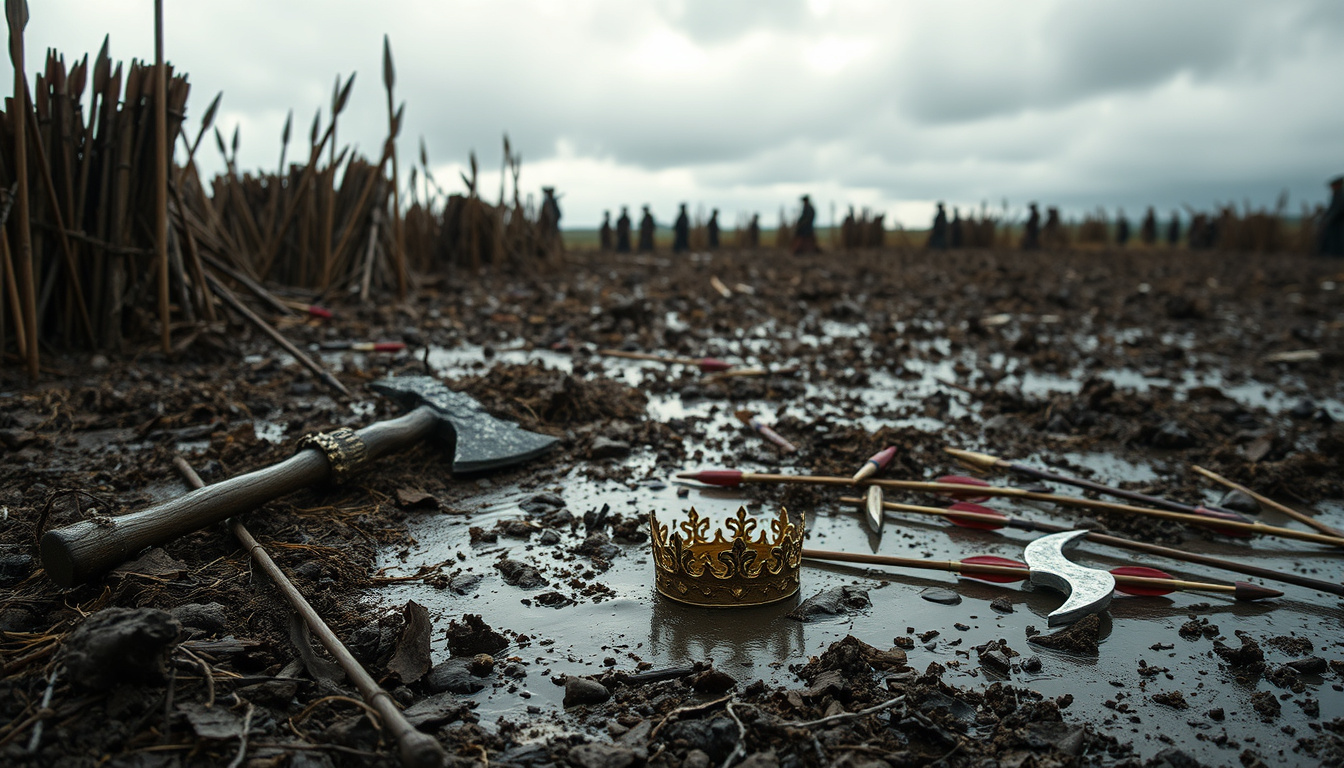
Few figures in English history meet their end in quite so many different ways as King Harold Godwinson. One chronicler says an arrow pierced his eye; another claims he was hacked down by Norman knights. This article pieces together the verifiable facts of the last crowned Anglo-Saxon king’s life, his ten-month reign, and the battle that ended it all — while separating what we actually know from the legends that have grown around his death.
Full Name: Harold Godwinson ·
Reign: 6 January 1066 – 14 October 1066 ·
Battle: Battle of Hastings ·
Death: 14 October 1066, Hastings, England ·
Predecessor: Edward the Confessor ·
Successor: William the Conqueror
Quick snapshot
- Harold Godwinson was the last crowned Anglo-Saxon king of England (Wikipedia).
- He died at the Battle of Hastings on 14 October 1066 (Britannica).
- The Bayeux Tapestry depicts his reign and death (Bayeux Museum).
- Whether Harold swore an oath to William voluntarily or under duress.
- The exact cause of his death (arrow to the eye is tradition but not proven).
- The identity of Harold’s wife: some sources list Edith Swanneck as his only wife, others mention Queen Edith (his sister) as a separate figure.
- Harold was crowned on 6 January 1066 and died on 14 October 1066 — a reign of less than ten months (English Heritage).
- He fought two major battles in 1066: Stamford Bridge (25 September) and Hastings (14 October). (English Heritage)
- His death at Hastings marked the beginning of the Norman Conquest (Britannica).
Eight key facts about Harold Godwinson, drawn from the primary sources that survive:
| Attribute | Value |
|---|---|
| Born | c. 1022/23, Wessex, England (Wikipedia) |
| Died | 14 October 1066, Hastings, England (Britannica) |
| Reign | 6 January 1066 – 14 October 1066 (English Heritage) |
| House | Godwin |
| Predecessor | Edward the Confessor (Britannica) |
| Successor | William the Conqueror (Britannica) |
| Spouse | Edith Swanneck (common-law); sister Edith (queen dowager) |
| Children | Godwin, Edmund, Magnus, Gytha, Others (Wikipedia) |
What was King Harold famous for?
Harold Godwinson is primarily remembered as the last crowned Anglo-Saxon king of England, a figure whose death at the Battle of Hastings marked the end of an era. His fame rests on three pillars: his brief reign in 1066, the dramatic battle that ended his life, and the visual legacy of the Bayeux Tapestry.
Harold’s ten months on the throne produced more historical drama than many kings managed in decades — two invasions, two battles, and a death that literally ended one chapter of English history and began another.
Coronation and reign
Harold was crowned king on 6 January 1066, the same day Edward the Confessor was buried at Westminster Abbey (English Heritage). His claim to the throne was contested immediately by William of Normandy, who argued that Edward had promised him the crown. Harold’s position was further complicated by his own earlier oath to support William’s claim — an event recorded by Norman chroniclers and depicted in the Bayeux Tapestry.
- Harold was crowned at Westminster Abbey, a location that would become the traditional coronation site for English monarchs (Britannica).
- His reign lasted less than ten months, from January to October 1066.
- He faced an immediate challenge from Harald Hardrada of Norway, who invaded the north of England in September.
Battle of Hastings
The Battle of Hastings on 14 October 1066 was the decisive engagement of the Norman Conquest. Harold’s army, exhausted after marching south from defeating Harald Hardrada at Stamford Bridge just three weeks earlier, took up a defensive position on a hilltop about 7 miles northwest of Hastings (English Heritage). William’s army, a mix of cavalry, infantry, and archers, attacked the English shield wall throughout the day.
According to the Bayeux Museum, the tapestry shows Harold wounded in the face by an arrow — the most famous depiction of his death. The Norman chronicler William of Poitiers recorded that Harold was killed late in the battle, after his shield wall was broken by feigned retreats (Wikipedia).
Death and legacy
Harold’s death at approximately age 44 ended the Anglo-Saxon line of kings. The Historical Association notes that the exact manner of his death remains controversial: later interpreters of the Bayeux Tapestry disagree on whether the figure is struck in the eye or in the face. What is certain is that his death led to the collapse of English resistance and William’s coronation on Christmas Day 1066.
Was King Harold a Viking?
No, but the question is understandable given the era. Harold Godwinson was of Anglo-Saxon descent, not Viking. His father, Godwin, was a powerful Anglo-Saxon earl, and his mother, Gytha, was of Danish nobility — but Danish is not Viking any more than Norman is Norse.
Harold’s ancestry
Harold was born around 1022/23 to Earl Godwin of Wessex and Gytha Thorkelsdóttir, whose father was a Danish nobleman (Wikipedia). While Gytha’s Danish lineage meant Harold had Scandinavian blood, this was common among the Anglo-Saxon aristocracy after centuries of Danish settlement in England. The term “Viking” refers specifically to Scandinavian raiders and traders active between the 8th and 11th centuries — not to settled landowners like the Godwin family.
- Godwin, Harold’s father, was a native English earl, not a Viking raider.
- Harold’s Danish ancestry came through his mother, a distant relation of the Danish royal family.
- Harold fought against Viking invaders at the Battle of Stamford Bridge in September 1066.
Anglo-Saxon vs. Viking identity
The Anglo-Saxon Chronicle entry for 1066 records Harold as “King of the English” — a title that placed him firmly in the English, not Viking, political tradition. By the time Harold was king, Anglo-Saxon England had been a unified kingdom for over a century, with established institutions like the Witan (the king’s council) and a written legal code.
Comparison with Viking rulers
The most useful comparison is with Harald Hardrada, the Viking king of Norway whom Harold defeated at Stamford Bridge. Hardrada was a classic Viking figure: a warrior who had served in the Varangian Guard in Constantinople and who invaded England to claim the throne. Harold Godwinson, by contrast, was a product of the English political system — an earl who rose through court politics to claim the crown.
Was King Harold related to William the Conqueror?
Yes, but distantly. Harold Godwinson and William of Normandy were linked through marriage and political alliance, not direct blood descent.
Family connections
Harold’s sister, Edith of Wessex, was married to King Edward the Confessor — who was William’s cousin through Emma of Normandy. This made Harold and William distant cousins by marriage, a relationship that became politically significant when Edward died without a direct heir.
- Edward the Confessor’s mother, Emma of Normandy, was William’s great-aunt.
- Harold’s sister Edith was Edward’s queen, making Harold the king’s brother-in-law.
- William claimed that Edward had promised him the English throne during his exile in Normandy in the 1040s.
The oath of loyalty
The most controversial episode in Harold’s relationship with William occurred in 1064, when Harold reportedly visited Normandy and swore an oath to support William’s claim to the English throne. The Norman chronicler Orderic Vitalis described the event as a solemn promise made on holy relics (Historical Association). Whether Harold swore voluntarily or under duress is unclear, but William certainly used the oath as propaganda.
The disputed succession
When Edward the Confessor died on 5 January 1066, the Witan elected Harold as king — a decision that bypassed William’s claim and Harold’s own oath. The succession crisis that followed had three parties: Harold (elected by the English nobility), William (claiming Edward’s promise and Harold’s oath), and Harald Hardrada (claiming through Danish treaties).
The pattern: Harold’s relationship with William was a tangle of family ties, political obligation, and personal ambition — the kind of dynastic knot that medieval succession crises regularly produced.
Why did William the Conqueror defeat King Harold?
The Norman victory at Hastings was not inevitable, but several factors combined to give William the advantage on 14 October 1066.
Battle of Hastings tactics
William’s army was more versatile than Harold’s. The Normans had cavalry, infantry, and archers — a combined-arms force that could adapt to changing battlefield conditions. The English army consisted primarily of infantry with axes and spears, fighting in a shield wall formation (English Heritage).
- William deployed archers in the front line, then infantry, and cavalry in reserve.
- Harold’s housecarls (professional soldiers) formed the front of the shield wall.
- The Fyrd (English militia) were less well-armored and trained.
Harold’s exhaustion after Stamford Bridge
Three weeks before Hastings, Harold had marched his army 200 miles north to defeat Harald Hardrada at the Battle of Stamford Bridge on 25 September 1066. After the battle, he received news of William’s landing in the south and force-marched his weary army back, covering 240 miles in about two weeks. The Britannica entry notes that Harold’s army arrived at Hastings exhausted and depleted.
William’s cavalry and archers
The critical tactical difference was William’s use of cavalry and archers in combination. Late in the afternoon, Norman archers fired volleys into the English shield wall from above, while Norman cavalry charged the weakened formations. The famous feigned retreats — where Norman knights pretended to flee, then turned on pursuing English soldiers — broke the discipline of the shield wall (Wikipedia).
The trade-off: Harold had the better defensive position on the hill, but William had the better army for offense. In a single-day battle, versatility beat position.
What happened to Harold Godwinson’s wife after his death?
The fate of Harold’s family after Hastings is a story of exile, survival, and historical ambiguity.
Edith Swanneck: Harold’s first wife
Harold had a common-law wife, Edith Swanneck (also called Edith the Fair). According to tradition, after the Battle of Hastings, Edith Swanneck was brought to the battlefield to identify Harold’s body — since his armor made visual identification difficult. The story, recorded in later medieval sources, claims she recognized him by marks on his body that only a lover would know.
- Edith Swanneck was never formally married to Harold under church law.
- She bore Harold several children, including Godwin, Edmund, Magnus, and Gytha.
- Her fate after 1066 is not recorded in contemporary sources.
Queen Edith: Harold’s sister
Harold’s sister, Edith of Wessex, was the widow of Edward the Confessor. She survived the Norman Conquest and lived until 1075, retaining some property and influence under William’s rule. As a key witness to the events of 1066, she is an important but often overlooked figure in the historical record.
The fate of Harold’s children
Harold’s sons fled into exile after the Norman Conquest. Two of them — Godwin and Edmund — led a failed invasion of England in 1068 with Irish support. His daughter Gytha was married to Vladimir Monomakh, Grand Prince of Kiev, connecting Harold’s bloodline to the Russian royal family (Wikipedia). Another son, Magnus, died in exile.
Why this matters: Harold’s line didn’t end at Hastings — it scattered across Europe, leaving descendants in Scandinavian and Russian nobility.
How accurate is King & Conqueror?
King & Conqueror, the 2025 TV series dramatizing the events leading to the Battle of Hastings, has generated significant interest in Harold Godwinson’s story. But how much of it is historically grounded?
Historical accuracy of the TV series
The series follows the basic arc of events that historians agree on: Harold’s rise under Edward the Confessor, his visit to Normandy and oath to William, the contested succession, and the two invasions of 1066. Britannica notes that the broad outline is consistent with the Norman and English chronicles.
- Harold’s relationship with William and the oath scene are based on historical accounts.
- The battle scenes are grounded in what is known about 11th-century warfare.
- Some characters and dialogue are invented for dramatic purposes.
Dramatization vs. recorded events
Where the series takes liberties is in the details. The timeline is compressed for narrative effect, and the personal relationships between characters are imagined. The character of Edith Swanneck, for example, is given a much larger role than the historical record supports — since very little is actually known about her.
Views of historians
Historians consulted on the series have noted that while the production values and battle sequences are impressive, viewers should be cautious about treating the drama as documentary. The Historical Association points out that the series glosses over the ambiguity in the source material — particularly the disputed nature of Harold’s oath and the uncertainty about his death.
The catch: King & Conqueror is entertainment, not education. It captures the spirit of the conflict, but the real story is messier, more ambiguous, and far less neatly scripted.
For readers who want to separate the medieval facts from modern dramatization, the primary sources — the Bayeux Museum, the English Heritage battlefield site, and the Britannica biography — offer a more complex picture than any TV drama can.
Timeline: Harold Godwinson’s life and death
- – Harold Godwinson born to Earl Godwin and Gytha (Wikipedia).
- – Harold and his father Godwin exiled after a dispute with Edward the Confessor.
- – Godwins return to power; Harold becomes Earl of East Anglia.
- – Harold visits Normandy, possibly swears an oath to support William’s claim (Historical Association).
- – Edward the Confessor dies; Harold claims the throne.
- – Harold crowned King of England (English Heritage).
- – Battle of Stamford Bridge: Harold defeats Harald Hardrada.
- – Battle of Hastings: Harold killed; William victorious (Britannica).
Clarity check: what we know and what we don’t
Confirmed facts
- Harold Godwinson was crowned king in January 1066 (Britannica).
- He died at the Battle of Hastings on 14 October 1066 (English Heritage).
- The Bayeux Tapestry depicts his reign and death (Bayeux Museum).
- His death led to the Norman Conquest of England.
- Harold was of Anglo-Saxon descent with Danish ancestry through his mother.
What’s unclear
- Whether Harold swore an oath to William voluntarily or under duress (Historical Association).
- The exact cause of his death (arrow to the eye is tradition but not proven).
- The identity of Harold’s wife: some sources list Edith Swanneck as his only wife, others mention Queen Edith (his sister) as a separate figure.
- The location of Harold’s burial (Waltham Abbey claims his remains).
- Whether Harold had legitimate heirs under church law.
Primary sources on Harold’s death
“Here King Harold is killed.”
— Inscription on the Bayeux Tapestry (Bayeux Museum)
“King Harold came against William, and he was slain.”
— The Anglo-Saxon Chronicle, entry for 1066 (Britannica)
“Harold swore on many holy relics that he would support William’s claim to the English throne.”
— Orderic Vitalis, 12th-century historian (Historical Association)
“The king fell at twilight, struck down by a chance arrow.”
— William of Poitiers, Norman chronicler (Wikipedia)
The story of King Harold Godwinson is one of the most consequential in English history — a reign that lasted less than a year but whose end reshaped the nation’s language, law, and aristocracy for centuries. For the modern reader, the challenge is not finding information, but separating the verifiable facts from the legends that have grown around them. The Bayeux Tapestry shows a king falling; the chronicles describe an oath broken and a dynasty ended. But what the sources don’t tell us — the exact moment, the precise manner, the final thoughts — remains as elusive as the battlefield at dusk on 14 October 1066. For anyone trying to understand the Norman Conquest, the lesson is clear: trust the primary sources, question the interpretations, and remember that every account was written by someone with a stake in the story.
en.wikipedia.org, nytimes.com, historiamag.com, reddit.com, youtube.com, cnn.com, youtube.com, perspektiv24.se
Frequently asked questions
How tall was King Harold?
No contemporary record of Harold’s height survives. Skeletons from the period suggest the average male height was around 5-foot-7, but Harold’s exact stature is unknown.
Did King Harold have any siblings?
Yes. Harold had several siblings, including Tostig Godwinson (who fought against him at Stamford Bridge), Queen Edith (wife of Edward the Confessor), and Gyrth and Leofwine (both killed at Hastings alongside Harold) (Wikipedia).
What is the Bayeux Tapestry?
The Bayeux Tapestry is an embroidered cloth nearly 70 meters long that depicts the events leading up to the Norman Conquest of England, including Harold’s death. It is housed at the Bayeux Museum in Normandy, France (Bayeux Museum).
How long did the Battle of Hastings last?
The Battle of Hastings was a single-day engagement on 14 October 1066, lasting from about 9 AM until dusk, approximately 10–12 hours (English Heritage).
Did Harold Godwinson have any legitimate heirs?
Harold’s children with Edith Swanneck were likely considered legitimate under Anglo-Saxon custom, but not under Norman church law. His sons Godwin and Edmund led invasions against William, while daughter Gytha married into the Russian royal family (Wikipedia).
Was King Harold buried at Waltham Abbey?
Tradition holds that Harold was buried at Waltham Abbey in Essex, a foundation he had supported as earl. However, no contemporary source confirms this, and the abbey’s claim is based on later medieval accounts (Britannica).
What happened to Harold’s children after William’s conquest?
Harold’s sons Godwin, Edmund, and Magnus fled to Ireland and then to Scandinavia. Godwin and Edmund launched a failed invasion of England in 1068. His daughter Gytha escaped to Denmark and later married Prince Vladimir Monomakh of Kiev, connecting Harold’s line to the Russian nobility (Wikipedia).

Henry William Bennett Murray is a staff writer for CivicInsight.uk, covering UK public affairs, policy and civic life. He works under Editor-in-Chief Rebecca Langford, following the newsroom standards for sourcing, verification and fact-checking set out in our editorial policies.