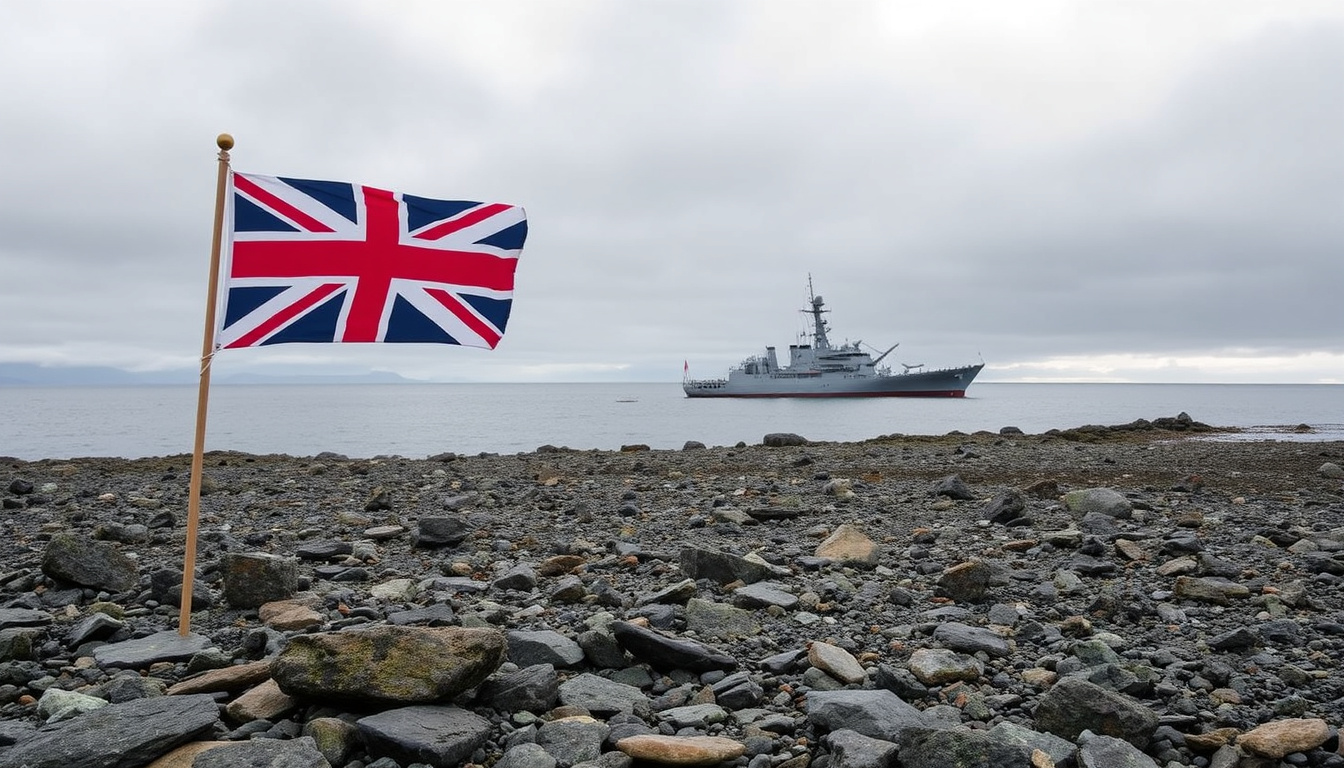
It started with a small island group most people couldn’t place on a map. By the time it ended 74 days later, the Falklands War had reshaped British politics, military doctrine, and the careers of everyone involved — including Prime Minister Margaret Thatcher, who staked her government on retaking a territory 8,000 miles away, turning a remote archipelago into the scene of one of the 20th century’s most consequential confrontations.
Start date: 2 April 1982 ·
End date: 14 June 1982 ·
Duration: 74 days ·
British fatalities: 255 ·
Argentine fatalities: 649 ·
Total casualties: 904
Quick snapshot
- Argentina invaded the Falkland Islands on 2 April 1982 (UK Parliament House of Lords Library)
- British task force sailed from Portsmouth on 5 April 1982 (The Telegraph)
- Conflict ended with Argentine surrender on 14 June 1982 (Britannica)
- Who fired the first shot of the war – some accounts differ on whether the invasion was entirely unopposed (Britannica)
- Whether the UK would have committed to war without Margaret Thatcher’s leadership – no definitive evidence exists (UK Parliament House of Lords Library)
- Exact Argentine casualty figures vary slightly across official records (Evening Standard)
- 2 April 1982: Argentine forces invade Falkland Islands (UK Parliament House of Lords Library)
- 14 June 1982: Argentine surrender; ceasefire declared (UK Parliament House of Lords Library)
- Sovereignty dispute remains unresolved; both UK and Argentina maintain claims (UK Parliament House of Lords Library)
- Falkland Islanders retain right to self-determination under British oversight (UK Parliament House of Lords Library)
Six key facts show the scale of the conflict at a glance.
| Fact | Value |
|---|---|
| Start | 2 April 1982 |
| End | 14 June 1982 |
| Location | Falkland Islands, South Georgia, South Atlantic |
| Outcome | British victory; Islands remain under British control |
| UK forces | 25,948 troops, 127 ships |
| Argentine forces | ~12,000 troops on islands |
Why did the UK start the Falklands war?
The British decision to send a task force wasn’t premeditated. It was a direct response to the Argentine invasion on , when forces under the military junta landed on the islands and captured Port Stanley (UK Parliament House of Lords Library).
- Prime Minister Margaret Thatcher’s government viewed the invasion as an act of aggression against British sovereign territory.
- The UK dispatched a naval task force within days — the first ships sailed from Portsmouth on 5 and 6 April (The Telegraph).
What triggered the British response?
The trigger was the seizure of British-administered land. The Falkland Islands had been under continuous British control since 1833, and the invasion represented the first time since World War II that British territory was taken by force. Thatcher’s cabinet deliberated over the weekend and agreed that diplomacy alone would not reverse the occupation.
What was the political context in 1982?
- Argentina was ruled by a military junta facing severe economic crisis.
- Thatcher’s own popularity was low — unemployment had hit 3 million, and her government was deeply unpopular.
- The invasion gave Thatcher a rallying point: defending national sovereignty and the principle that aggression should not pay.
Thatcher’s decision to send a task force was as much about domestic political survival as it was about a distant archipelago. The gamble paid off: after the victory, her approval ratings soared and she led the Conservatives to a landslide election win in 1983.
Thatcher’s decision to send the task force was a high-risk gamble that ultimately saved her premiership and reshaped British defence policy.
How many people died in the Falklands?
The official toll, cross-checked by multiple sources, stands at 255 British military personnel, 649 Argentine military personnel, and 3 Falkland Islanders (Royal Navy Museums). The Royal British Legion breaks down the British losses: 86 Royal Navy, 124 Army, 27 Royal Marines, 6 Merchant Navy, 4 Royal Fleet Auxiliary, and 8 Hong Kong sailors (The Royal British Legion).
How many British soldiers died?
- 255 British personnel killed (Royal Navy Museums)
- 777 wounded (Royal Navy Museums)
How many Argentine soldiers died?
- 649 Argentine personnel killed (Royal Navy Museums)
- 1,657 wounded (Royal Navy Museums)
- 11,313 taken prisoner (UK Parliament House of Lords Library)
What about civilian deaths?
Three Falkland Islanders died during the conflict: two were killed in a friendly-fire incident when the Royal Navy bombed Stanley airport, and one died when an Argentine mine exploded (The Royal British Legion).
The casualty asymmetry — 649 Argentine dead vs 255 British — shaped perceptions of the war. Argentine forces, poorly supplied and far from home, suffered heavily during bombing runs and the final land battles. The UK’s professional, volunteer military kept losses lower, but every death was a political cost Thatcher calculated carefully.
The implication: The human toll of the Falklands War continues to influence defence planning and national memory in both countries.
Why did NATO not help the UK in the Falklands war?
The North Atlantic Treaty Organization’s founding document, the North Atlantic Treaty, limits collective defence to attacks on member states in the North Atlantic area. The Falkland Islands lie in the South Atlantic, far outside that zone. As a result, NATO as an alliance had no obligation to intervene (Britannica).
Was the UK alone?
Not entirely. The United States provided vital intelligence and logistical support, including access to Ascension Island airbase. US Secretary of State Alexander Haig led a failed mediation effort between the UK and Argentina. However, the US stopped short of direct military participation.
Did the US support Britain?
- Intelligence sharing and satellite imagery (Britannica)
- Logistical support at Ascension Island (The Telegraph)
- Diplomatic backing at the United Nations (UK Parliament House of Lords Library)
NATO’s non-involvement revealed a strategic gap: European powers were exposed to threats outside the North Atlantic that their primary defence alliance would not cover. For the UK, it reinforced the need for its own expeditionary capability — a lesson that still influences British defence planning today.
The pattern: The Falklands underscored the limits of collective security and forced the UK to prioritise independent power projection.
Who fired the first shot in the Falklands war?
On , Argentine forces landed on the Falkland Islands and encountered minimal resistance. Governor Rex Hunt ordered the small Royal Marines garrison to surrender after a brief standoff. There is no clear record of the first shot fired in anger; most accounts say the invasion itself was “virtually unopposed” (UK Parliament House of Lords Library).
What was the first military engagement?
The first real combat came on when Argentine forces captured South Georgia. A small British detachment resisted briefly — that may have been the first exchange of fire. The British then regrouped: on , they recaptured South Georgia, a mission Thatcher famously called “Rejoice” (The Telegraph).
What role did the Argentine invasion play?
The invasion itself was the first shot — political and military. Argentina’s military junta believed the UK would not respond militarily. They were wrong. The British task force was already assembling within days.
The ambiguity about the first shot matters because it underscores the propaganda war: both sides later shaped the narrative to justify their actions. For Argentina, portraying the British as aggressors after the invasion helped rally domestic support.
What this means: The absence of a clear first shot fuels ongoing historical debate and reflects the contested nature of the conflict’s origins.
Who rightfully owns the Falklands?
The sovereignty of the Falkland Islands — called Islas Malvinas in Argentina — remains disputed. The UK bases its claim on continuous administration since 1833 and the principle of self-determination: the islanders have consistently voted to remain British. Argentina bases its claim on inheritance from Spain and geographic proximity (UK Parliament House of Lords Library).
What is the historical claim?
- UK: Uninterrupted possession since 1833, recognised by the islanders’ repeated referendums (99.8% voted to remain British in 2013).
- Argentina: Claims the islands were illegally seized by Britain in 1833; argues that the UN’s decolonisation committee calls for negotiations on sovereignty.
What do international law and the UN say?
The United Nations General Assembly has passed resolutions urging the UK and Argentina to negotiate. The UK maintains that the 1982 war settled nothing legally — the dispute remains open. However, under international law, self-determination is a strong principle: the islanders’ clear preference gives the UK a powerful argument (UK Parliament House of Lords Library).
The sovereignty deadlock persists because neither side can concede without domestic political damage. For the UK, handing the islands to Argentina would set a precedent for territorial revisionism. For Argentina, renouncing the claim would be politically toxic at home.
What this means: The Falklands remain a symbol of national pride and a legal quagmire, with no resolution in sight.
Why does Britain care about the Falklands so much?
Three main reasons:
- Self-determination: The islanders want to remain British, and the UK has pledged to respect their wishes.
- Strategic location: The islands sit in the South Atlantic, halfway to Antarctica, offering a valuable naval base.
- National pride: The successful recapture of the islands in 1982 became a defining moment for British identity and for Margaret Thatcher’s premiership.
What is the economic importance?
The Falklands are not a major economic asset — their population is about 3,500, and the economy relies on sheep farming and fishing. However, there are potential oil and gas reserves in the surrounding waters, adding strategic interest.
How did the war affect British national pride?
The Falklands War turned Thatcher into a war leader and revived a sense of British military prowess. More than 250,000 people turned out for the return of the task force. The conflict was later cited as a factor in the UK’s more assertive foreign policy stance throughout the 1980s (Britannica).
Thatcher’s strong response to the invasion was deeply controversial at the time — many in the UK opposed sending a task force so far. The victory didn’t just secure the islands; it reshaped British political culture, entrenching a more nationalist, assertive conservatism that lasted for years.
The catch: The war’s legacy is a double-edged sword: it boosted national pride while polarising opinion at home.
Timeline of the Falklands War
- 2 April 1982: Argentine forces invade Falkland Islands (UK Parliament House of Lords Library)
- 3 April 1982: South Georgia captured by Argentina (The Telegraph)
- 5 April 1982: British task force sails from Portsmouth (The Telegraph)
- 2 May 1982: ARA General Belgrano sunk by HMS Conqueror (UK Parliament House of Lords Library)
- 4 May 1982: HMS Sheffield sunk, 20 killed (The Telegraph)
- 21 May 1982: British landings at San Carlos Water (UK Parliament House of Lords Library)
- 25 May 1982: HMS Coventry sunk, 19 killed (The Telegraph)
- 8 June 1982: Attacks on RFA Sir Galahad and RFA Sir Tristram kill >50 (The Telegraph)
- 14 June 1982: Argentine surrender; ceasefire (UK Parliament House of Lords Library)
Confirmed facts vs what remains unclear
Confirmed facts
- Argentina invaded on 2 April 1982 (UK Parliament House of Lords Library)
- 255 British and 649 Argentine military deaths (Royal Navy Museums)
- UK won the war and retains sovereignty (UK Parliament House of Lords Library)
- NATO did not intervene because the conflict was outside its area (Britannica)
What’s unclear
- Who fired the first shot – accounts vary (Britannica)
- Whether the UK would have committed to war without Thatcher’s leadership – no definitive evidence (UK Parliament House of Lords Library)
- Exact Argentine casualty figures vary slightly across official records (Evening Standard)
Perspectives from the war
“Rejoice, rejoice!”
— Margaret Thatcher, then UK Prime Minister, after the recapture of South Georgia, 25 April 1982 (The Telegraph)
“The Malvinas belong to Argentina by right of inheritance.”
— Argentine General Leopoldo Galtieri, justifying the invasion (Britannica)
“We tried to find a diplomatic solution, but the positions were too far apart.”
— US Secretary of State Alexander Haig, on US mediation efforts (Evening Standard)
The Falklands War left a lasting mark on both countries. For the UK, it bolstered Margaret Thatcher’s government and reinforced the principle of self-determination. For Argentina, the defeat accelerated the fall of the military junta and led to a return to democracy in 1983. For the islanders themselves, life returned to normal, but the sovereignty question remains unresolved — a low-level diplomatic conflict that still plays out at the United Nations today.
For British defence planners, the lesson is clear: expeditionary capability outside NATO’s umbrella is essential. For Argentine politicians, the Malvinas remain a rallying cry, but any military solution is off the table. The ultimate consequence: a small archipelago with 3,500 residents continues to shape the foreign policy of two nations, 40 years after the shooting stopped.
en.wikipedia.org, erskine.org.uk, ssafa.org.uk, plymouthherald.co.uk, en.wikipedia.org, findmypast.co.uk
Frequently asked questions
What caused the Falklands War?
Argentina’s military junta invaded the Falkland Islands on 2 April 1982 to assert a long-standing sovereignty claim and divert attention from domestic economic problems. The UK responded by sending a naval task force to retake the islands.
How long did the Falklands War last?
The conflict lasted 74 days, from 2 April to 14 June 1982.
Who won the Falklands War?
The United Kingdom won the war. Argentine forces surrendered on 14 June 1982, and the islands remain under British control.
What was the role of the United States in the Falklands War?
The US provided intelligence, logistical support (including use of Ascension Island airbase), and diplomatic mediation but did not commit combat troops. The conflict fell outside NATO’s treaty area.
What is the current status of the Falkland Islands?
The Falkland Islands are a British Overseas Territory. The islanders have voted overwhelmingly to remain British. Argentina continues to claim sovereignty.
Did any countries support Argentina in the Falklands War?
Most Latin American countries supported Argentina diplomatically, but no nation sent military forces to fight alongside Argentina. The USSR leaned neutral.
What was the largest battle of the Falklands War?
The Battle of Goose Green (28-29 May 1982) was one of the largest land engagements, followed by the final assault on Port Stanley in June.
How were civilians affected during the Falklands War?
Three Falkland Islanders died during the war. Many civilians were evacuated or sheltered during bombing and shelling. Infrastructure, including the airport and telephone system, suffered damage.

Henry William Bennett Murray is a staff writer for CivicInsight.uk, covering UK public affairs, policy and civic life. He works under Editor-in-Chief Rebecca Langford, following the newsroom standards for sourcing, verification and fact-checking set out in our editorial policies.