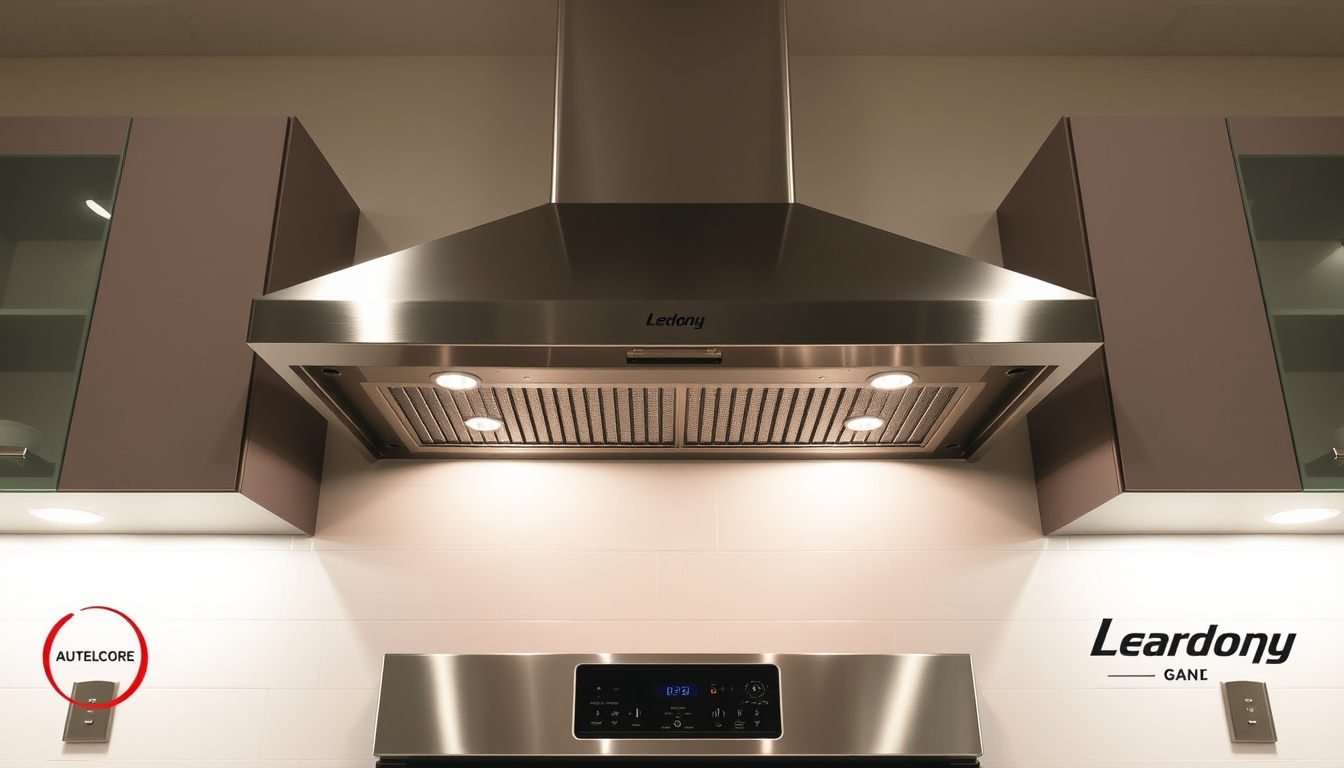
There’s a moment every home cook knows: you’re searing a steak, the kitchen fills with smoke, and you suddenly realize that little fan above the stove isn’t really keeping up. Whether you’re renovating, building new, or just replacing a tired old unit, a cooker hood is one of those appliances you don’t think about until you desperately need it.
Primary Function: Removes airborne grease, smoke, steam, and odors | Venting Options: Ducted (outside) or recirculating (carbon filter) | Installation Height Above Hob: 65-75 cm for gas, 60-70 cm for electric | Noise Level Range: 40 to 70 dB depending on model and speed
Chimney Cooker Hood
- Wall‑mounted
- Available in 60cm, 90cm widths
- High extraction power
Integrated Cooker Hood
- Built into cupboard above hob
- Discreet design
- Lower profile
Canopy Cooker Hood
- Flat panel design
- Slim and modern
- Often recirculating
Downdraft Cooker Hood
- Rises from hob surface
- Ideal for kitchen islands
- Less powerful than chimney hoods
What does a cooker hood do?
At its most basic, a cooker hood is a mechanical ventilation device that captures airborne grease, smoke, steam, and odors created while cooking. It sits above your hob and uses a fan to draw contaminated air through filters before either expelling it outside or cleaning it and recirculating it back into the room. Understanding this core function matters because it shapes every other decision you’ll make—from sizing to ducting to installation.
Core Components
- Fan motor: The heart of the system; pulls air through the filters.
- Grease filters: Usually metal mesh or baffle style; trap grease before it reaches the fan or ductwork.
- Carbon filter (recirculating models only): Activated charcoal that captures odors before air returns to the room.
- Ductwork (ducted models): Pipes that carry air from the hood to the outside of your home.
- Controls and lighting: Speed settings, sometimes heat sensors or smart features, plus work-surface illumination.
When you turn the hood on, the fan creates negative pressure that draws cooking air upward into the filter. Fisher & Paykel’s installation guide notes that the ducting must be kept as short and straight as possible to maintain maximum airflow, which hints at how sensitive the whole system is to installation quality. The efficiency of your hood depends less on raw fan power and more on how well the entire pathway—filters, ducting, and external vent—works together.
There’s a common misconception that a more expensive hood automatically means better performance. In practice, KitchenAid’s installation guidance explains that performance depends heavily on correct sizing relative to your cooktop and proper ducting configuration. A high-end hood installed poorly will underperform a modest unit installed correctly.
Do all cooker hoods need to be vented outside?
Before you even look at models, you need to answer one question: can you vent outside, or will you be recirculating the air? This single decision affects everything from installation complexity to ongoing maintenance costs.
Ducted hoods push air through pipes to the outside of your home, which is the most effective method for removing heat, moisture, and odors. Fisher & Paykel’s guide emphasizes that ducted hoods must vent outside and that the ducting diameter should never be smaller than the hood’s exhaust outlet. They also warn that flat ducting has more resistance than round ducting, which reduces airflow efficiency.
“Recirculating hoods are a viable option where ducting isn’t practical, but they’re generally considered less effective for heavy cooking.”
— KitchenAid installation guidance
Recirculating hoods, meanwhile, pass air through a charcoal filter to remove odors before releasing it back into the kitchen. These are simpler to install—no external venting required—but they don’t remove humidity, and the carbon filters need regular replacement. KitchenAid’s guidance notes that recirculating models are a viable option where ducting isn’t practical, but they’re generally considered less effective for heavy cooking.
Does a cooker hood have to be on an outside wall?
Yes, if you choose a ducted model, it must vent to the outside — typically through an exterior wall or the roof. Recirculating models can be placed anywhere because they return filtered air into the room.
Can I vent my cooker hood through the wall?
Venting through an exterior wall is the most common method. KitchenAid recommends checking for plumbing or electrical wiring behind the wall before cutting openings for ductwork — a practical reminder that installation isn’t just about the hood itself. Fisher & Paykel’s documentation also stresses checking for cables, gas pipes, and water pipes in the wall before any cutting begins.
“The ducting must be kept as short and straight as possible to maintain maximum airflow. Also check for cables, gas pipes, and water pipes before cutting.”
— Fisher & Paykel installation guide
Ducting Options Compared
Choosing between ducted and recirculating depends on your home’s construction and your cooking habits. Here’s how they stack up.
| Feature | Ducted Hood | Recirculating Hood |
|---|---|---|
| Venting method | Exhausts outside via ductwork | Releases cleaned air back into kitchen |
| Moisture removal | Yes, effective | No, limited |
| Odor removal | Excellent | Good with fresh carbon filter |
| Installation complexity | Higher; requires duct runs | Lower; no external vent needed |
| Maintenance | Grease filter cleaning only | Grease filter cleaning plus carbon filter replacement |
| Best for | Homes with exterior wall access | Apartments, condos, or homes without ducting |
Do you need an electrician to fit a cooker hood?
Installing a cooker hood isn’t a simple DIY project for most homes. It involves electrical work, potential ducting runs, and precise measurements. Before you start, it’s worth understanding what the job actually entails.
KitchenAid’s guide advises turning off power at the breaker before any removal or installation work begins — the kind of safety step that separates careful homeowners from emergency-room visits. They also note that ducting should be checked for obstructions and that all connections need to be secured to prevent leaks and noise.
Fisher & Paykel’s instructions highlight a few installation truths: the hood must be installed at the correct height above the cooking surface, the ducting path should be as straight as possible, and the ducting diameter must not be smaller than the hood’s outlet. They also warn against touching the ceiling with the hood — a clearance issue that’s often overlooked until installation day.
- Turn off power at the breaker before any electrical work.
- Check walls for plumbing, wiring, gas lines, or other obstructions before cutting.
- Measure and mark the correct height above the cooktop (typically 24–30 inches for electric, 30–36 inches for gas).
- Install ductwork for ducted models, or confirm charcoal filter placement for recirculating units.
- Secure the hood to wall brackets or cabinet framing.
- Connect electrical wiring, then test all fan speeds and lights.
The electrical connection is where most homeowners hit their limit. Hardwired hoods require a dedicated circuit and proper junction-box work — this isn’t a job for extension cords or creative wiring. KitchenAid’s documentation makes clear that electrical work on a hood should be performed by qualified personnel, which aligns with most local building codes.
Should a cooker hood touch the ceiling?
A hood that’s too small for your cooktop will struggle to capture smoke and steam. A hood that’s too large for your kitchen might look imposing and waste energy. Finding the sweet spot matters more than most shoppers realize.
The general rule is that your hood should be at least as wide as your cooktop, and ideally a bit wider if you have an island where drafts are more common. Fisher & Paykel’s installation guide specifies minimum installation heights above the cooking surface, which vary depending on whether you’re using electric or gas cooktops. Getting this height wrong doesn’t just hurt performance — it can be a safety issue if the hood gets too close to open flames.
Placement also matters. KitchenAid’s guidance notes that the hood should be centered over the cooktop and that there should be no obstructions between the hood and the cooking surface. This sounds obvious, but pendant lights, pot racks, or decorative elements can easily interfere with airflow if they’re in the wrong spot.
Height and Width Guidelines
- Width: Hood should be at least as wide as the cooktop; wider is better on islands.
- Height above electric cooktops: Typically 24–30 inches from the cooking surface.
- Height above gas cooktops: Typically 30–36 inches from the cooking surface.
- Island hoods: Often need higher CFM ratings due to open-air currents.
- Corner placement: Not recommended; airflow patterns become unpredictable.
Another overlooked detail: the hood shouldn’t touch the ceiling, according to Fisher & Paykel’s documentation. This clearance isn’t just aesthetic — it can affect airflow and make maintenance access difficult. If your kitchen has low ceilings, you may need to look for models designed for tighter clearances.
Which brand of cooker hood is the best?
If you’re shopping, you’ll see familiar appliance names alongside specialist ventilation brands. Bosch, Miele, AEG, Rangemaster, and Hotpoint are commonly cited in retail and review contexts, along with UK-focused brands like Zip and Cookology that appear in British retail listings. For premium options, Fisher & Paykel occupies the high end, and KitchenAid covers the mid-to-premium segment.
What’s notably missing from mainstream coverage is head-to-head independent comparison testing for cooker hoods. There’s no standalone independent comparison of brands in the research pack, and no coverage of alternative solutions like downdraft vents — a system that pops up from the countertop instead of hanging overhead. This gap means you’re mostly relying on manufacturer documentation and user reviews rather than third-party lab tests.
Brand Positioning at a Glance
Here’s a quick look at where the major brands sit in terms of price and reputation.
| Brand | Position | Typical Price Point | Notable Traits |
|---|---|---|---|
| Bosch | Premium German engineering | $$$ | Consistent quality, quiet motors |
| Miele | Luxury German brand | $$$$ | Excellent build, long lifespan |
| AEG | Premium European | $$$ | Design-forward, good performance |
| Rangemaster | British heritage | $$$ | Classic styling, integrated ranges |
| Hotpoint | Mid-market | $$ | Budget-friendly, widely available |
| Fisher & Paykel | Premium/design-led | $$$$ | Minimalist aesthetic, detailed manuals |
| KitchenAid | Mid-to-premium | $$$ | Strong brand, focus on durability |
The absence of independent testing means your best defense is manufacturer documentation. Fisher & Paykel’s user guide is a model of thoroughness, covering installation, cleaning, and troubleshooting in detail. KitchenAid’s guide is similarly practical. If you’re evaluating a brand, check whether their published documentation matches this level of detail — it’s often a proxy for how much engineering they put into the product itself.
Key Specs Decoded: What Those Numbers Mean
When you compare hoods, the spec sheet can feel like alphabet soup. But a few numbers actually matter for real-world performance.
Airflow is measured in cubic feet per minute (CFM), and the general rule is that you want about 100 CFM per 10,000 BTUs of gas cooktop output, or roughly 100 CFM per linear foot of electric cooktop. Noise is measured in decibels (dB), with typical hoods ranging from 40 to 70 dB depending on speed and brand. Lower is better — 70 dB is roughly the level of a vacuum cleaner, while 40 dB approaches a quiet conversation.
| Spec | Typical Range / Note |
|---|---|
| Primary function | Removes airborne grease, smoke, steam, and odors |
| Venting options | Ducted (outside) or recirculating (carbon filter) |
| Installation | Hardwired or plug-in; under-cabinet, wall-mount, or island |
| Noise level | Typically 40–70 dB depending on model and speed |
| Filter types | Metal mesh, baffle, or charcoal (for recirculating) |
| Lighting | LED or halogen work lights on most models |
| Control types | Push-button, slider, touch, or remote/smart |
| Ducting diameter | Typically 5, 6, or 7 inches depending on model |
| Cleaning method | Removable filters that can be hand-washed or dishwasher-safe |
The pattern: Two hoods with identical CFM ratings can perform very differently in practice.
Is there an alternative to a cooker hood?
While a traditional overhead cooker hood is the most common choice, there are alternatives worth considering. Downdraft extractors pop up from the hob surface, making them ideal for kitchen islands where an overhead hood would block sightlines. However, they are generally less powerful than chimney hoods. Ceiling-mounted extractors are another option for island kitchens, though they require complex ducting. Recirculating hoods themselves can be considered an alternative to ducted models when external venting isn’t possible.
Maintenance: Filters, Cleaning, and Longevity
A cooker hood is only as good as its maintenance. Grease filters clog, carbon filters saturate, and fans accumulate grime — all of which reduce performance over time. The good news is that most hoods are designed for simple, routine maintenance.
Fisher & Paykel’s guide notes that their metal grease filters are dishwasher-safe, which makes cleaning less of a chore. KitchenAid emphasizes checking filters regularly and replacing charcoal filters in recirculating models according to the manufacturer’s schedule — typically every 3 to 6 months depending on cooking frequency.
The lifespan of a hood depends heavily on usage and maintenance. A hood that’s run frequently for high-heat cooking will need more attention than one used occasionally for light simmering. KitchenAid’s guidance recommends cleaning the exterior surfaces regularly and checking that all filters are properly seated after cleaning — small details that prevent bigger problems later.
Maintenance Checklist
- Clean or replace grease filters monthly for heavy cooking, quarterly for light use.
- Replace carbon filters in recirculating models every 3–6 months.
- Wipe down the exterior and controls regularly to prevent grease buildup.
- Check the ducting annually for obstructions or leaks (ducted models).
- Listen for unusual fan noise — it might indicate a bearing issue or obstruction.
The hidden cost of recirculating hoods is that carbon filter replacements add up. Over a few years, those replacements can exceed the price difference between a recirculating and ducted model. KitchenAid’s guide suggests considering this long-term cost when choosing between venting options — advice that’s easy to overlook when you’re just looking at purchase prices.
What’s confirmed
- Cooker hoods are essential for removing cooking byproducts
- Ducted hoods are more effective than recirculating
- Installation height standards exist (65‑75 cm for gas)
What’s unclear
- Best brand is subjective and depends on individual needs
- Whether recirculating hoods are sufficient for heavy cooking
diydoctor.org.uk, homebuilding.co.uk, scribd.com, homedepot.com, airtasker.com, i-sells.co.uk, myappliances.co.uk, howdens.com, media.miele.com, media.miele.com
Frequently Asked Questions
How often should I clean the filters?
For heavy cooking, clean or replace grease filters monthly; for light use, quarterly. Carbon filters in recirculating models should be replaced every 3-6 months.
Can a cooker hood reduce condensation?
Ducted hoods help reduce condensation by removing moisture-laden air. Recirculating hoods do not remove humidity, so they won’t help with condensation.
What size cooker hood do I need for a 60cm hob?
Your hood should be at least as wide as the hob — so for a 60cm hob, look for a 60cm hood. Wider models (e.g., 90cm) provide better capture.
Are ductless cooker hoods effective?
Ductless (recirculating) hoods are effective for odor removal with a fresh carbon filter, but they don’t reduce moisture and are generally less effective for heavy cooking than ducted models.
Do cooker hoods need to be vented if they are recirculating?
No — recirculating hoods pass air through a charcoal filter and release it back into the kitchen. They do not require external venting.
How loud is a typical cooker hood?
Most hoods operate between 40 and 70 dB, similar to a vacuum cleaner at high speed. Quieter models are available but cost more.
What is the difference between a baffle filter and a mesh filter?
Baffle filters use angled metal strips to capture grease through condensation, while mesh filters use a fine metal grid. Baffle filters are generally easier to clean and maintain performance longer.
Related Reading
The bottom line: a well-chosen and properly installed cooker hood — whether ducted or recirculating — will keep your kitchen fresher and your cooking more enjoyable.

Henry William Bennett Murray is a staff writer for CivicInsight.uk, covering UK public affairs, policy and civic life. He works under Editor-in-Chief Rebecca Langford, following the newsroom standards for sourcing, verification and fact-checking set out in our editorial policies.