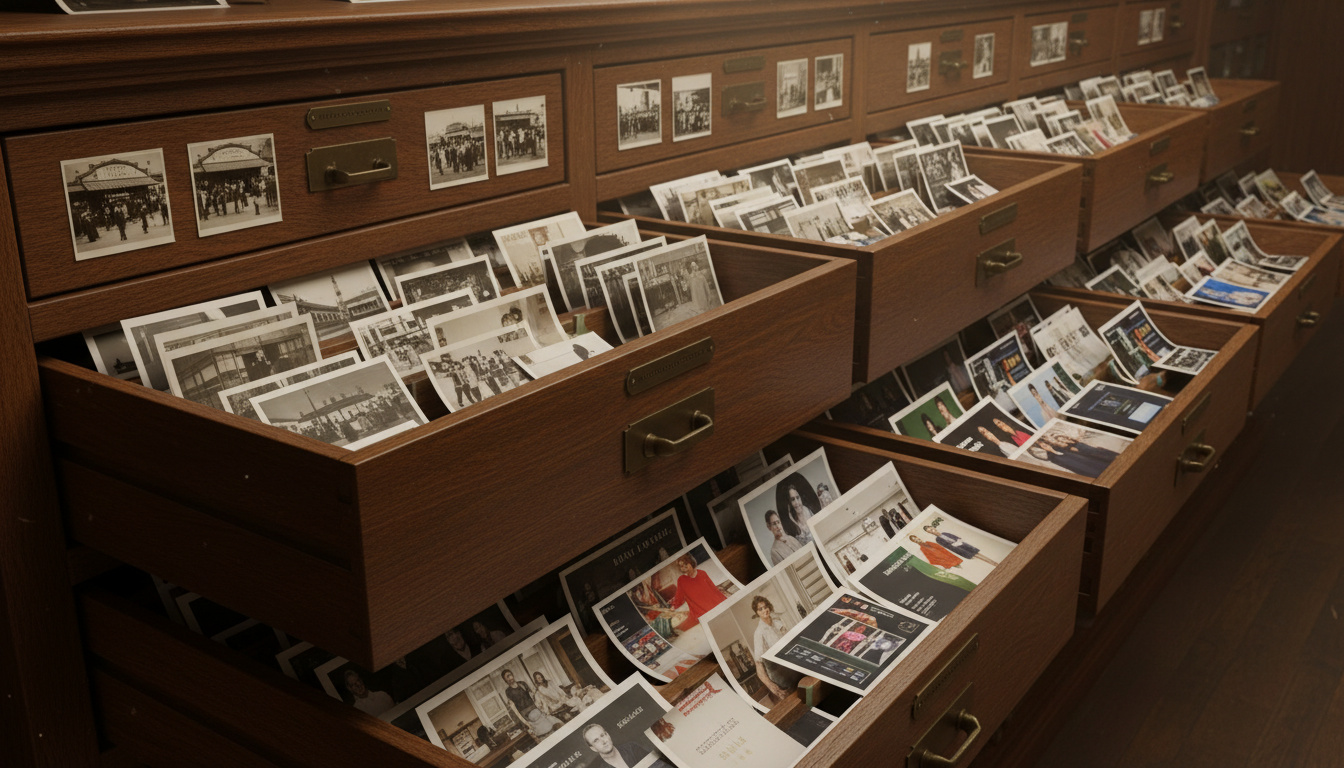
Marks & Spencer maintains one of the most comprehensive visual archives in British retail, documenting its transformation from a Leeds penny bazaar in 1884 to a global brand with over 1,400 stores. The company’s photographic legacy spans crowded Victorian market stalls, the 1930 Marble Arch flagship, wartime bomb damage, and contemporary 2024 fashion collections.
Today, researchers and enthusiasts access thousands of images through the M&S Company Archive in Leeds and corporate history portals. These collections capture textile laboratories, the introduction of packaged sandwiches in 1980, and the evolution of the St Michael brand identity that dominated mid-century clothing labels.
This guide examines the major categories of Marks & Spencer photography, from product imagery and store architecture to historical milestones and advertising campaigns, based on verified archival sources and corporate records.
Marks and Spencer Product Photos
Product Highlights
Contemporary and vintage clothing, food packaging, and home goods from 1884 to 2024 collections.
Iconic Stores
Flagship locations including Marble Arch, Oxford Street, and bomb-damaged WWII sites.
Historical Milestones
Penny bazaars, St Michael branding, and post-war reconstruction documented in archive photography.
Campaign Spotlights
Advertising photography from early press ads to 2024 sustainability and fashion imagery.
Key Insights
- The St Michael trademark, introduced in 1928, appears across vintage clothing labels, packaging, and store signage in thousands of archive photographs.
- M&S established a textile research laboratory in 1934, generating visual campaigns about fabric innovation that continue to influence product photography today.
- The retailer pioneered packaged sandwich photography in 1980, establishing the on-the-go lunch aesthetic still used in contemporary food imagery.
- Autograph womenswear, launched in 2000, shifted M&S toward premium fashion-editorial photography.
- Fiscal year 2024 reports highlight renewed investment in high-resolution Clothing & Home imagery to support digital growth.
- The Percy Pig confectionery line, introduced in the 1990s, remains one of the most frequently photographed product ranges in advertising archives.
Company Overview
| Founded | 1884 (Kirkgate Market, Leeds) |
|---|---|
| Headquarters | London, United Kingdom |
| Global Stores | 1,400+ |
| Primary Categories | Clothing, Food, Home |
| Archive Location | M&S Company Archive, Leeds |
| Key Trademark | St Michael (1928) |
| First Packaged Sandwiches | 1980 |
| FY2024 Revenue | £11.9 billion |
Marks and Spencer Store Photos
The physical evolution of Marks & Spencer appears most dramatically in its store photography. From open-air penny bazaars to the 1930 Marble Art Deco flagship, architectural documentation tracks the company’s expansion from northern England markets to nationwide retail dominance.
Flagship Locations
The Marble Arch store on Oxford Street, opened in 1930, represents the most photographed single location in M&S history. Corporate histories and press archives repeatedly feature this flagship, which established the template for modern department store design. By 1930, M&S operated over 100 stores nationwide, with distinctive frontages documented in town and city photography collections.
London stores feature prominently in wartime and post-war imagery. The Harlesden location in North London became the first M&S store destroyed by enemy bombing during WWII, generating significant photographic documentation of damage and subsequent reconstruction efforts.
Wartime Documentation
World War II created an unintended photographic record of M&S infrastructure. Archive images capture bomb-damaged locations, temporary shopfronts, and staff conducting war work. Ration-era food displays appear alongside images of scientific laboratories established in 1948 to ensure food safety standards. These photographs now serve as historical records of both retail adaptation and mid-century British urban life.
The Marble Arch flagship remains the single most documented M&S location in corporate photography, appearing in annual reports and press materials from 1930 through 2024.
Historical Marks and Spencer Photos
Historical imagery of Marks & Spencer divides into distinct eras, each with characteristic photographic styles and subjects. The M&S Company Archive in Leeds preserves these collections, including the Menswear Timeline PDF that traces fashion photography from formal early tailoring to contemporary casual wear.
Penny Bazaars and Early Markets
Photography from the 1880s through 1910s captures Michael Marks’s original penny bazaar stalls at Kirkgate Market in Leeds. These images show crowded market conditions, handwritten signage reading “Don’t ask the price, it’s a penny,” and the transition from temporary stalls to permanent shops across northern England and the North West, including early locations in Birkenhead and Manchester.
Interwar Expansion
The period between 1918 and 1939 produced structured store imagery as M&S Ltd registered in 1903 and expanded systematically. Photographs from this era show the standardization of store facades, the introduction of the St Michael brand in 1928, and the development of food departments in 1931. The 1934 establishment of textile research laboratories generated corporate imagery focused on fabric quality and innovation.
Post-War Modernisation
Post-1945 photography documents the shift toward modernist high-street architecture. Images from the 1950s and 1960s reveal new lighting systems, window-display innovations, and the expansion of ready-to-wear family clothing ranges. The introduction of chilled ready meals in the 1970s added new subjects to product photography, while the 1980s saw the emergence of luxury-style food imagery that defined the “this is not just food” advertising approach.
The M&S Archive holds extensive photographic documentation of WWII bomb damage, including the destroyed Harlesden store, alongside images of temporary wartime trading locations and ration-era food counters.
Where to Find High-Quality Marks and Spencer Photos
Authentic, high-resolution Marks & Spencer photography resides primarily in institutional collections. The M&S Company Archive in Leeds serves as the central repository for historic materials, while corporate communications provide contemporary imagery. For those interested in other archival research methods, see our guide on How to Book a Driving Test – Step-by-Step DVSA Guide.
Official Archives
The M&S Company Archive timeline provides curated access to historic photographs of stores, staff, factories, and food laboratories. This resource includes themed timelines for food, fashion, stores, and advertising, with illustrated stories covering WWI and WWII periods, post-war reconstruction, and 1960s-1990s fashion ranges. The archive also maintains the Menswear Timeline PDF, which contains historic product and model photography.
Corporate history pages on the official M&S corporate site offer restored high-quality scans from 1884 onward, including store exteriors, product packaging, and logo evolution. These materials typically appear in annual reports and investor presentations, particularly for fiscal year 2024 content featuring current collections.
Digital Access and Resolution
Vintage imagery from the 19th and early 20th centuries includes scans of penny bazaar stalls, interwar storefronts, and St Michael era visuals. Modern 2020-2024 materials emphasize high-resolution product photography for e-commerce, particularly following the 2020 Ocado joint venture that expanded online grocery imagery requirements.
High-resolution historic images from the M&S Archive are rights-controlled. Commercial use requires licensing through official channels, while many historical photographs remain restricted to educational and research purposes.
For verified high-resolution images spanning 1884 to 2024, the M&S Company Archive in Leeds and the corporate “Our History” portal provide the most authoritative sources, superseding user-uploaded content on social platforms.
Marks and Spencer Photo Timeline
- – Michael Marks opens stall at Kirkgate Market, Leeds; earliest photographic records of penny bazaars begin. Source
- – Partnership with Thomas Spencer formalizes the Marks & Spencer name; structured store imagery emerges.
- – Marks & Spencer Ltd registered; expansion from stalls to permanent shops documented in architectural photography.
- – St Michael trademark launched; appears across clothing labels, packaging, and signage in vintage photography.
- – Marble Arch flagship opens on Oxford Street, becoming the most photographed M&S location. Source
- – Food department introduced; counter displays and packaging photography expands.
- – Textile research laboratory established; corporate imagery emphasizes fabric innovation.
- – WWII bomb damage documented, including the destroyed Harlesden store in North London. Source
- – Food laboratories established; scientific imagery supports quality communications.
- – First packaged sandwiches sold; product photography defines convenience food aesthetic. Source
- – Autograph womenswear introduced; fashion-editorial photography style adopted.
- – Plan A sustainability programme launches; imagery includes farmers, supply chains, and eco-initiatives.
- – FY2024 reports £11.9bn revenue; corporate materials feature refreshed 2024 collection photography.
What We Know vs. What Remains Unclear
Established Information
- The M&S Company Archive in Leeds holds the definitive collection of historic photographs from 1884 onward.
- The St Michael trademark appeared in 1928 and dominates clothing imagery through the mid-20th century.
- Marble Arch (1930) is the most documented flagship location.
- FY2024 corporate reports include verified high-resolution imagery of current collections.
- WWII bomb damage to specific stores (including Harlesden) is photographically documented.
Information That Remains Unclear
- Specific photographer credits for many vintage images in the archive are not publicly catalogued.
- Exact resolution specifications for certain historical digitization projects remain unspecified in public sources.
- The complete inventory of lost or damaged photographic materials from WWII bombings is not fully enumerated.
- Specific licensing terms for individual archive images require direct inquiry with M&S corporate communications.
The Visual Evolution of British Retail
Marks & Spencer’s photographic history mirrors broader changes in British commerce and society. Early images of penny bazaars capture a pre-supermarket economy where goods sold from open stalls. The transition to permanent stores in the early 1900s, documented in archive timelines, reflects the formalization of high-street retail.
The introduction of the St Michael brand in 1928 established a visual identity that persisted for decades, appearing on millions of clothing labels and packaging designs. Post-war photography shows the shift toward modernist consumer culture, while 1980s food imagery helped invent the visual language of convenience dining. Contemporary 2024 photography emphasizes sustainability credentials and premium positioning, reflecting current consumer priorities.
This visual archive serves not only as corporate history but as a record of changing British dress, diet, and domestic life across fourteen decades.
Sources and Documentation
“From a penny bazaar in Leeds to a global brand, our history is built on trust, quality, and innovation.”
— M&S Corporate History Archives
“The M&S Archive holds thousands of photographs documenting our stores, staff, and products from 1884 to the present day.”
— M&S Company Archive, Leeds
Summary
Marks & Spencer’s photographic legacy spans from 1884 penny bazaars to 2024 high-resolution campaign imagery, housed primarily in the Leeds-based Company Archive and corporate history portals. Key visual milestones include the 1928 St Michael branding, the 1930 Marble Arch flagship, 1980s convenience food photography, and contemporary sustainability imagery. Researchers seeking authoritative sources should consult the official M&S Archive timelines and corporate “Our History” sections for verified high-resolution materials. For those interested in other archival research methods, see our guide on How to Book a Driving Test – Step-by-Step DVSA Guide.
Frequently Asked Questions
Can I use Marks and Spencer photos commercially?
Commercial use requires licensing through M&S corporate communications or the Company Archive. Many historical images are rights-controlled and restricted to educational purposes, while contemporary product photography is protected by trademark and copyright law.
What is the oldest Marks and Spencer photograph?
The earliest photographic records date to 1884, documenting Michael Marks’s original penny bazaar stall at Kirkgate Market in Leeds. These images appear in the M&S Company Archive and corporate history materials.
How has M&S food photography changed since 1980?
Since introducing packaged sandwiches in 1980, M&S food photography evolved from simple product shots to premium close-up textures emphasizing quality ingredients. The 1990s Percy Pig launch and recent “this is not just food” campaigns reflect increasingly sophisticated studio lighting and styling.
Where are the original M&S photo negatives stored?
The M&S Company Archive in Leeds holds the primary collection of historic photographs, negatives, and advertising materials. Corporate communications departments maintain contemporary digital image libraries for current campaigns.
Does M&S have photos of bomb-damaged stores from WWII?
Yes, the archive contains verified photographs of WWII damage, including the Harlesden store destroyed in 1940, alongside images of temporary wartime shopfronts and ration-era food displays.
How can I access high-resolution M&S logo images?
High-resolution logo images and visual identity materials are available through the corporate “Our History” portal and the M&S Archive timeline, documenting the evolution from early wordmarks through the St Michael era to modern lockups.
Are there photos of the original 1884 Leeds market stall?
Yes, the Kirkgate Market stall appears in early photographic records from 1884, showing the crowded market conditions and distinctive “Admission Free” signage that characterized the penny bazaar era.

Oliver Hayes is a staff writer for CivicInsight.uk, reporting on news, local government and public services. His work is reviewed by the editorial desk and checked against our sourcing and fact-checking standards before publication.