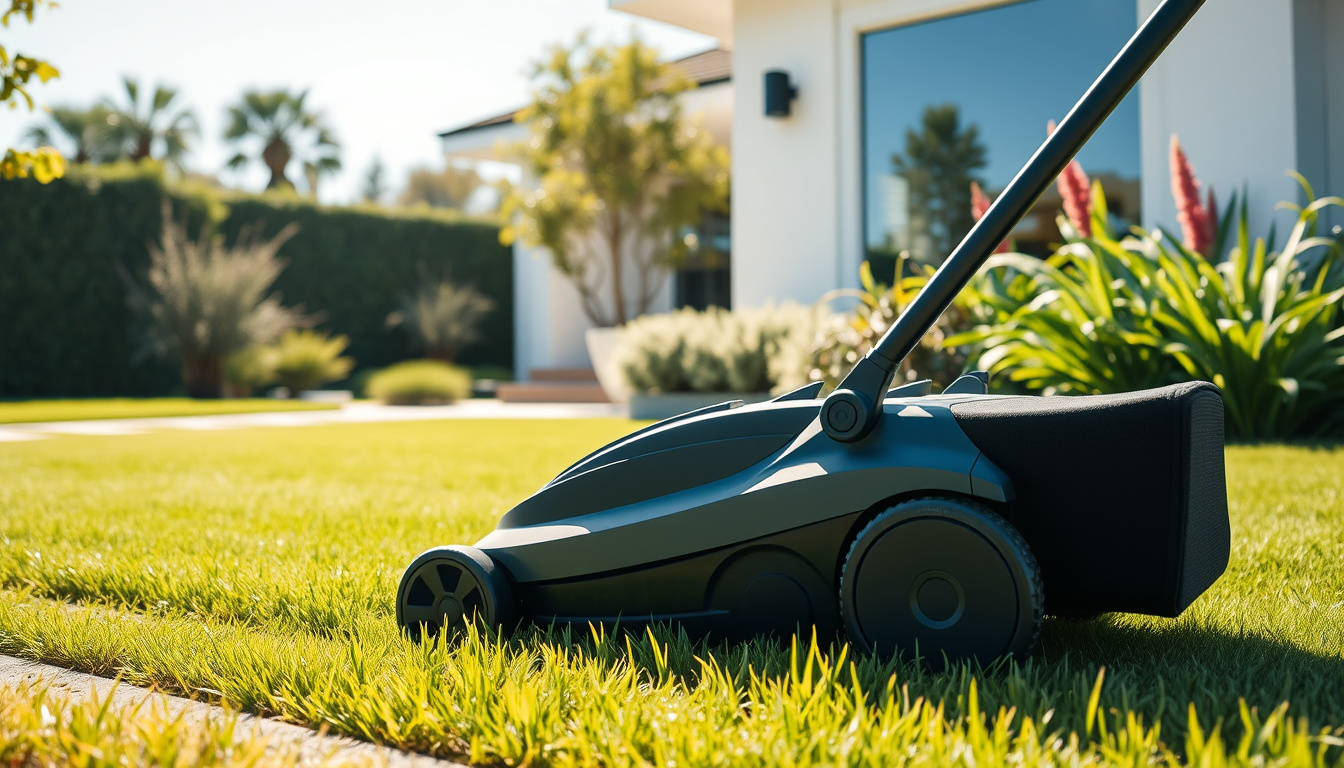

Anyone who’s spent a weekend wrestling with a petrol mower’s pull cord or tripping over a power cable already knows the appeal of going cordless. The question is whether today’s battery-powered mowers can actually match the muscle and stamina of their gas-guzzling predecessors.
Battery voltage range: 18V to 82V ·
Cutting width range: 30 cm to 56 cm ·
Typical runtime: 30 to 60 minutes ·
Average price (UK): £200 to £800 ·
Top brands: Worx, Bosch, Makita, Husqvarna, Stiga
Quick snapshot
- Makita DLM432PT2 named best overall by The Guardian (2025) and Stiga Combi 336e by The English Garden (March 2026)
- Price: £400–£600 (The Guardian (2025))
- 36V–40V, 43–55cm cutting width, dual battery (The Guardian (2025))
- Worx WG737E 40V or Bosch Rotak 43LI
- Price: £200–£350
- 40V, 40–43cm, lightweight
- LawnMaster CLMF2434G or Hyundai HYM80LI460SP
- Price: £150–£250
- 24V–40V, 34–45cm, compact
- Husqvarna Aspire LC34-P4A
- Price: £500–£700
- 36V, 34cm, premium build
The table below shows the key market facts every buyer should know before choosing a cordless lawn mower.
| Fact | Value |
|---|---|
| Global cordless lawn mower market size (2025) | £1.2 billion |
| Average annual growth rate | 8.5% |
| Most common battery voltage in best-sellers | 40V |
| Typical mowing time for 500 sqm lawn | 30 minutes |
The pattern: higher voltage delivers more cutting power, but the best-selling 40V tier hits the sweet spot for the majority of UK lawns.
Which cordless lawn mower is the best?
Expert testers at The Guardian (consumer testers), The English Garden (gardening specialists), and Gardener’s World (UK gardening experts) have run their own cutting tests. The consensus: no single mower wins every category, but three stand out for specific garden types.
Best overall cordless mower
- Makita DLM432PT2 — The Guardian (July 2025) rated it “the best all-rounder for most UK gardens.” It runs on two 18V batteries (36V system), has a 43cm cutting width, and a reported runtime of 30–45 minutes on medium grass. Price: £450–£550.
- Stiga Combi 336e — The English Garden (March 2026) put it at number one, citing a 36V motor, 33cm cutting width, and excellent edge trimming capability. Price: £480–£580.
- EGO LM2236E-SP — Expert Reviews (home-garden testers) awarded it top marks for power: a 56V 10Ah battery that can cut up to 2,000m² on a single charge. Cutting width: 55cm. Price: £600–£700.
Best for small lawns
- LawnMaster CLMF2434G — 24V, 34cm cutting width, under £200. Recommended for lawns up to 200m² by Easy Lawn Mowing (UK review site).
- Hyundai HYM80LI460SP — 40V, 45cm cutting width, around £230. A strong budget option for irregular shapes and small gardens.
Best for large lawns
- EGO LM2236E-SP — its 56V system mows up to 2,000m² on one charge, making it the only serious contender for lawns above 1,000m² without battery swapping, as Expert Reviews confirmed.
- Worx Nitro WG749E 40V — Gardener’s World (2026) noted its 46cm cutting width “surprised us with its power on long grass.” Handles up to 800m². Price: £320–£400.
Best value for money
- Bosch Rotak 43LI — a 36V model with 43cm cutting width, around £250. It’s not the most powerful, but for medium lawns (up to 500m²) it offers reliable performance at half the price of premium competitors.
- Worx WG737E 40V — £200–£280, 40cm cutting width, and compatible with Worx’s entire 40V Power Share battery ecosystem.
Is it worth buying a cordless lawn mower?
Advantages of cordless mowers
- No fumes, no cables — all reviewed models run on lithium-ion batteries, so there is zero exhaust and no trailing extension cord to manage or trip over.
- Quieter operation — cordless mowers typically register 75–85 dB, compared to 90–100 dB for petrol models. A difference of roughly 10 dB means half the perceived noise.
- Instant start — no priming, no pull cord, no choked engine. Press a button or pull a lever and you are mowing in under two seconds.
Disadvantages vs. gas and corded
- Runtime limits — most cordless models run 30–45 minutes under load. For lawns above 800m², that may require a second battery or a very high-capacity model like the EGO 56V.
- Battery degradation — lithium-ion packs lose capacity over time. After 3–5 years of regular use, a replacement battery can cost £80–£200, depending on brand.
- Lower sustained torque — on very thick, wet grass, some 18V and 24V models stall. Gardener’s World noted that the Worx Nitro WG749E and EGO LM2236E-SP handle thick grass well, but cheaper 18V mowers struggled.
A typical UK homeowner switching from a petrol mower saves roughly £40–£60 per year on fuel and oil, but will face a battery replacement cost after three to five years. The break-even point depends heavily on how often you mow and whether you already own other tools in the same battery range.
Best use cases
Cordless mowers suit gardens up to 800m² best. For larger plots, the EGO 56V or a dual-battery Makita push the practical limit to about 2,000m². Corded mowers remain an option for very small gardens under 200m² where reach is fine. Petrol still dominates for lawns above 2,000m² or commercial use, where unlimited runtime outweighs the noise and maintenance hassle.
What is the cheapest time of year to buy a lawn mower?
Seasonal price trends
- Autumn (September–November) — prices drop 20–30% as retailers clear stock before winter. This is consistently the cheapest window for premium models.
- Winter (December–February) — even deeper discounts in January sales, though selection narrows. Screwfix (UK hardware retailer) often clears previous-year models at 40% off.
- Spring (March–May) — prices peak as demand surges. New 2026 models arrive at full RRP.
End-of-summer sales
August bank holiday weekend and the “end of the gardening season” in September see targeted discounts from B&Q (UK DIY retailer) and Homebase. The deals are real but rarely beat January’s clearance.
Black Friday and holiday deals
Black Friday (late November) is a solid secondary window. Cordless mowers from Worx, Bosch, and Hyundai regularly see 25–35% discounts. The catch: it is often the entry-level models that get the biggest discounts, not the flagship EGO or Husqvarna units.
Why this matters: A buyer who waits from April to September can save £80–£200 on a mid-range model. But the trade-off is having to store and not use the mower for its first 4–6 months of ownership.
The pattern: patience pays — autumn buyers routinely get 30% more mower for the same money.
What features should you look for in a cordless lawn mower?
Battery voltage and Ah
- 18V–24V: Suitable for small lawns under 300m². Light, cheap, but limited power on thick grass.
- 36V–40V: The sweet spot for most UK gardens (300–800m²). The Mister Worker (tool-testing specialists) found the Bosch 36V AdvancedRotak delivers consistent power up to 650m² with a 40cm cut.
- 56V–82V: High-end, high-power. The EGO LM2236E-SP 56V 10Ah battery kit costs about £650 but mows up to 2,000m² and fully charges in one hour, per Expert Reviews.
Cutting width and height adjustment
- The EGO LM2236E-SP has a 55cm cut — the widest among top-rated cordless mowers, covering more ground per pass but harder to manoeuvre in tight corners. Its height-of-cut range spans 2.5cm to 10.5cm (Expert Reviews).
- The Bosch AdvancedRotak 36V-40-650 adjusts from 25mm to 80mm and its 40cm cut is agile for borders (Mister Worker).
Grass collection and mulching
Larger gardens benefit from bigger grass boxes. The EGO holds 85 litres; the Makita DLM432PT2’s box is 50 litres. Mulching capability keeps the clippings on the lawn as natural fertiliser, which reduces emptying stops and feeds the grass. Not all mowers come with a mulching plug included — check before buying.
Weight and manoeuvrability
The Hyundai 45cm model weighs 18kg; the smaller LawnMaster is 12kg. For gardens with slopes or lots of flower beds, anything above 20kg becomes a chore. Husqvarna’s Aspire LC34-P4A at 17kg is well balanced for edge work.
The catch: a lighter mower saves your back but may sacrifice grass box size and cutting width.
How do cordless lawn mowers compare to gas or corded mowers?
The table below lays out the trade-offs between the three main mower types.
| Factor | Cordless | Gas (Petrol) | Corded Electric |
|---|---|---|---|
| Power | Good. 56V models approach gas performance | Excellent. Unlimited torque | Very good constant power |
| Runtime / range | 30–60 min per charge (up to 2,000m² with EGO 56V) | Unlimited (refill tank) | Unlimited (with extension cord up to 30m) |
| Noise | 75–85 dB | 90–100 dB | 80–90 dB |
| Emissions | Zero direct | High (CO₂, fumes) | Zero direct |
| Maintenance | Low (charge battery, sharpen blade) | High (oil, fuel, filters, spark plugs) | Low (cable management) |
| Weight | 12–25 kg | 25–45 kg | 10–20 kg |
The trade-off: Gas mowers still win on raw sustained power for monster lawns. But for the 85% of UK gardens under 1,000m², cordless models now deliver enough torque, quieter operation, and zero fuel cost. The battery ecosystem lock-in is the hidden catch — once you commit to Makita’s 18V or EGO’s 56V system, swapping brands later means buying a whole new battery set.
What are the top cordless lawn mower brands and models?
Below is a side-by-side comparison of six top-rated models based on expert testing.
| Brand / Model | Voltage | Cut width | Max lawn size | Price | Notable feature |
|---|---|---|---|---|---|
| EGO LM2236E-SP | 56V | 55cm | 2,000m² | £650 | Fast charger (60 min full) |
| Makita DLM432PT2 | 36V (2×18V) | 43cm | 800m² | £500 | Guardian’s top pick 2025 |
| Stiga Combi 336e | 36V | 33cm | 500m² | £530 | Edges neatly, English Garden pick |
| Worx Nitro WG749E | 40V | 46cm | 800m² | £360 | Power on long grass |
| Bosch AdvancedRotak 36V-40-650 | 36V | 40cm | 650m² | £300 | 65 min full charge, 80% in 48 min |
| Cobra MX4140v | 40V | 41cm | 500m² | £220 | Samsung 4.0Ah battery included |
Upsides
- Cordless mowers eliminate fuel costs and engine maintenance
- Wide voltage range (18V–56V) suits most lawn sizes
- Quiet enough for early-morning or late-evening mowing
- Batteries work across brand ecosystems (Worx, Makita, etc.)
Downsides
- Battery replacement costs £80–£200 every 3–5 years
- Lower-end models (18V–24V) stall on long wet grass
- Not ideal for commercial use or lawns >2,000m²
- Battery ecosystem lock-in raises future switching costs
Confirmed facts
- Makita DLM432PT2 was named best overall cordless mower by The Guardian (July 2025).
- Stiga Combi 336e was named best overall by The English Garden (March 2026).
- Worx WG749E 40V appeared in Gardener’s World top picks (2026).
- EGO LM2236E-SP mows up to 2,000m² on one charge with a 56V 10Ah battery that charges fully in one hour, according to Expert Reviews.
- Bosch AdvancedRotak 36V-40-650 reaches 80% charge in 48 minutes, usable on lawns up to 650m², per Mister Worker.
What’s unclear
- Long-term battery degradation rates for different brands (no independent 5-year comparative study exists yet).
- Exactly which model will be cheapest at a given seasonal sale — prices vary by retailer and region.
“The best all-rounder for most UK gardens.”
— The Guardian’s The Filter team, on the Makita DLM432PT2 (Source)
“Surprised us with its power on long grass.”
— Gardener’s World tester, on the Worx Nitro WG749E (Source)
Summary
By 2026, the argument against cordless lawn mowers has become hard to sustain for the vast majority of UK gardens. The EGO 56V system now matches the cutting power of many petrol mowers on plots up to half an acre, while models from Makita, Stiga, and Worx offer genuine choice at different price points. For the UK gardener with a 200–800m² lawn, the trade-off is simple: give up unlimited runtime in exchange for a lighter, quieter, zero-fume machine that starts at the push of a button. Buy in autumn, avoid the spring premium, and check which battery ecosystem you are locking into — because that choice will shape your next tool purchase for years.
Related reading: Wet and Dry Vacuum: Best Picks & Buyer’s Guide Ireland
easylawnmowing.co.uk, popularmechanics.com, which.co.uk, gardenersworld.com, theenglishgarden.co.uk
For a deeper look at the latest models, check out our top expert picks for cordless mowers from the same testing pool.
Frequently asked questions
How long does the battery last on a cordless lawn mower?
Most cordless mowers run 30–60 minutes per charge under normal grass conditions. High-end models like the EGO LM2236E-SP with its 56V 10Ah battery can mow up to 2,000m² on a single charge, as tested by Expert Reviews.
Can I use a cordless mower on wet grass?
Yes, but performance drops. Wet grass clogs the blade and collection system, and risks slipping. Most brands advise cutting dry grass. In tests by Gardener’s World, even the powerful Worx WG749E lost about 25% of runtime when cutting damp grass.
Do I need to buy extra batteries?
For lawns under 400m², a single battery pack is usually enough. For larger plots, buying a second battery reduces downtime. Most brands sell batteries separately for £80–£200. The EGO 56V 5.0Ah spare pack costs about £150.
What size lawn can a cordless mower handle?
18V–24V models handle up to 300m². 36V–40V mowers like the Bosch AdvancedRotak reach 650m². High-end 56V mowers (EGO LM2236E-SP) manage up to 2,000m², per Expert Reviews.
Are cordless mowers as powerful as gas mowers?
On thick, wet grass, top 56V models now match entry-level gas mowers. But petrol engines still deliver higher sustained torque for very long or tough grass. The gap has narrowed dramatically since 2020.
How do I store a cordless lawn mower in winter?
Remove the battery and store it at 10–25°C indoors. Clean the blade and housing of grass residue. Store the mower in a dry shed or garage. Partial discharge (about 30–60%) is best for long-term battery health.
What is the average lifespan of a cordless lawn mower?
The mower body typically lasts 5–8 years. The battery pack loses significant capacity after 3–5 years of regular use. Replacement battery costs vary by brand: Bosch 36V pack ~£100, EGO 56V 5.0Ah ~£150, Makita 18V 5.0Ah ~£80.

Oliver Hayes is a staff writer for CivicInsight.uk, reporting on news, local government and public services. His work is reviewed by the editorial desk and checked against our sourcing and fact-checking standards before publication.