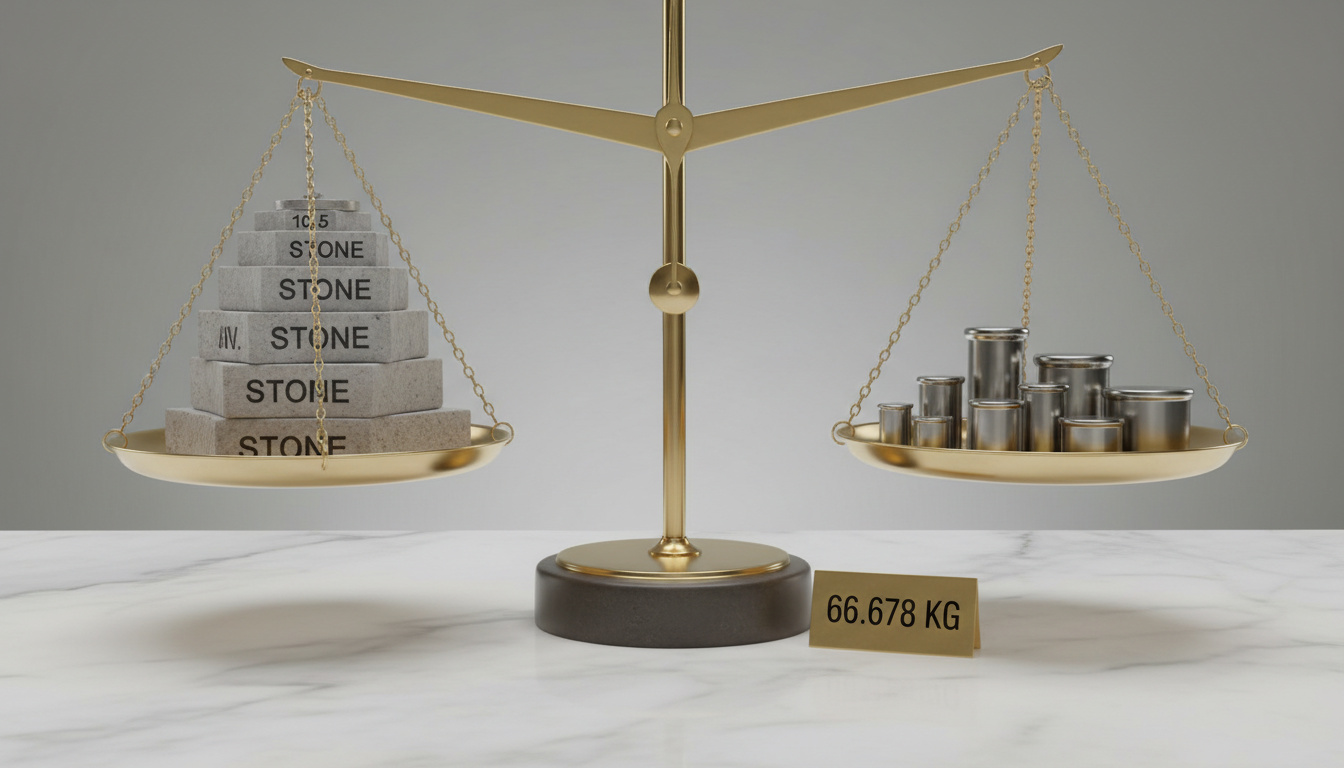
Ten and a half stone converts to exactly 66.678 kilograms when using the standard international conversion factor. This unit, still widely used for body weight across the United Kingdom and Ireland, sits at the intersection of imperial tradition and metric precision.
While metric measurements dominate medical and scientific contexts, the stone remains embedded in everyday British conversation. Understanding the precise relationship between these systems clarifies everything from grocery labels to BMI calculations.
Exact conversion methodology, legal standards underpinning the calculations, and practical health context follow below.
What is 10.5 Stone in Kg?
The conversion relies on the internationally agreed definition of the avoirdupois pound. CalculateMe.com confirms that 10.5 stone equals precisely 66.678078 kilograms when applying the full conversion factor of 6.35029318 kilograms per stone. Mathematical verification supports this calculation through independent formula application.
- Precise multiplier: Multiply any stone value by 6.35029318 for exact kilograms
- Common rounding: Medical contexts often record 10.5 stone as 66.7 kg or 67 kg
- BMI relevance: Accurate conversion critical for body mass index calculations
- Pound bridge: 10.5 stone equals exactly 147 pounds (10 stone + 7 pounds)
- Standard stability: The conversion factor has remained fixed since the 1959 international agreement
- Decimal precision: Scientific contexts retain full 6.35029318 factor; daily use simplifies to 6.35
| Stone | Kilograms | Pounds |
|---|---|---|
| 8.0 st | 50.802 kg | 112 lb |
| 9.0 st | 57.153 kg | 126 lb |
| 10.0 st | 63.503 kg | 140 lb |
| 10.5 st | 66.678 kg | 147 lb |
| 11.0 st | 69.853 kg | 154 lb |
| 12.0 st | 76.204 kg | 168 lb |
| 13.0 st | 82.554 kg | 182 lb |
| 14.0 st | 88.904 kg | 196 lb |
How Many Kg is 1 Stone? (Formula Explained)
Standard Conversion Factor
One stone equals exactly 6.35029318 kilograms. Metric-Conversions.org verifies this derives from the definition of one stone as fourteen avoirdupois pounds, with each pound defined as exactly 0.45359237 kilograms under the 1959 international agreement.
Step-by-Step Calculation
To convert 10.5 stone manually, multiply the stone value by the conversion factor. First, recognize that 10.5 stone represents ten stone plus seven pounds (since 0.5 stone equals half of fourteen pounds).
The calculation proceeds: 10.5 × 6.35029318 = 66.678078 kilograms. This yields 66.678 kilograms when rounded to three decimal places.
For medical records requiring exact body mass, use the full factor 6.35029318. For everyday conversation, 6.35 suffices, yielding 66.7 kg for 10.5 stone.
Stone to Kg Conversion Chart
8-12 Stone Range
Reference tables provide quick lookup values for common body weights. The Calculator Site publishes comprehensive charts showing incremental conversions between imperial and metric units.
| Stones & Pounds | Pounds Only | Kilograms |
|---|---|---|
| 8 st 0 lb | 112 lb | 50.80 kg |
| 9 st 0 lb | 126 lb | 57.15 kg |
| 10 st 0 lb | 140 lb | 63.50 kg |
| 10 st 7 lb | 147 lb | 66.68 kg |
| 11 st 0 lb | 154 lb | 69.85 kg |
| 12 st 0 lb | 168 lb | 76.20 kg |
Pounds Equivalents
Each stone comprises exactly fourteen pounds. Therefore, 10.5 stone equals 147 pounds (140 pounds for the full ten stone, plus seven pounds for the half stone). This equivalence allows conversion to kilograms through either the stone-to-kg factor or the pound-to-kg factor of 0.45359237.
What is a Stone? Unit Background
Origin and Usage
The stone emerged as a standardized unit in fourteenth-century England, originally representing the approximate weight of an actual stone. Historical records indicate standardization to fourteen pounds occurred primarily for wool trade purposes, creating a consistent measure for commodity exchange.
Modern Contexts (UK Weights)
Despite metrication efforts beginning in 1965, the stone persists in British and Irish culture specifically for human body weight. Medical practitioners in these regions typically record patient weights in both stones and kilograms, ensuring clarity across generational and professional divides. The British Heart Foundation Collection includes historical documentation of weight measurement standards used in cardiovascular health screenings throughout the metrication transition period.
The UK’s Weights and Measures Act 1985 legally defines one stone as exactly fourteen pounds, preserving its status for trade and commerce despite the metric system’s dominance in scientific contexts.
Is 10.5 Stone a Healthy Weight?
BMI Context by Height
Whether 10.5 stone constitutes a healthy weight depends entirely on stature. At 66.7 kilograms, this weight produces a BMI of approximately 23.1 for an adult standing 1.70 metres tall, which falls within the healthy range of 18.5 to 24.9. NHS conversion charts facilitate these calculations by providing stone-to-kilogram reference points for clinical use.
Comparisons
For a taller individual of 1.80 metres, 10.5 stone yields a BMI near 20.6, toward the lower end of healthy. Conversely, at 1.60 metres, the same weight produces a BMI of roughly 26.0, classified as overweight. These variations demonstrate why absolute stone measurements require height context for health assessment.
BMI calculations serve as screening tools, not diagnostic instruments. Individual health status requires assessment by qualified medical professionals considering factors beyond weight and height.
General wellness extends beyond scale readings. Readers experiencing digestive discomfort might consult guidance on How to Relieve Trapped Wind, as overall comfort contributes to accurate health monitoring.
History and Standardization Timeline
- : Stone standardized to fourteen pounds in England for wool trade regulation
- : UK Weights and Measures Act codifies the fourteen-pound stone for legal trade
- : International agreement defines pound as exactly 0.45359237 kilograms, establishing precise stone-to-kg relationship
- : UK metrication begins, though stones remain exempt from mandatory conversion for body weight
- : Weights and Measures Act reaffirms stone’s legal status as fourteen pounds exactly
Exact vs. Rounded: What We Know for Certain
Established Facts
- 10.5 stone equals exactly 66.678078 kilograms
- Conversion factor 6.35029318 kg per stone is internationally standardized
- One stone equals exactly fourteen avoirdupois pounds
- One pound equals exactly 0.45359237 kilograms
Practical Variations
- Medical scales may round to nearest 0.1 kg or whole kilogram
- Digital converters vary in decimal display (2-6 places)
- Historical records show regional stone variations pre-1835 (not applicable post-standardization)
Where Does the Stone Unit Come From?
The stone represents one of humanity’s oldest standardized weights, originally based on literal stones used as counterbalances in commerce. By the medieval period, English merchants required consistent measures for wool and agricultural products, leading to the fourteen-pound standardization that persists today.
Unlike the pound or kilogram, the stone saw limited international adoption, remaining largely confined to the British Isles. This geographic specificity explains its absence from American customary systems and its gradual retreat from formal scientific usage, even as it dominates casual British conversation about personal weight.
Omni Calculator provides additional context on regional usage patterns, noting that Ireland shares the UK’s preference for stones in body weight discussion despite both nations’ official metric status.
Official Sources and Legal Definitions
“The stone shall be a unit of measurement of mass equal to fourteen pounds.”
— UK Weights and Measures Act 1985
“The international pound shall be exactly 0.45359237 kilogram.”
— International Agreement on the Pound, 1959 (referenced in NIST standards)
These legal instruments provide the foundation for all modern conversions. The 1959 agreement established the precise kilogram value of the pound, while the 1985 Act preserved the stone’s definition for UK domestic use.
Summary
Ten and a half stone converts precisely to 66.678 kilograms using the standardized factor of 6.35029318. This conversion, rooted in the 1959 international pound definition and preserved under UK law, bridges imperial tradition with metric precision. Whether for medical records, fitness tracking, or everyday conversation, understanding this relationship ensures accurate communication across measurement systems. For those exploring related health topics, the British Heart Foundation Collection offers additional resources on cardiovascular wellness and weight management.
Frequently Asked Questions
How many kilograms are in one stone exactly?
One stone equals exactly 6.35029318 kilograms, derived from fourteen pounds at 0.45359237 kg per pound.
How many pounds equal 10.5 stone?
Ten and a half stone equals exactly 147 pounds (140 pounds for ten stone plus seven pounds for the half stone).
Is the stone used outside the UK?
The stone sees regular use in Ireland and limited use in Australia and New Zealand, though it remains largely confined to the British Isles for body weight measurement.
Why does the UK still use stones?
Despite metrication beginning in 1965, stones received exemption for body weight measurements due to cultural embeddedness and public familiarity.
How do I convert stone to kg without a calculator?
Multiply the stone value by 6.35 for a close estimate, or use 6.35029318 for precision. For 10.5 stone, 10 × 6.35 = 63.5, plus 0.5 × 6.35 = 3.175, totaling approximately 66.7 kg.

Henry William Bennett Murray is a staff writer for CivicInsight.uk, covering UK public affairs, policy and civic life. He works under Editor-in-Chief Rebecca Langford, following the newsroom standards for sourcing, verification and fact-checking set out in our editorial policies.