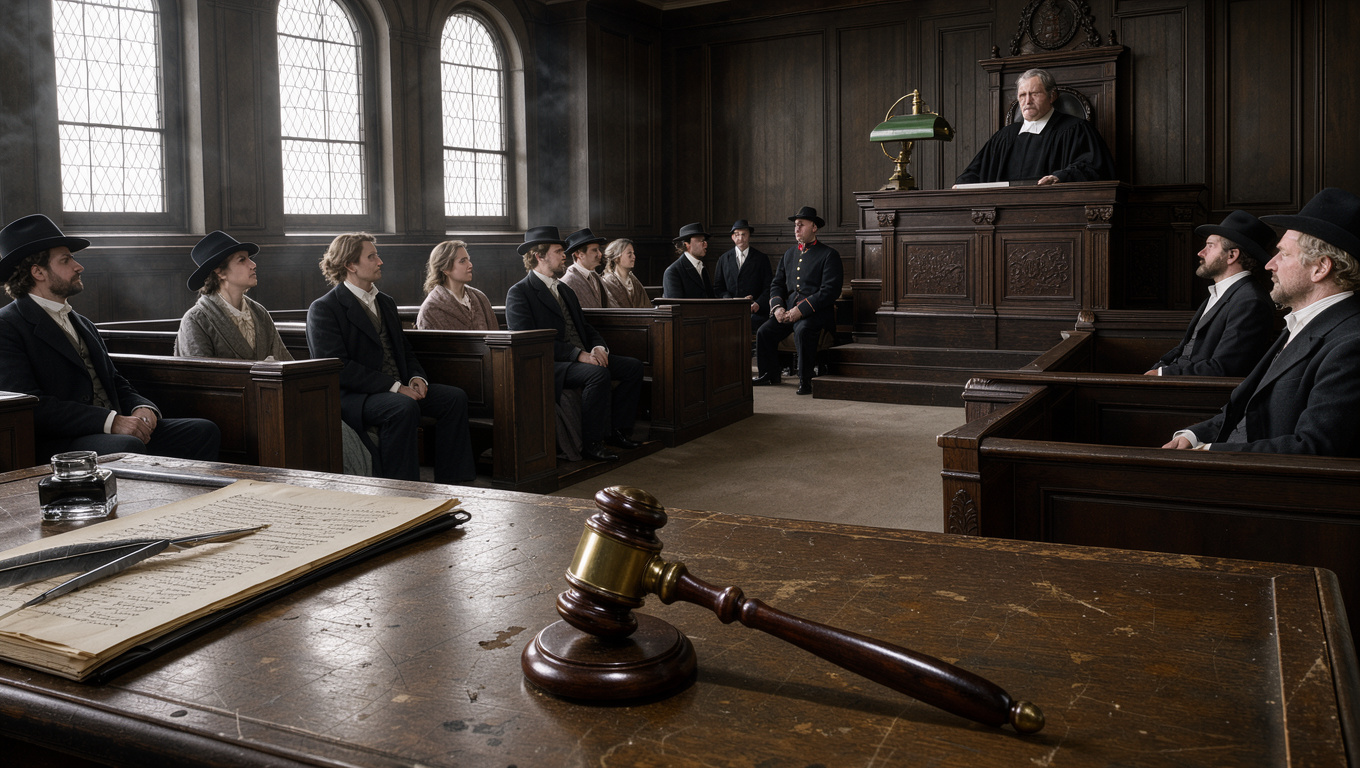
Many people first meet Lizzie Borden through a playground rhyme or a television drama, and the gap between those versions and the record is wide. The record is a courtroom story, and according to Smithsonian Magazine (history journalism), Fall River was left out of the jury pool.
Born: 19 July 1860 · Died: June 1, 1927 · Age at the 1892 murders: 32 · Victims: Andrew Borden and Abby Borden, Fall River, Massachusetts · Murder date: August 4, 1892 · Acquittal: June 20, 1893
Quick snapshot
- Andrew and Abby Borden were murdered in their Fall River home on August 4, 1892 (Library of Congress (US national library))
- Lizzie Borden was arrested on August 11, 1892 (Library of Congress (US national library))
- The case rested on circumstantial evidence, and the murder weapon was never conclusively identified (Encyclopaedia Britannica (general reference publisher))
- No one else was ever charged, and the murders remain officially unsolved (Encyclopaedia Britannica (general reference publisher))
- According to Wikipedia, Bertha Manchester was murdered with an axe in Fall River on June 1, 1893, shortly before Borden’s trial began (Wikipedia (open encyclopedia))
- The trial opened in New Bedford on June 5, 1893, and the jury returned a not-guilty verdict on June 20, 1893 (Library of Congress (US national library))
- Judges excluded Borden’s inquest testimony, which she had given without an attorney present (American Heritage (history magazine))
Six fixed points frame the case, and each date below matches the sources cited in the snapshot above.
| Fact | Value |
|---|---|
| Full name | Lizzie Andrew Borden |
| Born | 19 July 1860 |
| Died | June 1, 1927 |
| Place of the murders | Fall River, Massachusetts |
| Murder date | August 4, 1892 |
| Acquittal date | June 20, 1893 |
Why was Lizzie Borden found innocent?
The acquittal did not rest on one piece of proof. It rested on which evidence the judges allowed into the courtroom and how the jury weighed what remained.
What the prosecution had to prove
- The prosecution relied on circumstantial evidence and motive, while the defense argued there was no direct evidence, no bloodstain, and no weapon tying Borden to the killings (Encyclopedia.com (Gale reference library))
- Judges excluded Borden’s inquest testimony because she had given it without an attorney present, according to American Heritage (history magazine)
- Judges also excluded testimony that Borden tried to buy prussic acid on August 3, 1892. Eli Bence, a Fall River drugstore clerk, said he refused the sale without a prescription (A&E (Biography))
What this means: the jury heard a motive-and-opportunity case with some of its strongest pieces removed before deliberation began.
How circumstantial evidence was weighed
Presiding Justice Justin Dewey told jurors that suspicion, or even a strong probability of guilt, was not enough to convict. The charge required proof beyond a reasonable doubt, as reported by Encyclopedia.com (Gale reference library).
“[I]f the evidence falls short of providing such conviction in your minds, although it may raise a suspicion of guilt, or even a strong probability of guilt, it would be your plain duty to return a verdict of not guilty.”
Defense counsel Andrew Jennings built the case around what was missing. He argued that the prosecution had no direct proof against his client.
“There is not one particle of direct evidence in this case, from beginning to end, against Lizzie Andrew Borden.”
The forensic tools of the period narrowed what either side could prove. Blood typing, DNA testing, and routine fingerprint identification did not exist in the 1890s, according to A&E (Biography). Britannica also records that no blood was seen on Borden when police arrived, and a pail of bloodied fabric in the basement was not investigated. Borden said the fabric came from menstrual rags.
Without blood typing, a stain on fabric could not be tied to a specific victim with the certainty a modern laboratory would offer. That gap is the main reason the defense could argue that nothing physical connected Borden to the killings.
The jury verdict of June 1893
Smithsonian Magazine reports that Fall River was excluded from the jury pool. The jurors were men largely from small agricultural towns, and half were farmers, according to the same account.
Accounts of the deliberation disagree. Contemporary newspapers reported a verdict in about 40 minutes on a single ballot, while later accounts, including A&E (Biography), put the deliberation at about 90 minutes. The sources reviewed here do not settle which figure is correct.
Dennis Binette, assistant curator at the Fall River Historical Society, offered a plain assessment of the result.
“They really couldn’t get a conviction with the evidence they had.”
The verdict answered one question: whether the state had proved guilt beyond a reasonable doubt. It did not establish who killed Andrew and Abby Borden.
Bottom line: The jury decided a case in which the judges had removed the inquest testimony and the poison-purchase evidence, which left the prosecution with circumstantial proof that the jury was not required to accept.
How did Lizzie Borden get caught?
Andrew and Abby Borden were killed in their Fall River home on August 4, 1892. No eyewitness identified the killer. The case moved through the discovery of the bodies, an inquest, a grand jury, and finally an arrest.
The discovery of the bodies on 4 August 1892
Encyclopaedia Britannica reports that Abby Borden was killed about 90 minutes before Andrew Borden. Bridget Sullivan, the Borden maid, was outside cleaning windows when Abby was believed to have been killed, and she was in her attic room during Andrew’s murder.
Britannica’s biography estimates that Abby was struck about 18 or 19 times and Andrew up to 11 times in the head. Those figures are estimates from later accounts and should be read as approximate.
The inquest and investigation that followed
Borden gave testimony at the inquest without an attorney present. Judges later excluded that testimony from the trial, a ruling that shaped what the jury could consider.
Alice Russell, a friend of the family, told the grand jury on December 1, 1892 that she saw Borden burning a dress in the kitchen stove the Sunday after the murders, according to Smithsonian Magazine.
The arrest in August 1892
Lizzie Borden was arrested on August 11, 1892, one week after the killings, according to the Library of Congress. The grand jury indicted her on December 2, 1892 on three counts of murder, as reported by People.
Later retellings often compress the inquest, the arrest, and the indictment into a single scene. Keeping these dates apart shows that the case was built over several months, not in one moment of discovery.
The arrest and indictment established the charges. They did not establish the facts that the jury would later have to weigh.
Were Lizzie Borden’s parents cruel to her?
The sources reviewed here do not document a clear record of abuse in the Borden household. Accounts of cruelty appear mainly in later retellings and in contemporary gossip, and they are hard to check against primary records.
Andrew Borden as a father and businessman
Andrew Borden was a prominent Fall River figure, and the household he ran was part of the town’s social and economic life in 1892. Descriptions of him in the period sources focus on his standing in the community rather than on his relationship with his daughter.
Accounts from family members and neighbors
Family and neighbor accounts that describe the household are largely secondhand. Many were recorded after the killings, when suspicion of Borden was already public, which makes them hard to read as neutral evidence.
What the sources can and cannot establish
The documented record covers the killings, the inquest, the arrest, and the trial. It does not establish the day-to-day treatment of Lizzie Borden inside the home with any reliability.
Claims of cruelty should be labeled as allegations unless a dated, sourced record supports them.
What happened to Lizzie Borden’s money after she died?
Lizzie Borden died on June 1, 1927 in Fall River. Wikipedia reports that she lived the rest of her life under suspicion and ostracism in the town, though she was acquitted and never convicted.
Family wealth from Andrew Borden’s estate
Family wealth is part of the 1892 household context. The sources reviewed here do not give an amount, a list of assets, or a full account of how Andrew Borden’s estate was divided.
Lizzie Borden’s will and final property
The sources reviewed here do not describe Lizzie Borden’s will or the property she held at her death. Any statement about her final estate should wait for the primary documents.
What probate records confirm
Estate details must be confirmed against Massachusetts probate records before publication. Until those records are checked, the inheritance question stays open.
Readers looking for a fast answer should treat any figure for Borden’s estate as unverified until probate records are cited directly.
The estate question matters less to the verdict than the trial did, but it is the part of the story that remains least documented.
Is the Lizzie Borden Chronicles a true story?
Dramatized versions of the case take liberties with the record. The editorial plan for this article names Monster The Lizzie Borden Story as one of these portrayals.
Where dramatizations take liberties
Dramatized series invent scenes, dialogue, and motives that do not appear in the trial record. A drama can make a motive feel certain when the court never established one.
What the trial record supports
The core events are documented: the killings on August 4, 1892, the arrest on August 11, 1892, the trial in New Bedford beginning June 5, 1893, and the not-guilty verdict on June 20, 1893. The judges’ exclusions and the circumstantial nature of the case are also part of the documented record.
The sources reviewed for this article are secondary. No full trial transcript was among them, so claims about the exact wording of rulings rely on quotations in those secondary accounts.
How to read Monster The Lizzie Borden Story
Check any dramatized scene against the court and newspaper sources that cover the same event. If a scene introduces a motive, a relationship, or a confession that no source records, treat it as fiction.
A drama can be accurate about the dates and still be wrong about what the jury knew. The trial hinged on which evidence reached the jury, and many dramatized scenes skip that question entirely.
Related reading: Ian Brady and the Moors Murders: verified facts · Griselda Blanco: verified facts and biography
people.com, lamag.com, bakersfieldnow.com, bbc.com, guides.justwatch.com, genealogytrails.com, ynetnews.com
Frequently asked questions
Was Lizzie Borden ever convicted?
No. She was found not guilty on June 20, 1893, and she was never convicted of any crime. According to People, she spent about 10 months in jail before the trial.
How old was Lizzie Borden at the time of the murders?
She was 32 when Andrew and Abby Borden were killed on August 4, 1892.
Did police find blood on Lizzie Borden?
According to Encyclopaedia Britannica, no blood was seen on Borden when police arrived.
How long did the jury deliberate?
Accounts differ. Contemporary newspapers reported about 40 minutes on a single ballot, while later accounts put the deliberation at about 90 minutes.
Is the case still officially unsolved?
Yes. The murders remain officially unsolved, and no one else was ever charged.
Did Lizzie Borden and the maid have a relationship?
The sources reviewed here do not establish one. Bridget Sullivan appears in the record as a witness, and any relationship beyond that remains unclear.

Henry William Bennett Murray is a staff writer for CivicInsight.uk, covering UK public affairs, policy and civic life. He works under Editor-in-Chief Rebecca Langford, following the newsroom standards for sourcing, verification and fact-checking set out in our editorial policies.