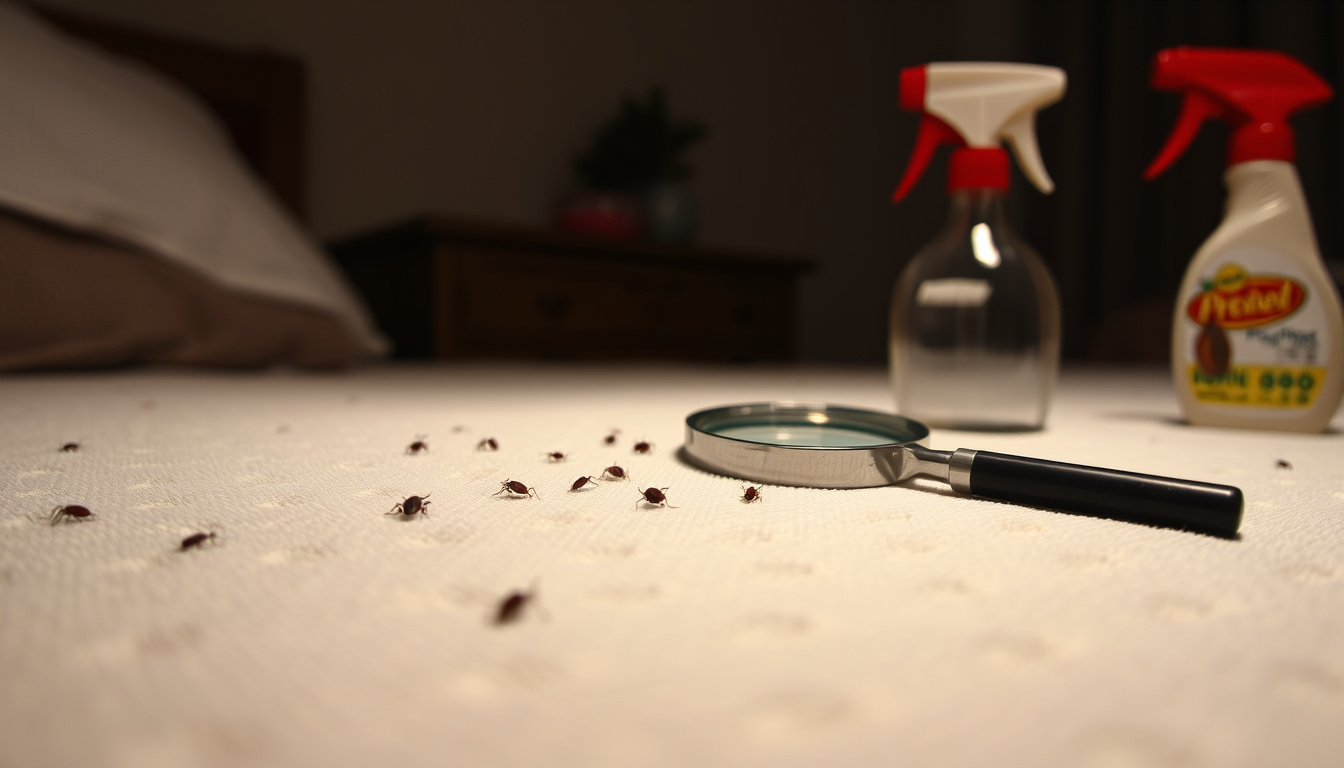
Few things can disrupt a good night’s sleep quite like the suspicion that tiny, wingless, blood-feeding insects are sharing your bed. Knowing exactly what to look for—shed skins, rusty spots, a distinct musty odor—is the first step, as emphasized by the US Environmental Protection Agency (EPA Bed Bug Prevention, Detection and Control (agency guidance)). From there, understanding causes, immediate actions, and effective treatment plans can turn a stressful situation into a manageable one.
Adult bed bug size: 4–5 mm (apple seed) ·
Lifespan: 4–6 months under normal conditions ·
Common bite pattern: Clusters or lines of itchy red welts ·
Preferred hiding spots: Mattress seams, headboards, furniture cracks ·
Feeding frequency: Every 5–10 days, usually at night
Quick snapshot
- Bed bugs are blood-feeding parasites (CDC Health Alert Network (public health advisory))
- Infestations are not caused by poor hygiene (CDC Health Alert Network (public health advisory))
- Heat above 120°F kills all life stages (CDC Health Alert Network (public health advisory))
- Effectiveness of DIY versus professional treatments in specific settings
- Current level of resistance to common pesticides
- Long-term psychological effects of chronic infestations
- Heat treatment at 120°F for 90 minutes eliminates eggs (EPA Integrated Pest Management Guide (agency guidance))
- Cold treatment requires below 0°F for at least 4 days (EPA Integrated Pest Management Guide (agency guidance))
- High-heat dryer kills all stages in 30 minutes (EPA Integrated Pest Management Guide (agency guidance))
- Conduct thorough inspection in mattress seams, headboards, and furniture cracks
- Apply a multi-step IPM approach combining cleaning, heat, and targeted insecticides
- Monitor with interceptors for at least two weeks after treatment
Bed bugs are often mistaken for other household pests, but a few key measurements and behaviors set them apart.
| Attribute | Details |
|---|---|
| Adult size | 4–5 mm |
| Lifespan | 4–6 months |
| Bite appearance | Itchy red welts, often in clusters (CDC Health Alert Network (public health advisory)) |
| Common hiding places | Mattress seams, headboards, furniture cracks |
| Feeding frequency | Every 5–10 days |
How can I tell if I had bed bugs?
Bite marks alone aren’t reliable—reactions vary widely from person to person. That is why the CDC and Purdue University Extension stress looking for physical evidence rather than symptoms.
What are the first signs of bedbugs?
- Rusty or reddish stains on bed sheets or mattresses caused by crushed bugs
- Dark spots (bed bug excrement) which may bleed on the fabric like a marker would
- Specks of blood on bedding
- Sweet, musty odor often described as coriander or berries
What do bed bug bites look like?
- Appear as itchy red welts, often in clusters or lines (zigzag pattern)
- Commonly found on exposed skin: face, neck, arms, hands
- Some people develop allergic reactions and large welts
How to find bed bugs on a mattress?
- Inspect mattress seams and tags (Purdue University Extension (entomology experts))
- Remove and inspect the headboard and box spring
- Look along baseboards, picture frames, and electrical outlets
The implication is clear: relying on bite symptoms alone is unreliable. Physical signs—the shells, the spots, the smell—are the gold standard for early detection.
What do you do if you find a bed bug?
Panic is the enemy. The EPA’s guidance is straightforward: confirm the pest, contain the area, and plan your response.
The US Environmental Protection Agency warns that bug bombs and foggers rarely penetrate the deep crevices where bed bugs hide, and their use can sometimes scatter an infestation rather than eliminate it.
How to contain a bed bug finding
- Capture the bug for positive identification
- Isolate the area: do not move furniture to other rooms
- Reduce clutter to eliminate hiding spots
When to call a professional
- If the infestation is widespread across multiple rooms
- If you have mobility or health issues that make DIY difficult
- For heat treatment or fumigation which require industrial equipment
The pattern: small, isolated finds can often be tackled with EPA-recommended DIY steps. Widespread infestations require professional IPM programs.
What is the main cause of bed bugs?
A common myth is that bed bugs only thrive in dirty environments. The CDC and EPA are emphatic: cleanliness has no bearing on susceptibility.
Are bed bugs due to poor hygiene?
- Bed bugs do not discriminate by income or cleanliness
- They hitchhike on luggage, clothing, and second-hand furniture
How do bed bugs spread?
- Travel: hotels, hostels, and public transport are common vectors
- Second-hand furniture: buying used mattresses and upholstered furniture without inspection
- Multi-unit buildings: bed bugs travel through wall voids and floor cracks
The trade-off: because bed bugs spread passively with human movement, the most effective prevention focuses on inspection rituals after travel and before bringing used furniture indoors.
What kills bedbugs permanently?
The scientific answer is heat, but the practical answer is patience—and a multi-method strategy.
What kills bedbugs instantly?
- Heat: temperatures above 120°F for 90 minutes kill all life stages including eggs
- Steam: a steamer on mattress seams and furniture kills on contact
- Cold: below 0°F for at least 4 days can eliminate some infestations
While heat and steam kill instantly on contact, they rarely reach bugs deep inside walls or thick upholstery. That is why the EPA recommends IPM—a sequence of methods—rather than a single kill step.
What is the most effective bed bug spray?
- Use only EPA-registered products with bed bugs listed on the label (US Environmental Protection Agency (DIY control guidance))
- Foggers (“bug bombs”) rarely penetrate crevices and can spread infestation
- Desiccant sprays (e.g., diatomaceous earth) work but take days to weeks
The catch: no single chemical will permanently eradicate a full infestation. Permanent elimination requires combining methods over a 2–4 week span.
How to get rid of bed bugs?
The EPA recommends a structured do-it-yourself approach that starts with identifying the problem, developing a plan, and keeping the infestation from expanding.
Step-by-step removal process
- Identify and confirm: Collect a sample and verify it is a bed bug.
- Declutter and clean: Remove items from the floor, launder bedding and clothing in hot water, and dry on high heat for 30 minutes.
- Encase mattress and box spring: Use bed-bug-proof covers to trap existing bugs and block new ones (CDC Health Alert Network (public health advisory)).
- Vacuum and steam: Vacuum all cracks, crevices, and mattress seams. Steam clean where possible.
- Apply treatment: Use EPA-registered insecticides strictly according to label directions.
- Monitor: Place bed bug interceptors under bed posts and furniture legs to capture any survivors.
Prevention after treatment
- Inspect luggage and clothing immediately after travel
- Inspect second-hand furniture thoroughly before bringing indoors
- Maintain encasements and interceptors for ongoing monitoring
Why this matters: eradication takes discipline. Skipping the monitoring phase is the most common reason for recurrent infestations.
What we know vs. what remains unclear
Confirmed facts
- Bed bugs feed on blood (CDC Health Alert Network (public health advisory))
- They are not known to transmit disease
- Heat above 120°F kills all life stages
- Infestations are not caused by poor hygiene
What remains unclear
- Effectiveness of DIY versus professional treatments in specific settings
- Current level of resistance to common pesticides
- Long-term psychological effects of chronic infestations
Expert perspectives
“Bed bug bites are not usually dangerous, but can cause itching and allergic reactions.”
— NHS (UK National Health Service)
“Integrated pest management (IPM) is recommended for effective bed bug control.”
— U.S. Environmental Protection Agency (EPA)
“Bed bugs are not known to spread disease, but secondary infections from scratching can occur.”
— U.S. Centers for Disease Control and Prevention (CDC)
Bed bugs are resilient, but they are not invincible. The evidence from the CDC and EPA shows that a disciplined, multi-step IPM strategy—combining heat, targeted insecticides, encasements, and diligent monitoring—is the most reliable path to permanent elimination. For the average homeowner, the choice between a weekend of DIY integrated pest management and a professional heat treatment comes down to timeline and infestation size. Letting it sit is not an option.
epa.gov, extension.usu.edu, epa.gov, epa.gov, stacks.cdc.gov, epa.gov, cdc.gov, netzweltreport.de
For those seeking a deeper understanding of the initial signs and effective treatment methods, a detailed bed bug identification and removal guide offers a thorough overview of the entire process.
Frequently asked questions
Can bed bugs fly?
No. Bed bugs are wingless and rely on crawling to move between hiding spots and hosts (Purdue University Extension (entomology experts)).
Do bed bugs only come out at night?
Bed bugs are primarily nocturnal, but hungry bed bugs may venture out during the day if their hosts are inactive for long periods.
How long can bed bugs live without feeding?
Under normal conditions, adult bed bugs can survive 4–6 months without a blood meal. The University of New Hampshire Extension notes that in cool conditions, they can last even longer (University of New Hampshire Extension (research-based field guidance)).
Can bed bugs infest clean homes?
Yes. The CDC and EPA have repeatedly stated that bed bugs are not attracted to dirt or grime. They hitchhike on luggage, furniture, and clothing, meaning any home or hotel is vulnerable.
What is the best way to prevent bed bugs?
Inspect second-hand furniture before bringing it inside. When traveling, check hotel mattress seams and headboards before unpacking. After returning, launder all clothing on high heat.
How to treat bed bug bites?
Wash bites with soap and water to reduce itching. Apply corticosteroid cream or take an oral antihistamine if swelling is severe. Scratching can lead to secondary bacterial infection.
Are bed bugs visible to the naked eye?
Yes. Adult bed bugs are about 4–5 mm long, roughly the size of an apple seed, and visible without magnification. Nymphs are smaller and pale yellow, making them harder to spot (Purdue University Extension (entomology experts)).
Related reading

Henry William Bennett Murray is a staff writer for CivicInsight.uk, covering UK public affairs, policy and civic life. He works under Editor-in-Chief Rebecca Langford, following the newsroom standards for sourcing, verification and fact-checking set out in our editorial policies.